
Numbers and Counting to 7 Worksheets
These preschool early math worksheets help children practice numbers and counting to 7 by connecting numerals with pictures, frames, number words, and simple counting activities. Every activity is free, ready-to-print, available in PDF format, and designed for immediate classroom use. Children strengthen one-to-one counting, numeral recognition, quantity matching, sequencing, and early comparison skills aligned with beginning common core counting concepts.
About This Collection of Worksheets
This collection helps preschool children move beyond counting to 5 and become more comfortable with quantities through 7. Learners count pictures, dots, shapes, and objects while connecting those amounts with written numerals and number words. The slightly larger number range gives children a manageable next step without making the counting feel too difficult.
The worksheets use matching, coloring, tracing, number searches, picture scenes, structured frames, missing sets, comparisons, and number trails. Children may match a numeral to a group, color an exact amount, draw missing shapes, find target numbers, or complete a counting sequence. These different activities repeat the same important number ideas while keeping practice varied.
These printable activities work well during math centers, small-group instruction, homeschool practice, early intervention, and short independent lessons. The collection supports beginning Common Core skills connected with K.CC.A.1, K.CC.A.2, K.CC.A.3, K.CC.B.4, K.CC.B.5, and early comparison work from K.CC.C.6. As children become more comfortable with numbers through 7, they build a stronger foundation for counting to 10, comparing quantities, and beginning addition.
Paul’s Teacher Tip
As groups get larger, encourage children to touch or point to each object while counting so nothing gets skipped or counted twice. Have them repeat the final number after every count because that last number tells how many objects are in the whole group. When a numeral is involved, ask children to say it aloud before matching, tracing, or writing it. For number trails, let them count aloud through the sequence before filling in the blank. Keeping the counting slow and steady is more useful than pushing for speed.
Worksheet Collection Skill Spotlights
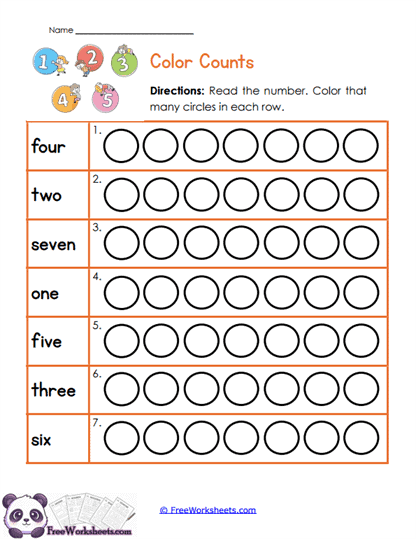
Color Numbers
What Kids Do: Children listen to or read number words from one through seven and color exactly that many circles in each row. They stop once they reach the target amount and leave the remaining circles blank.
Target Skill: This activity connects spoken or written number words with real quantities. Learners practice one-to-one counting, stopping at the correct amount, and understanding that a number word represents a specific set size.
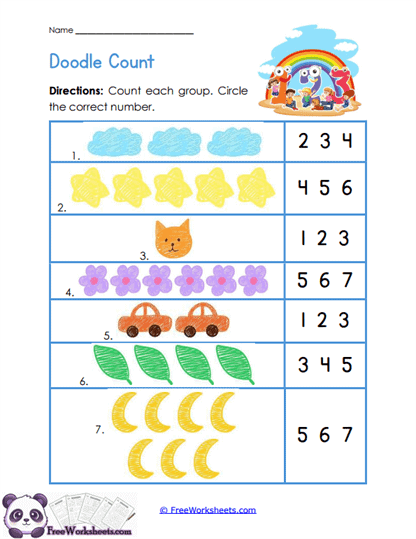
Doodle Counts
What Kids Do: Children count friendly picture groups such as clouds, stars, flowers, cars, leaves, moons, and other simple objects. They then circle the numeral that matches each total.
Target Skill: This worksheet strengthens the connection between counted quantities and written numbers through 7. Children practice accurate counting before choosing the symbol that represents the amount.
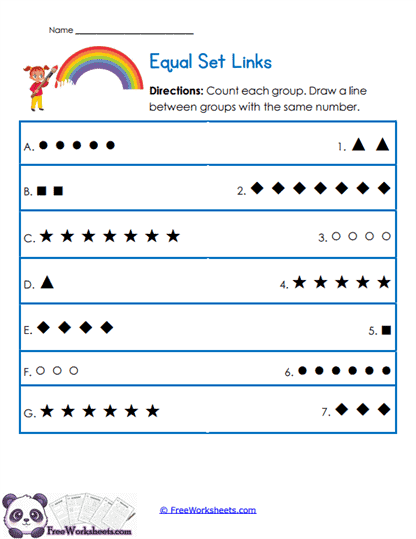
Equal Sets
What Kids Do: Children count picture groups on both sides of the page and draw lines between groups showing the same number of objects. The shapes differ, so learners must focus on quantity instead of appearance.
Target Skill: This activity develops equal-quantity understanding and number sense. Children learn that two groups can represent the same amount even when the objects, shapes, or arrangement look different.
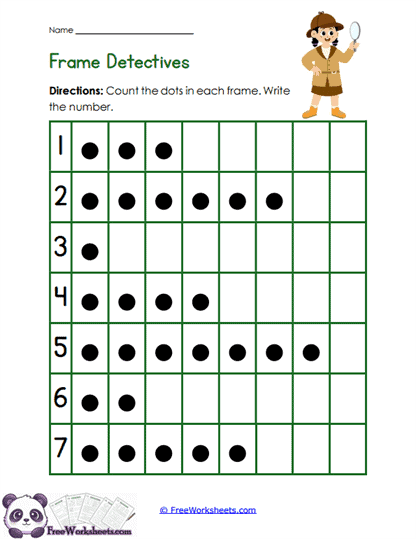
Frame Counts
What Kids Do: Children count black dots arranged inside structured rows and write the numeral that matches each amount. Seven problems give practice with organized quantities through 7.
Target Skill: Learners practice one-to-one counting in a neat visual structure. The frames also begin building the ability to recognize organized quantities more quickly instead of always counting scattered objects.
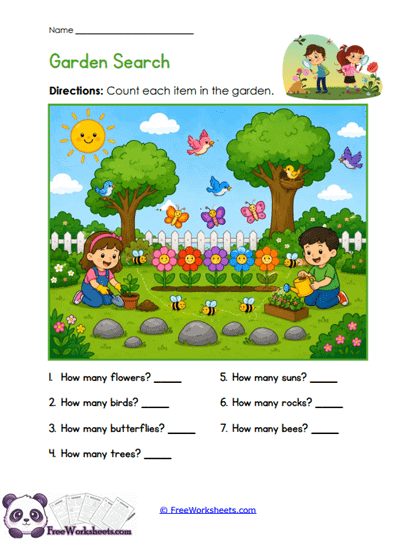
Garden Counting
What Kids Do: Children search a colorful garden scene for flowers, birds, butterflies, trees, a sun, rocks, and bees. They count each named group and write the matching total.
Target Skill: This activity develops counting in a more natural and visually busy setting. Learners strengthen visual scanning, careful tracking, numeral writing, and the understanding that the final counting word gives the total.
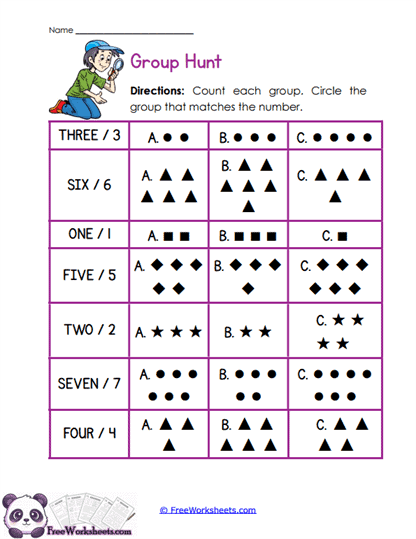
Group Hunt
What Kids Do: Children look at a target number and then count the shapes in choices A, B, and C. They circle the group containing exactly the requested amount.
Target Skill: This worksheet builds quantity matching and careful comparison. Children learn to count every choice rather than picking the group that simply looks fullest or largest.
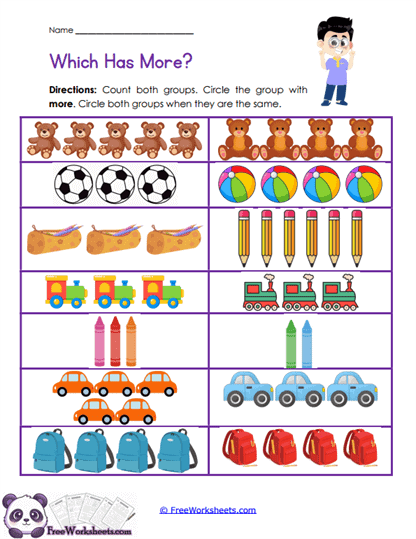
More Groups
What Kids Do: Children count two picture groups in each row and decide which side has more objects. If both groups have equal amounts, they circle both sides.
Target Skill: Learners connect counting with early comparison and equality. The activity prepares children for later work using words such as more, fewer, and same with written numbers.
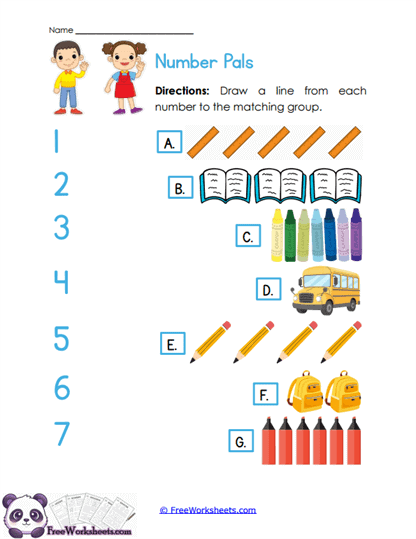
Number Pals
What Kids Do: Children look at numerals 1 through 7 and count picture groups of crayons, books, markers, buses, pencils, backpacks, and other familiar objects. They draw lines between matching numbers and quantities.
Target Skill: This page strengthens the idea that written numerals stand for real amounts. Learners practice recognizing each number and connecting it with a counted group.
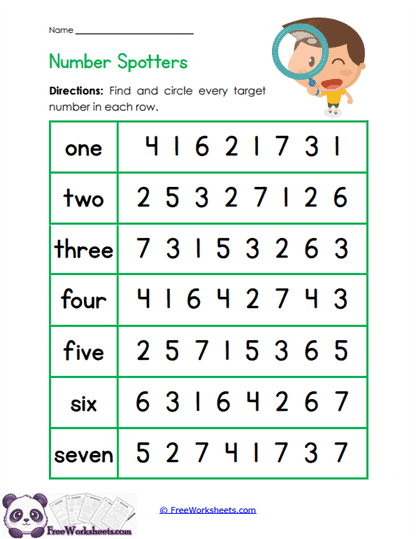
Number Search
What Kids Do: Children look at a target number word and scan a row of mixed numerals to find every matching example. They circle all appearances of numbers 1 through 7.
Target Skill: This activity develops numeral recognition and visual discrimination. Children practice identifying numbers quickly without needing picture quantities as clues.
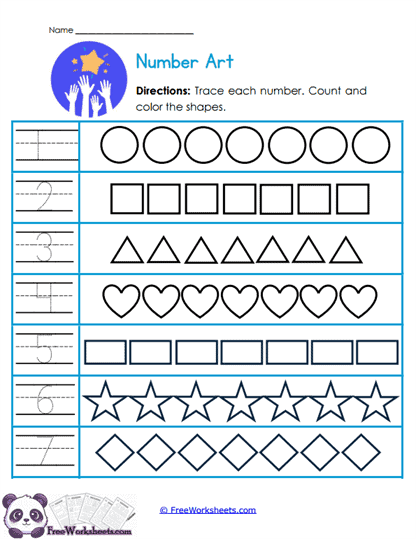
Number Shapes
What Kids Do: Children trace numerals from 1 through 7 and then color the same number of circles, squares, triangles, hearts, rectangles, stars, or diamonds in each row.
Target Skill: Learners connect numeral formation with quantity and shape recognition. Tracing, saying, and showing each number through objects helps deepen understanding of what the written numeral means.
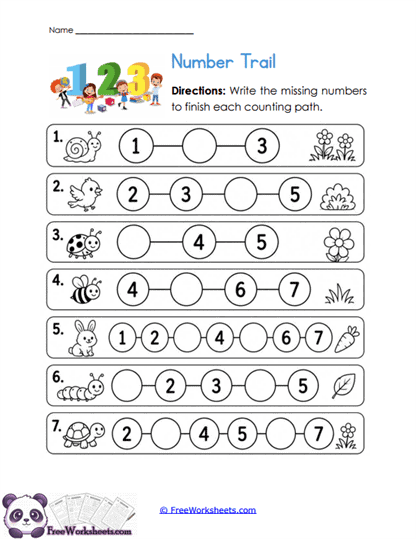
Number Trails
What Kids Do: Children study short counting paths with some numerals missing and write the numbers needed to complete each sequence. All trails stay within the range of 1 through 7.
Target Skill: This worksheet builds number order and sequencing. Children practice understanding what comes before, after, and between other numbers rather than thinking of numerals only as separate symbols.
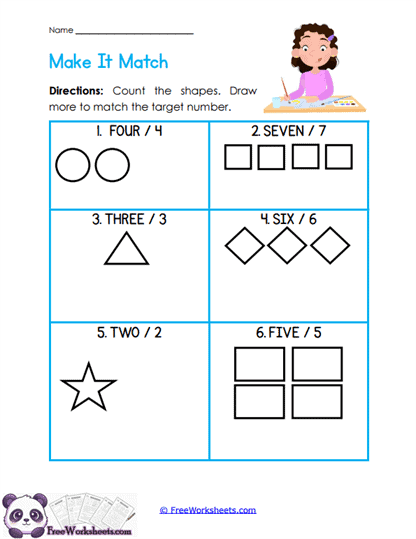
Target Sets
What Kids Do: Children count a partially completed group, look at the target number, and draw only enough extra shapes to reach that amount. They recount the completed set to check their work.
Target Skill: This activity introduces early missing-part thinking. Children see that a number can be built from an existing amount plus a smaller amount that still needs to be added.