
Pre-writing Strokes Worksheets
Pre-writing strokes for preschool fine motor skills help children practice lines, circles, crosses, and other movements that prepare their hands for early writing. These free, ready-to-print PDF worksheets are prepared for immediate classroom use, fine motor centers, homeschool lessons, quiet work, or practice at home. Children strengthen pencil control, visual tracking, and motor planning while working toward important preschool pre-writing goals.
About This Collection of Worksheets
Pre-writing strokes give preschool children a foundation for the movements they will later use to form letters, numbers, and simple drawings. Straight vertical and horizontal lines teach direction and control, circles introduce continuous curved movement, and crosses ask children to combine two strokes in a planned way. As children become more confident, they can begin switching among strokes, copying simple forms, following patterns, and tracing longer curved paths.
This collection progresses through many of those early movements in manageable activities. Children trace rain and road lines, move up and down with directional strokes, alternate vertical and horizontal patterns, trace balloon outlines and circles, create crosses inside windows, review multiple stroke types, copy forms independently, continue repeating patterns, and follow a spiral toward the center. The variety gives children opportunities to practice both individual strokes and combinations of movements that support handwriting readiness.
Teachers can use these worksheets in preschool fine motor centers, handwriting-readiness lessons, small groups, morning work, or targeted pre-writing practice. Parents and homeschool educators can begin with straight strokes before moving into circles, crosses, patterns, and independent copying as hand control improves. Because several pages move from tracing into more independent drawing, the collection also provides a natural way to see when a child is ready for less guidance.
Paul’s Teacher Tip
Teach pre-writing movements as directional habits, not just lines to copy. Simple verbal cues such as “top to bottom,” “left to right,” “around and close,” or “across, then down” can help children remember how each stroke should move. Let children practice the motion in the air or with a finger before using a pencil if a new pattern feels difficult. When circles or crosses become uneven, focus on the movement rather than erasing and repeating for perfection. Short, successful practice usually builds better control than asking tired hands to finish an entire page at once.
Worksheet Collection Skill Spotlights
Balloon Loops
What Kids Do:
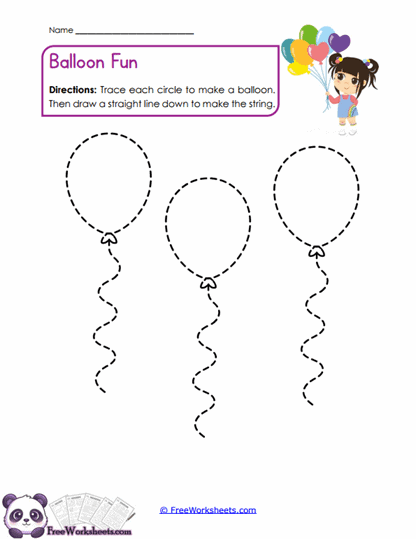
Children trace around three dashed balloon outlines and then follow each long string downward toward the bottom of the page. They complete one closed curved shape before switching to a straighter downward movement and can color the balloons afterward for additional practice.
Target Skill:
This activity combines two important pre-writing movements: continuous closed curves and longer vertical strokes. Children strengthen hand-eye coordination, shape closure, directional control, and the ability to transition smoothly from one type of pencil movement to another.
Bounce Lines
What Kids Do:
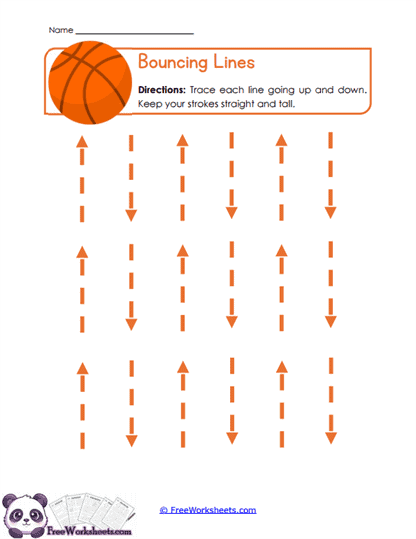
Children trace repeated vertical lines by following arrows that tell them whether each stroke should move upward or downward. They switch directions from one line to the next while trying to keep every stroke tall, straight, and close to the dashed guide.
Target Skill:
The worksheet develops vertical-line control while adding directional awareness. Children practice noticing where a movement begins and ends, following visual cues, and changing stroke direction deliberately instead of tracing every line in the same way.
Circle Tracing
What Kids Do:
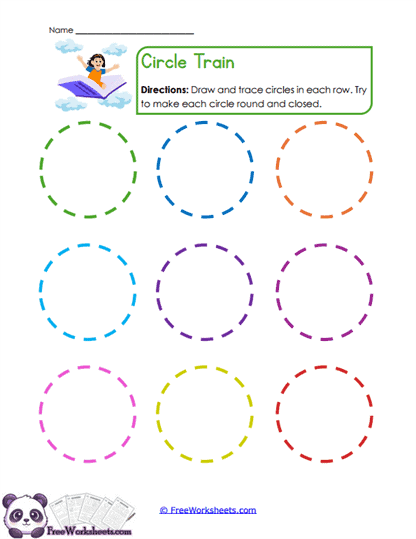
Children trace nine large dashed circles arranged in spacious rows. They guide the pencil all the way around each curve, try to meet the starting point to close the shape, and can color inside the completed circles afterward.
Target Skill:
This activity strengthens smooth circular motion, visual tracking, and shape closure. Repeated round movements prepare children for later letters and numbers that use curves while helping them control a continuous stroke without flattening or leaving large gaps.
Pattern Repeats
What Kids Do:
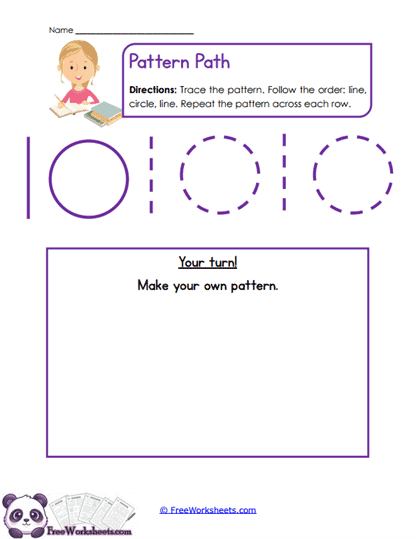
Children trace a repeating sequence made from straight lines and circles, following the pattern from left to right. After completing the guided example, they use an open practice area to create a simple repeating pattern of their own.
Target Skill:
The worksheet combines fine motor practice with early sequencing. Children strengthen visual attention, memory, and pattern recognition while switching between straight and curved strokes and maintaining the correct order across a repeated series.
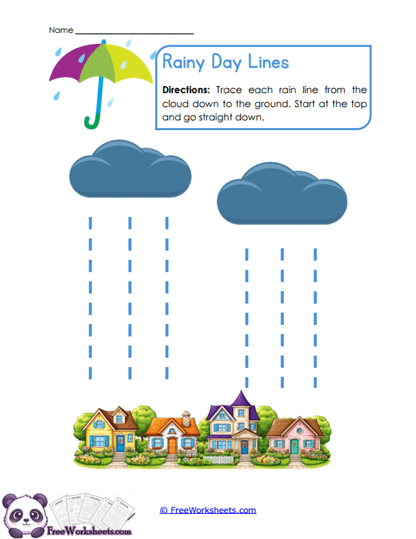
Rain Strokes
What Kids Do:
Children trace long dashed rain lines from clouds at the top of the page toward houses below. They begin each stroke near the cloud, move straight downward, and repeat the same top-to-bottom movement several times across the worksheet.
Target Skill:
This beginner activity develops consistent vertical strokes, hand strength, and top-to-bottom directionality. Children build the controlled downward movement used later in many letters, numbers, and drawings while strengthening basic hand-eye coordination.
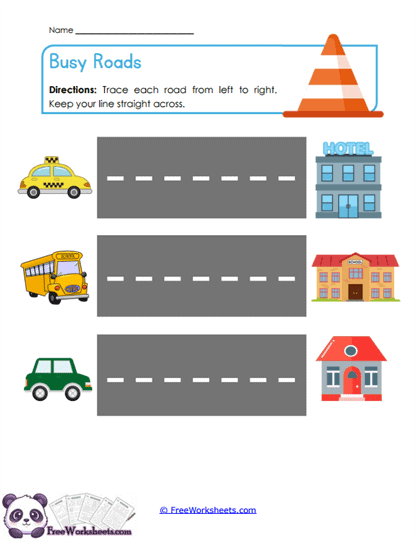
Road Strokes
What Kids Do:
Children trace three horizontal road lines from vehicles on the left toward destinations on the right. They follow each dashed path across the page, keeping the pencil as level and steady as possible until reaching the matching building.
Target Skill:
The worksheet strengthens left-to-right movement, horizontal stroke control, and visual tracking. These habits support the direction children later use for reading and writing while giving them repeated practice maintaining a longer straight line.
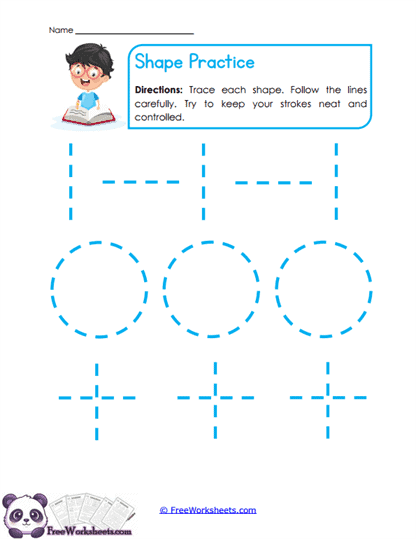
Shape Strokes
What Kids Do:
Children trace several groups of basic pre-writing forms, including vertical lines, horizontal lines, circles, and crosses. Each section asks them to adjust how they move the pencil as they switch between straight, curved, and intersecting strokes.
Target Skill:
This broad review strengthens flexible pencil control and motor planning across several foundational stroke types. Children practice recognizing the movement needed for each form and shifting from one hand pattern to another, which supports later letter and number formation.
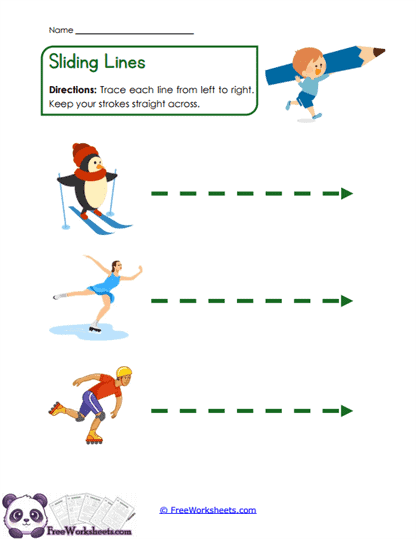
Sliding Strokes
What Kids Do:
Children trace long horizontal dashed lines from left to right beside winter sports pictures. Directional arrows show where to begin and how the pencil should travel, giving children repeated practice with the same controlled side-to-side stroke.
Target Skill:
This activity reinforces smooth horizontal movement, visual directionality, and consistent starting position. Children strengthen the left-to-right habits needed for future handwriting while learning to keep a longer stroke level and controlled.
Spiral Practice
What Kids Do:
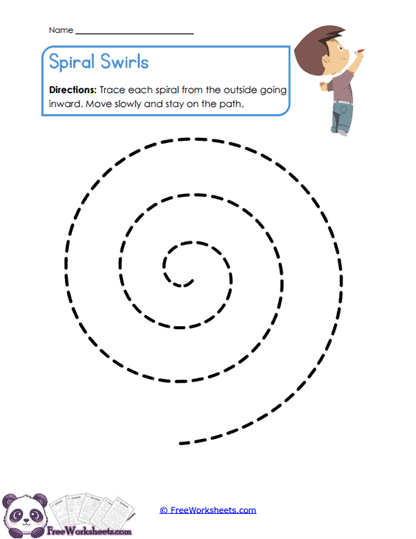
Children begin at the outside of one large dashed spiral and trace inward toward the center. As the curve gradually becomes tighter, they slow their hand movements, make smaller turns, and try to stay on the same path without jumping across nearby sections.
Target Skill:
This advanced pre-writing activity develops sustained curved control, visual tracking, and fine motor endurance. Children learn to gradually adjust the size of circular movements while maintaining concentration across one continuous and increasingly precise stroke.
Stroke Copying
What Kids Do:
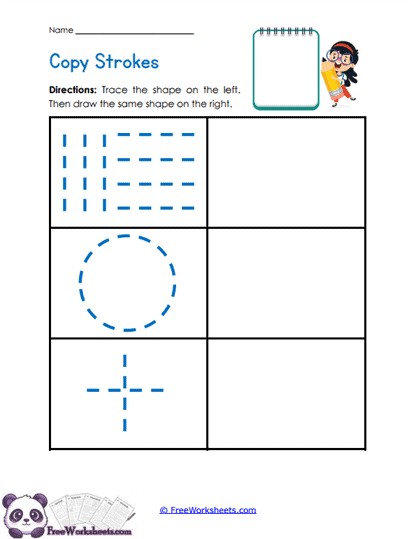
Children first study and trace examples of vertical lines, horizontal lines, a circle, and a cross. They then move to blank boxes and recreate the same forms independently by looking back at the model as often as needed.
Target Skill:
The worksheet moves children beyond tracing into early visual-motor copying. They strengthen visual memory, motor planning, spatial awareness, and independent pencil control by turning a pictured model into a matching hand movement without a full tracing guide.
Stroke Patterns
What Kids Do:
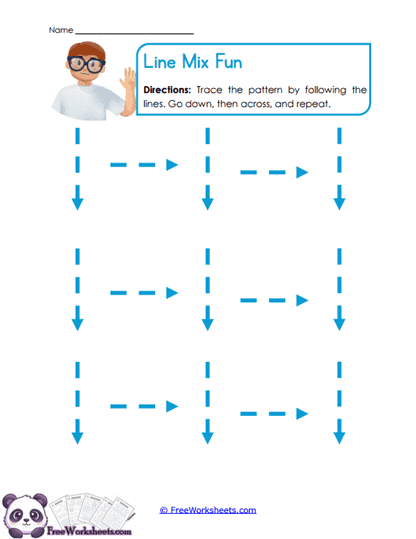
Children follow arrows through repeated patterns that alternate vertical and horizontal movements. They trace down one segment, change direction, move across the next, and continue repeating the sequence while pausing briefly at each transition.
Target Skill:
This activity teaches children to combine basic straight strokes into an organized pattern. They strengthen directional attention, controlled changes in movement, and motor sequencing, all of which support later construction of letters and shapes from multiple strokes.
Window Crosses
What Kids Do:
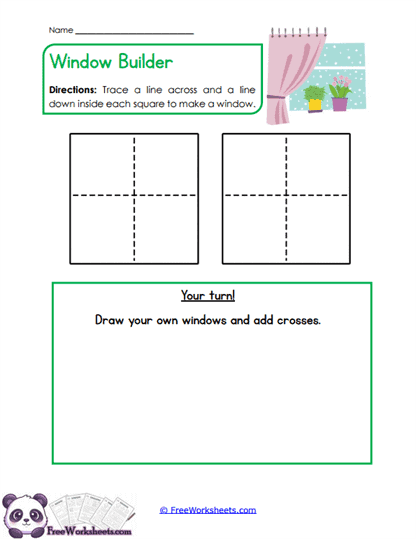
Children trace one horizontal line and one vertical line inside square window shapes so the strokes meet near the middle. After completing guided examples, they use a larger blank area to draw their own window shapes and add crosses independently.
Target Skill:
The worksheet develops intersecting-line control and spatial awareness. Children practice coordinating horizontal and vertical strokes around a shared center point, then apply the same movement without full tracing support as an early step toward independent copying and writing.