
Classifying Objects Worksheets
These preschool early math worksheets help children practice classifying objects by noticing similarities, differences, uses, and simple category rules. Every activity is free, ready-to-print, available in PDF format, and designed for immediate classroom use. Children strengthen observation, comparison, sorting, vocabulary, and early reasoning skills that support later work with patterns, sets, and data.
About This Collection of Worksheets
This collection helps preschool children understand that objects can be grouped because they share something in common. Learners sort by color, shape, size, habitat, purpose, object type, and other simple features. These early classification activities encourage children to slow down, look carefully, and explain why one item belongs with another.
The worksheets use matching lines, sorting boxes, coloring, circling, letter codes, hidden rules, and odd-one-out activities. Children may connect objects to color baskets, match everyday items with shapes, compare animal sizes, sort things by use, or choose which picture completes a group. The different formats help preschoolers practice the same reasoning skill without making every page feel alike.
These printable activities work well during math centers, small-group lessons, homeschool practice, preschool science units, and early reasoning activities. They build important foundations for organizing information, recognizing patterns, comparing attributes, and eventually working with sets and simple data. Several pages also strengthen vocabulary because children need to name objects and describe the rule that connects them.
Paul’s Teacher Tip
Start with real objects before moving to pictures whenever possible. Put a few toys, crayons, blocks, or household objects on a table and ask your child to make two groups. Always ask, “Why do these belong together?” because explaining the rule is just as important as making the match. If a child sorts by the wrong feature, do not immediately correct the answer; remind them of the rule and let them look again. As children improve, encourage them to think of more than one possible way the same set of objects could be grouped.
Worksheet Collection Skill Spotlights
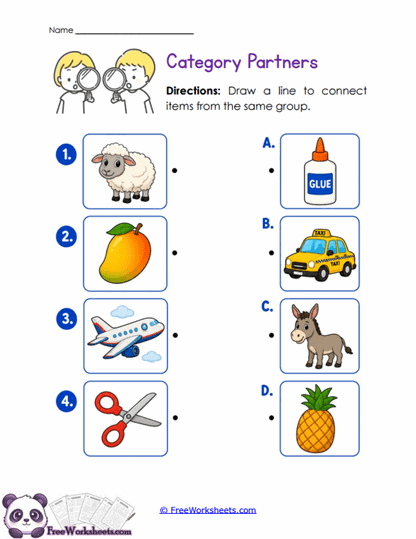
Category Pairs
What Kids Do: Children look at pictures such as a sheep, mango, airplane, and scissors, then find a matching item from the same general category. They draw lines between pairs such as two animals, two fruits, two forms of transportation, or two school tools.
Target Skill: This activity develops category recognition and comparison. Children learn that two objects do not need to look alike in color, size, or shape to belong together when they share a broader purpose or type.
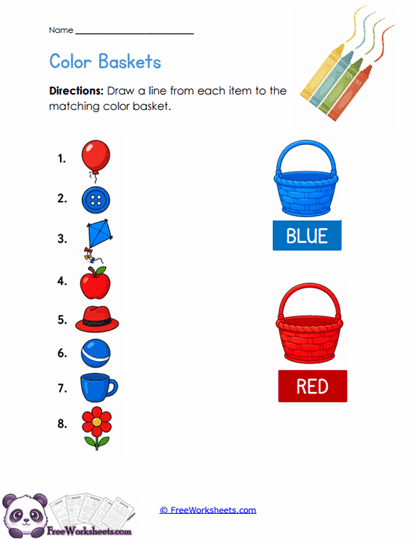
Color Sorting
What Kids Do: Children examine eight everyday objects and decide whether each one is mainly red or blue. They draw a line from every picture to the basket showing the matching color.
Target Skill: Learners practice sorting by one visible attribute while ignoring other details about the object. This helps build the basic understanding that a classification rule tells us which feature matters.
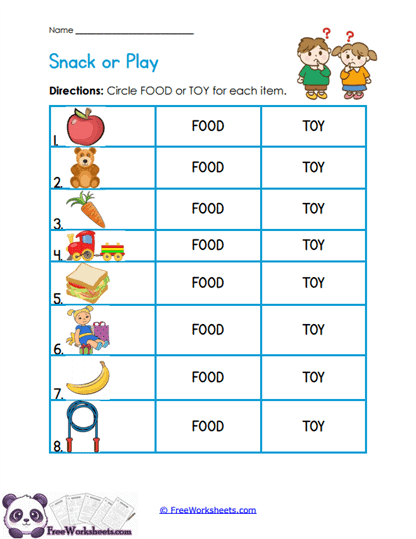
Food Toys
What Kids Do: Children look at familiar items such as apples, carrots, sandwiches, dolls, trains, and jump ropes. For each picture, they decide whether it belongs in the food group or the toy group.
Target Skill: This worksheet shifts classification from appearance to purpose. Preschoolers practice thinking about what an object is used for and placing it into a meaningful everyday category.
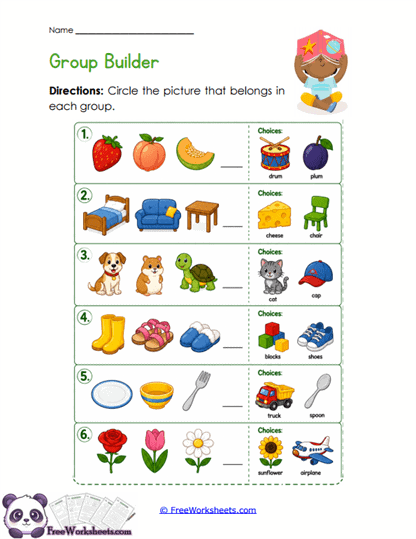
Group Builder
What Kids Do: Children study three pictures that already belong together and then choose which of two new pictures should join the group. Categories include foods, furniture, animals, footwear, table items, and flowers.
Target Skill: Learners identify a shared rule and apply it to a new example. This builds flexible reasoning because children must understand what connects the original group before choosing the missing member.
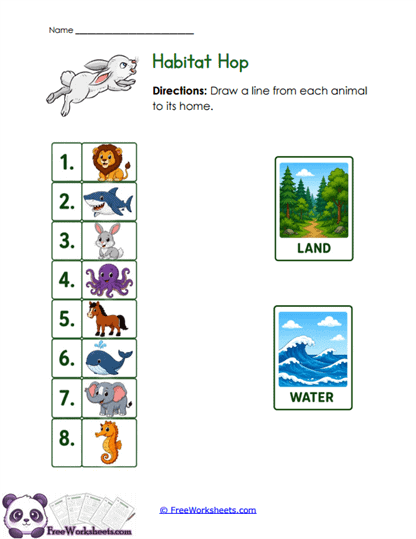
Habitat Sort
What Kids Do: Children look at animals such as lions, sharks, rabbits, whales, horses, and seahorses. They decide whether each animal belongs on land or in water and connect it to the correct habitat picture.
Target Skill: This activity strengthens classification while connecting early math with basic science knowledge. Children practice using habitat as the sorting rule instead of relying on appearance or personal preference.
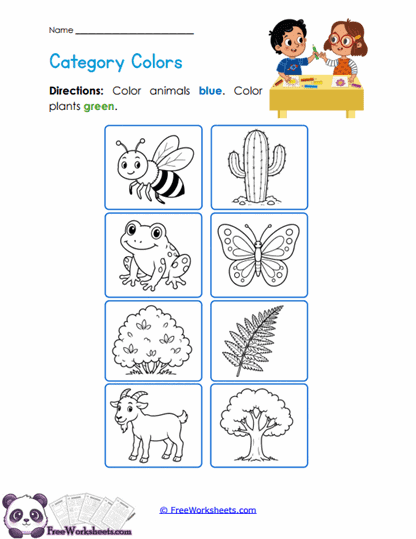
Living Colors
What Kids Do: Children examine pictures of animals and plants, including bees, frogs, butterflies, trees, cacti, and ferns. They color animals one color and plants another according to the directions.
Target Skill: Learners practice separating living things into two broad categories while remembering a two-part color rule. The activity supports classification, science vocabulary, attention, and following directions.
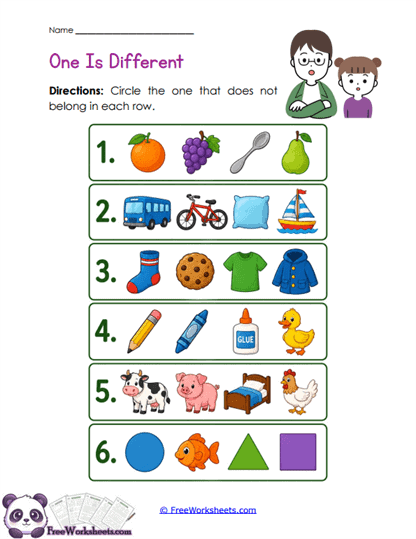
Odd One
What Kids Do: Children study groups of four pictures and find the one that does not belong. The rows cover categories such as fruits, transportation, clothing, school supplies, animals, and shapes.
Target Skill: This worksheet develops deeper classification by asking children to identify both the shared rule and the exception. Learners practice explaining what three objects have in common before deciding which picture is different.
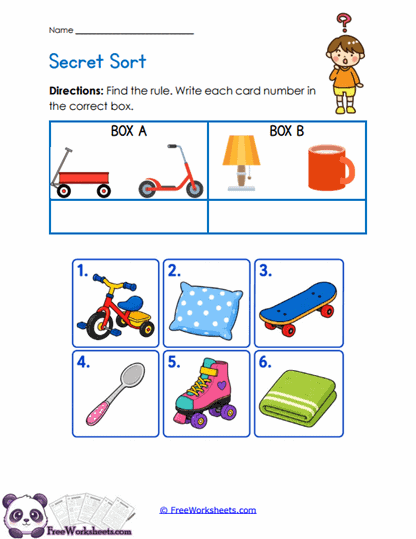
Rule Sort
What Kids Do: Children study two example groups and try to figure out the hidden rule that separates them. They then sort six new picture cards by writing each picture number under the correct group.
Target Skill: This activity builds early logical reasoning because the sorting rule is not stated directly. Children must use examples to infer what belongs in each group and then apply that idea consistently.
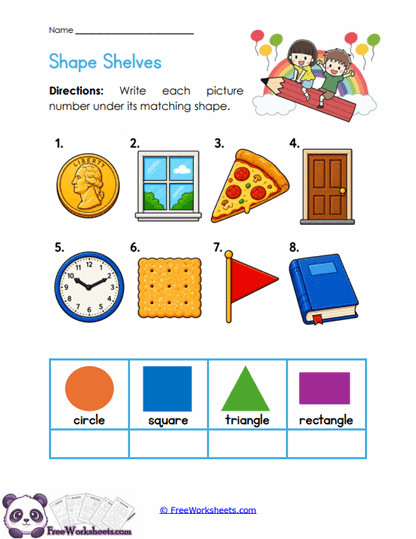
Shape Matching
What Kids Do: Children look at everyday objects such as coins, windows, pizza slices, doors, clocks, and books. They decide whether each item most closely matches a circle, square, triangle, or rectangle.
Target Skill: Learners connect geometric shapes with familiar objects from daily life. The worksheet also encourages them to focus on the outer form of an object rather than becoming distracted by smaller details inside it.
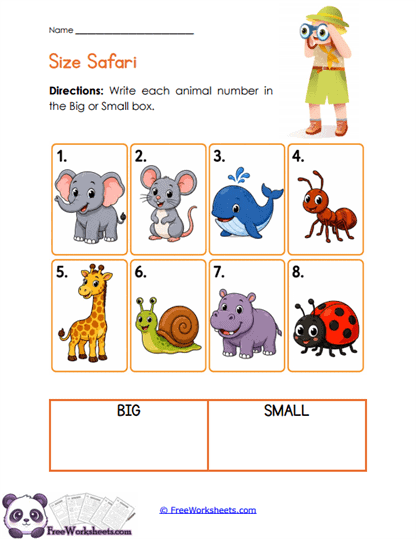
Size Groups
What Kids Do: Children compare animals such as elephants, mice, whales, ants, giraffes, snails, hippos, and ladybugs. They write each animal number in either the BIG or SMALL sorting box.
Target Skill: This page develops size comparison and measurement language. Children practice thinking about real-world size rather than judging how large each illustration happens to appear on the worksheet.
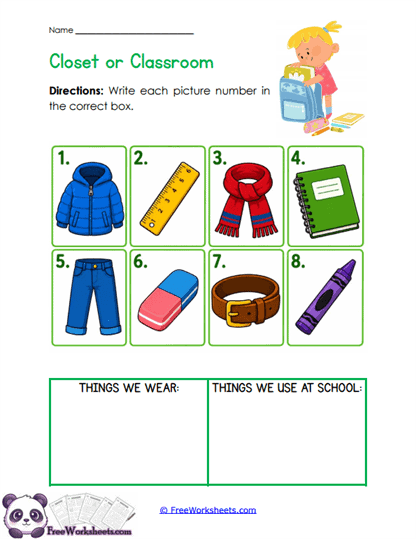
Use Groups
What Kids Do: Children sort numbered pictures into things we wear and things we use at school. Items include jackets, scarves, pants, belts, rulers, notebooks, erasers, and crayons.
Target Skill: Learners classify familiar objects by their everyday purpose. The activity strengthens vocabulary and helps children understand that an object’s use can be a meaningful sorting feature.
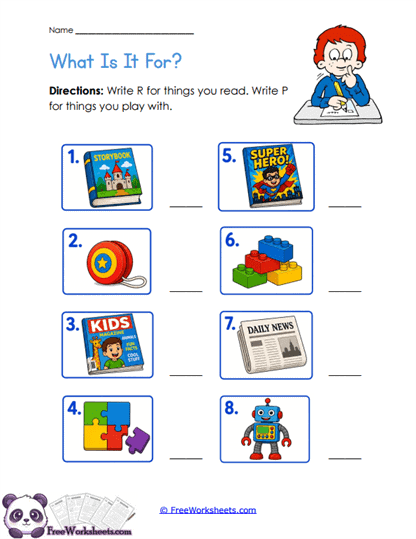
Use Sort
What Kids Do: Children look at books, magazines, comic books, newspapers, toys, blocks, puzzles, and a robot. They mark each item with an R for things people read or a P for things people play with.
Target Skill: This worksheet develops purpose-based sorting while also giving children light practice with letter recognition. Learners focus on what people normally do with an object rather than how the object looks.