
Numbers and Counting to 20 Worksheets
Preschool early math learners can use these numbers and counting to 20 worksheets to strengthen number sense through clear visual practice. These free, ready-to-print activities come in PDF format for immediate classroom use during centers, small groups, or home practice. Children build one-to-one counting, numeral recognition, quantity matching, and number-order skills that prepare them for common core kindergarten math.
About This Collection of Worksheets
Learning to count through 20 gives preschool children an important bridge between basic counting and more advanced early math. This collection helps children connect spoken number words, written numerals, and actual quantities through activities that involve shapes, dots, toys, frames, and other easy-to-count objects. The visual approach gives young learners plenty of support as they begin working with teen numbers and larger groups.
The worksheets offer several ways to practice the same core ideas without making the work feel repetitive. Children count sets, match quantities, trace numerals, complete number sequences, color target amounts, compare groups, and add missing objects to reach a given total. Some activities also introduce patterns involving even numbers and groups that increase by twos, giving children an early foundation for skip counting.
Across the collection, children practice one-to-one correspondence, cardinality, number order, numeral formation, quantity comparison, and recognizing equal groups. Many activities also encourage learners to organize larger sets into rows or groups so quantities through 20 become easier to manage. These experiences support early preparation for Common Core counting and cardinality skills, including K.CC.A.1, K.CC.A.2, K.CC.A.3, K.CC.B.4, K.CC.B.5, and K.CC.C.6.
Paul’s Teacher Tip
When children begin counting past 10, encourage them to touch or point to each object as they say each number. For larger groups, show them how to work from left to right or one row at a time so they do not skip or count an object twice. It can also help to pause at 10 and then continue with 11, 12, and the remaining numbers. When possible, have children say the final total aloud and connect it to the matching written numeral. Recounting a group in a different way is also a useful habit because it shows children that the total stays the same even when the objects are arranged differently.
Worksheet Collection Skill Spotlights
Collection Compare
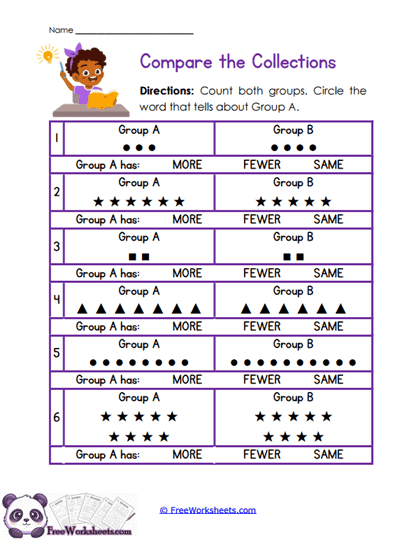
What Kids Do: Children count the objects in Group A and Group B, compare the two totals, and decide whether Group A has more, fewer, or the same number. Six problems use simple symbols so learners can focus closely on counting and comparison words.
Target Skill: This activity builds accurate counting and early quantity comparison while helping children use the words more, fewer, and same correctly. It provides preschool practice that prepares learners for Common Core K.CC.C.6 and later comparison of written numerals.
Complete Counts
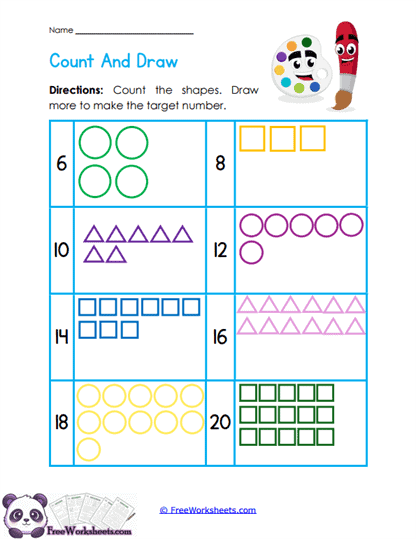
What Kids Do: Children look at a target number, count the shapes already provided, and draw enough additional shapes to complete the group. Targets range from 6 through 20, so learners practice continuing a count instead of starting every quantity from zero.
Target Skill: Learners strengthen counting through 20, quantity composition, and early missing-part reasoning as they determine how many more objects are needed. The activity supports preparation for Common Core K.CC.B.5 while introducing thinking that connects naturally with K.OA.A.4.
Crayon Counts
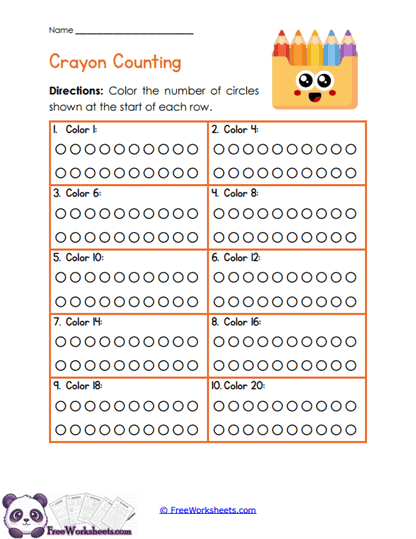
What Kids Do: Children read an even target number and color exactly that many circles in the matching section. Ten problems move from 2 through 20 by twos, giving learners repeated chances to count carefully, stop at a target amount, and notice a simple number pattern.
Target Skill: This page strengthens one-to-one counting, numeral recognition, and the ability to produce a requested quantity through 20. It also gives children informal experience with even-number patterns while preparing them for the object-counting expectations of Common Core K.CC.B.4 and K.CC.B.5.
Even Matches
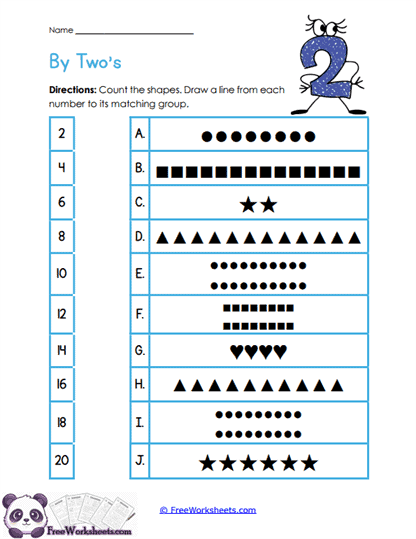
What Kids Do: Children count groups of dots, stars, hearts, squares, triangles, and other symbols and connect each set to the matching even numeral. The numbers progress from 2 to 20, encouraging careful counting while introducing the visual pattern created by counting in twos.
Target Skill: Learners connect written numerals with counted quantities and become more comfortable managing larger sets in the teens. The activity supports early preparation for Common Core K.CC.B.4 and K.CC.B.5 while giving children useful exposure to the number pattern 2, 4, 6, 8, and beyond.
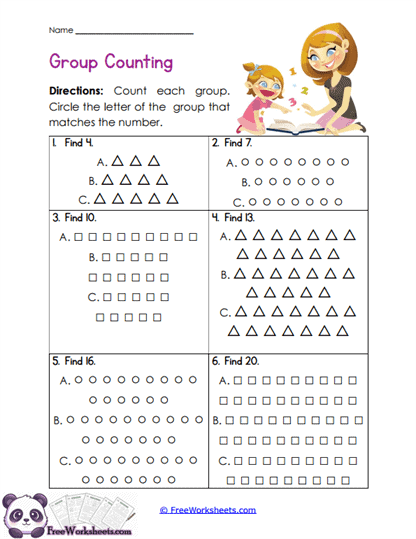
Group Finder
What Kids Do: Children study a target number and then count three different shape groups to find which choice contains exactly that amount. Six problems include quantities ranging from smaller numbers to teen numbers and 20, requiring learners to count before making a choice.
Target Skill: This activity develops one-to-one counting, numeral recognition, quantity matching, and careful comparison between sets. It prepares preschool learners for Common Core K.CC.B.4 and K.CC.B.5 by asking them to connect a written number with a group containing that exact quantity.
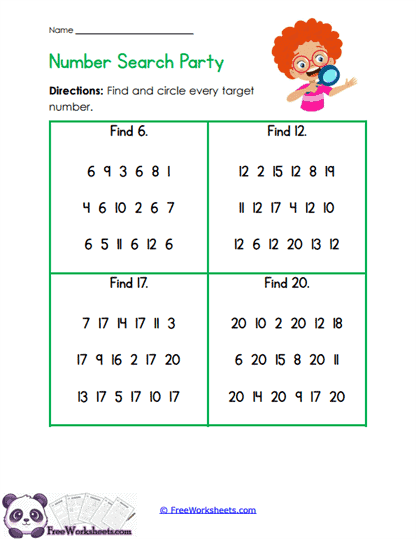
Number Finder
What Kids Do: Children search mixed groups of numerals and circle every example of a target number. Separate sections focus on 6, 12, 17, and 20, helping learners distinguish larger numerals from nearby choices while following an organized left-to-right search routine.
Target Skill: The page builds visual numeral recognition and discrimination, especially for teen numbers that may still look unfamiliar to preschool learners. This practice supports early preparation for Common Core K.CC.A.3 by helping children identify written numbers through 20 with greater speed and confidence.
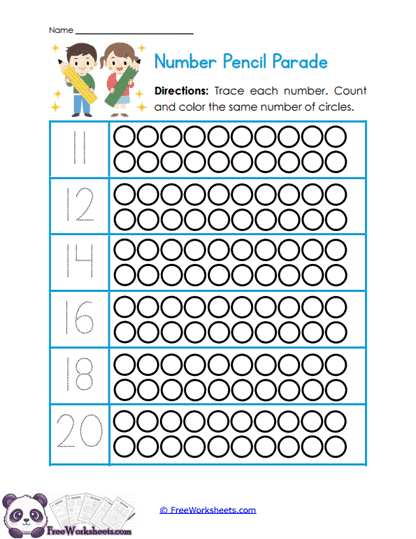
Number Parade
What Kids Do: Children trace selected numerals between 11 and 20 and then color the same number of circles in the matching row. Each task connects how a numeral looks and is formed with the quantity it represents, combining number writing with hands-on counting practice.
Target Skill: Learners strengthen numeral formation, number recognition, one-to-one counting, and quantity matching while becoming more familiar with numbers beyond 10. The activity prepares children for Common Core K.CC.A.3 and K.CC.B.5 by linking written numerals with counted sets.
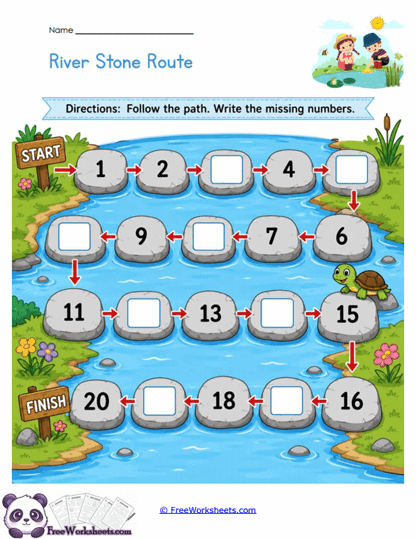
River Numbers
What Kids Do: Children follow arrows across a river-themed path from 1 through 20 and fill in the missing numerals on blank stepping stones. They must keep the counting sequence in order even when the path changes direction, making the activity both visual and sequential.
Target Skill: This worksheet strengthens forward counting, number order, missing-number recognition, numeral writing, and visual tracking. It supports early preparation for Common Core K.CC.A.1 and K.CC.A.2 by helping children understand that counting follows a predictable sequence through 20.
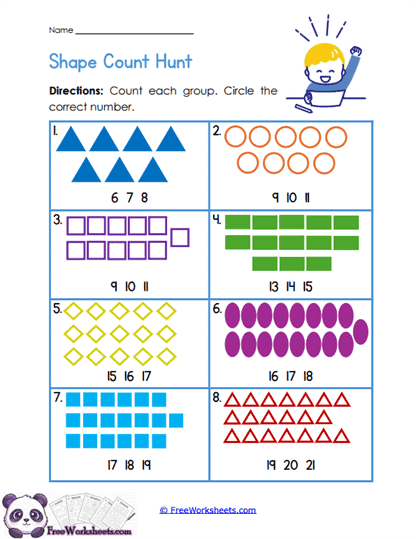
Shape Counts
What Kids Do: Children count groups of triangles, circles, squares, diamonds, ovals, and other simple shapes and choose the numeral that matches each total. Three answer choices are provided for every problem, allowing learners to check their count against several possible numbers.
Target Skill: Learners build one-to-one correspondence, cardinality, numeral recognition, and accurate counting with quantities that extend into the teens. This practice directly prepares preschool children for Common Core K.CC.B.4 and K.CC.B.5, including understanding that the last number counted names the total.
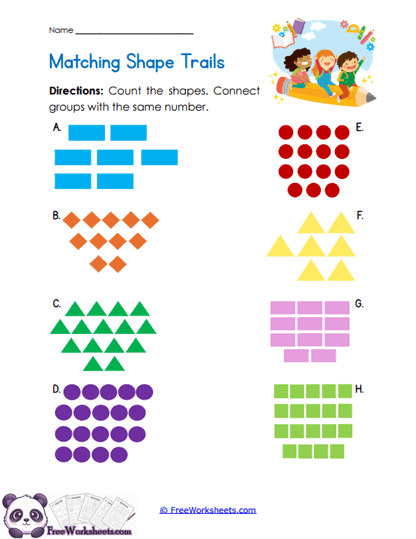
Shape Matches
What Kids Do: Children count shape groups on both sides of the page and draw lines between two sets that contain the same number of objects. The shapes and colors differ, so children cannot rely on appearance and must use the counted quantity to find each match.
Target Skill: This activity develops accurate counting, recognition of equal quantities, and the understanding that two sets can have the same amount even when they look different. It prepares learners for Common Core K.CC.B.4 and K.CC.C.6 by combining counting with early equality and comparison reasoning.
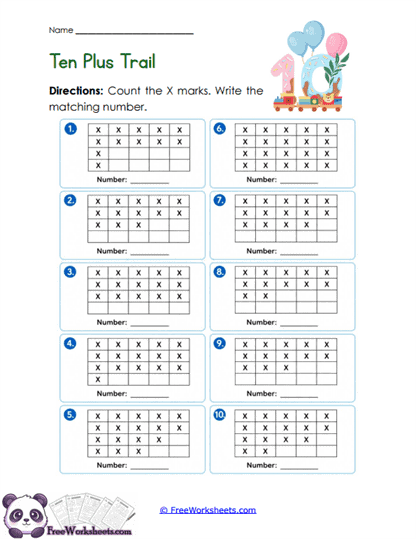
Ten Frames
What Kids Do: Children count X marks arranged in structured frames and write the matching numeral on the answer line. The organized rows help children handle quantities above 10 by counting systematically instead of trying to keep track of a scattered group of objects.
Target Skill: Learners strengthen one-to-one counting, numeral writing, cardinality, and early understanding of teen quantities as 10 and some more. The structured format supports preparation for Common Core K.CC.B.4 and K.CC.B.5 while building visual number sense for later addition work.
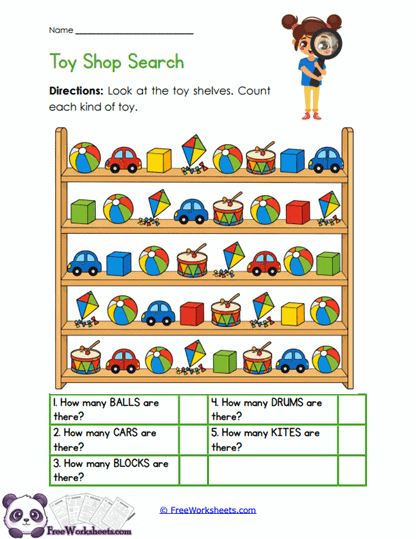
Toy Counting
What Kids Do: Children search a busy toy-shop picture for balls, cars, blocks, drums, and kites, count every example of one toy type, and record each total. Objects appear across several shelves, so learners must scan the entire scene without skipping or counting an item twice.
Target Skill: This activity combines counting through 20 with classification, visual scanning, one-to-one correspondence, and numeral writing. It supports early preparation for Common Core K.CC.B.4 and K.CC.B.5 by asking children to isolate a category, count all objects in that group, and record the total.