
Compare Numbers Worksheets
These preschool early math worksheets help children practice compare numbers by counting groups, noticing differences, and deciding which amount is larger, smaller, or equal. Every activity is free, ready-to-print, available in PDF format, and designed for immediate classroom use. Children strengthen counting, one-to-one matching, comparison vocabulary, and early reasoning skills aligned with beginning basic number concepts.
About This Collection of Worksheets
This collection helps preschool children understand that groups can be compared by how many objects they contain. Learners count pictures, shapes, dots, and organized frames before deciding which group has more, fewer, or the same amount. Using visible groups first makes comparison easier to understand before children are expected to compare written numbers on their own.
The worksheets give children several ways to explore the same important idea. Some pages ask them to circle a larger or smaller group, while others use matching, ten-frames, drawing, sorting, number choices, or busy picture scenes. Children also practice making unequal groups equal and comparing three groups to find the most or fewest.
These printable activities work well during math centers, guided lessons, homeschool practice, early intervention, and short independent work. The collection supports early Common Core skills involving counting and comparing groups, especially the ideas behind K.CC.C.6 and K.CC.C.7. As children become more comfortable with words such as more, fewer, and same, they build a strong foundation for later work with greater than, less than, and equal relationships.
Paul’s Teacher Tip
Always have children count both groups before asking which one has more or fewer. Young learners are often drawn to larger pictures or groups that take up more space, even when those groups contain fewer objects. When possible, line up counters one-to-one so children can physically see which group has extras. Encourage full sentences such as, “This group has fewer than that group,” because saying the comparison helps build the vocabulary. Once children are confident with pictures, begin showing the matching numerals so they can connect quantities with written numbers.
Worksheet Collection Skill Spotlights
Compare Groups
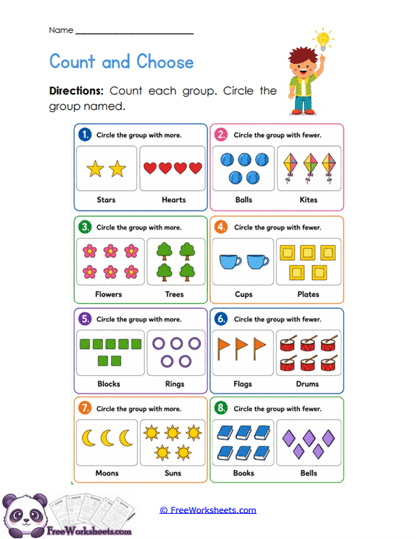
What Kids Do: Children count two picture groups in each problem and pay attention to whether the direction asks for more or fewer. They then circle the correct group among familiar pictures such as stars, hearts, balls, flowers, blocks, books, and bells.
Target Skill: This activity builds the basic idea that quantities can be compared even when the objects look different. Children practice counting accurately and using the words more and fewer based on number rather than picture size.
Compare Sets
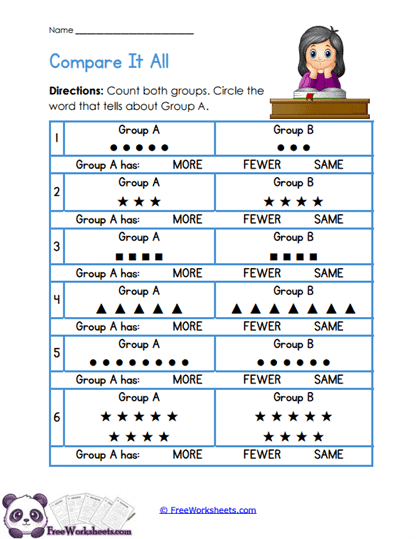
What Kids Do: Children count the symbols in Group A and Group B, compare the two totals, and circle MORE, FEWER, or SAME. Six repeated rows give them several chances to use the same comparison process.
Target Skill: Learners strengthen comparison vocabulary while paying close attention to which group is being described. The worksheet prepares children to move from visual groups toward comparing written numbers more independently.
Equal Makers
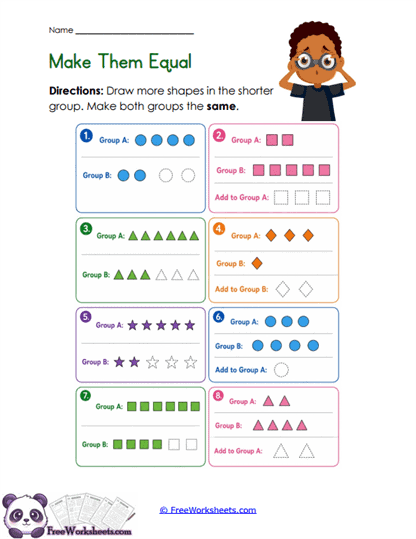
What Kids Do: Children count two groups, identify which side has fewer shapes, and draw enough new shapes to make both groups equal. They recount after drawing to check whether the amounts now match.
Target Skill: This page develops a deeper understanding of equality by showing that equal means the same amount. Children also begin exploring missing-part thinking as they figure out exactly how many more objects are needed.
Equal Pairs
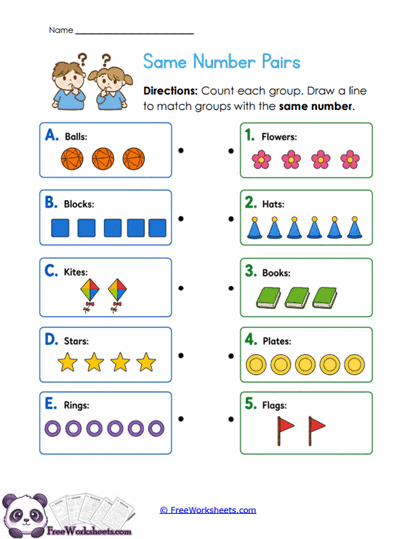
What Kids Do: Children count picture groups on both sides of the page and look for pairs containing the same number of objects. They draw lines between matching quantities even when the pictures themselves are different.
Target Skill: Learners discover that equality depends on quantity rather than object type, color, or appearance. This supports strong number sense and prepares children for understanding equal values in later number sentences.
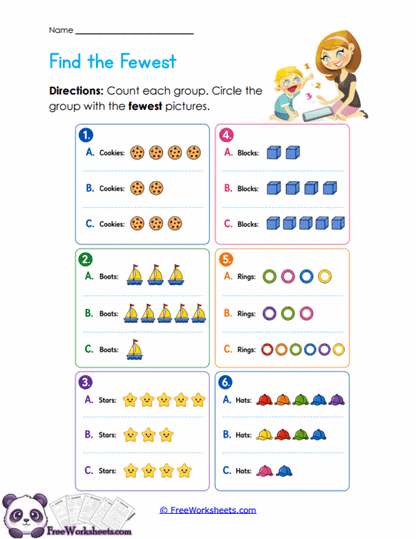
Fewest Groups
What Kids Do: Children count three picture choices in each problem and compare all of the totals. They circle the group containing the fewest objects among choices such as cookies, boats, stars, blocks, rings, and hats.
Target Skill: This worksheet extends comparison beyond two groups. Children practice holding several quantities in mind and identifying the smallest amount, which builds understanding of the word fewest.
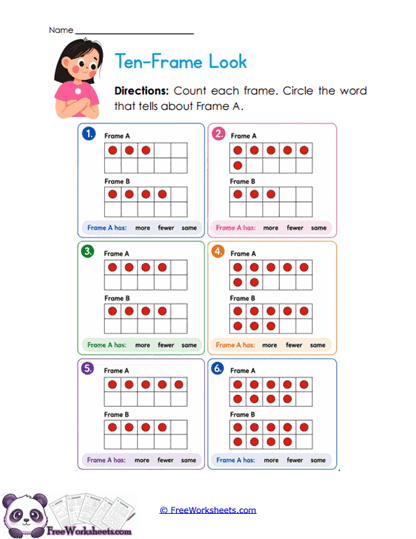
Frame Compare
What Kids Do: Children count red dots inside paired ten-frames and decide whether Frame A has more, fewer, or the same number as Frame B. They circle the correct comparison word for each problem.
Target Skill: Learners practice comparing quantities in an organized visual structure. Ten-frames also help children begin noticing fullness, empty spaces, and number patterns instead of relying only on counting scattered pictures.
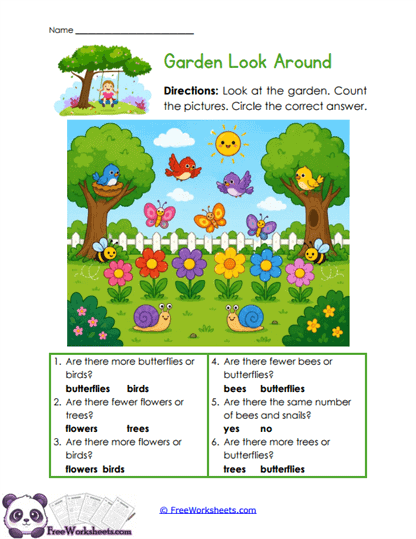
Garden Compare
What Kids Do: Children search a colorful garden scene for butterflies, birds, flowers, trees, bees, snails, and other objects. They count the named groups and answer questions asking which has more, fewer, or the same amount.
Target Skill: This activity combines quantity comparison with careful visual scanning. Children practice keeping track of objects in a busy scene while using comparison words correctly after counting.
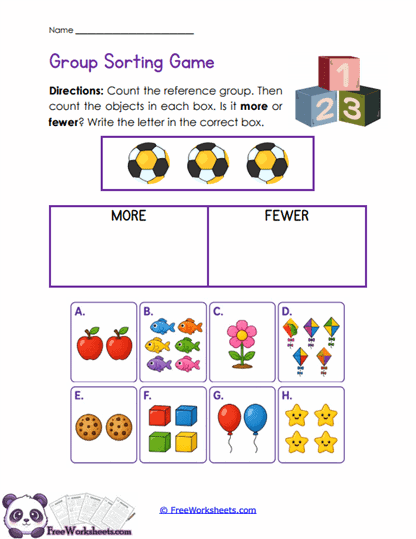
More Fewer
What Kids Do: Children first count a reference group of three soccer balls. They then count several new picture groups and sort each one into MORE or FEWER depending on how its amount compares with the reference set.
Target Skill: Learners begin using one quantity as a benchmark for several comparisons. This builds flexible number thinking because every new group must be compared back to the same reference amount.
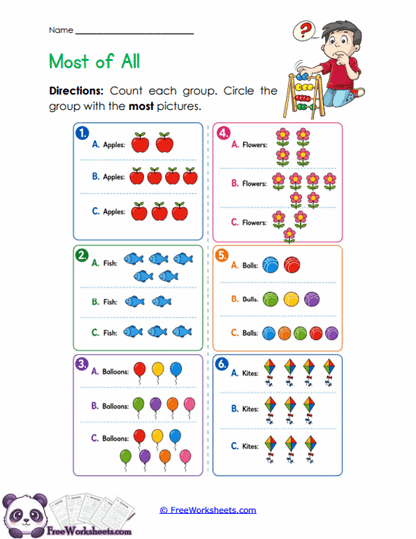
Most Groups
What Kids Do: Children count three groups labeled A, B, and C in each problem and decide which contains the greatest number of objects. They circle the group with the most after comparing all three totals.
Target Skill: This page helps children move from two-way comparisons to comparing several quantities at once. Learners connect the word most with the greatest count rather than the biggest-looking or widest group.
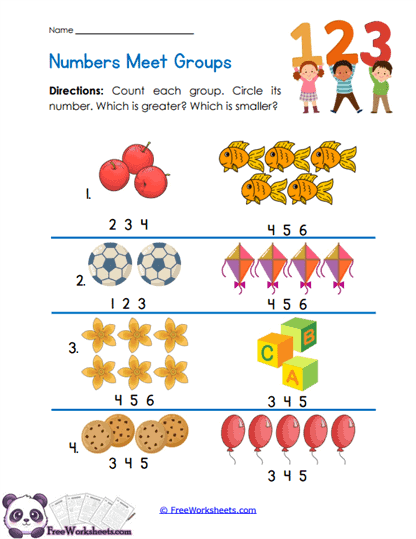
Number Groups
What Kids Do: Children count each picture group, circle the numeral that matches its quantity, and then compare the two resulting numbers. Familiar pictures such as apples, fish, balls, kites, flowers, and balloons support the counting.
Target Skill: This worksheet bridges visual quantity comparison and written number comparison. Children begin seeing that the numeral and the picture group represent the same amount, which prepares them for comparing numbers without pictures.
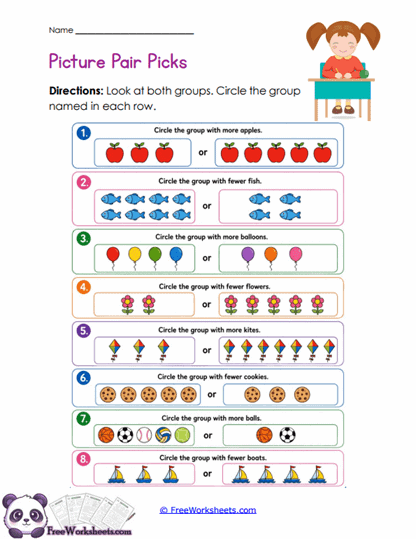
Picture Choice
What Kids Do: Children count two familiar picture groups in each row and circle the one requested by the direction. Some problems ask for more, while others ask for fewer, so learners must read or listen carefully before choosing.
Target Skill: Learners strengthen counting accuracy and comparison language while resisting visual distractions such as picture size or spacing. Repeated practice helps make the meanings of more and fewer more automatic.
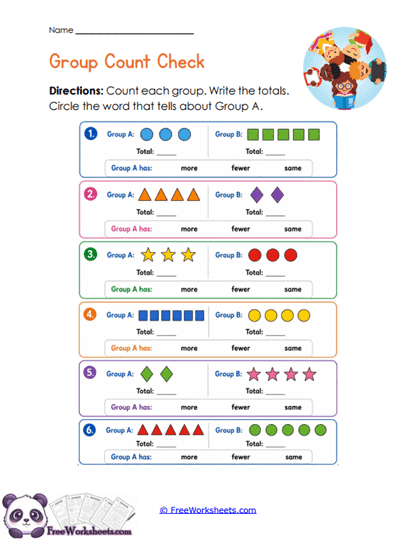
Quantity Check
What Kids Do: Children count Group A and Group B, write each total, and then circle more, fewer, or same to describe Group A. Simple shapes keep the focus on quantity rather than decorative details.
Target Skill: This activity connects counting, number writing, and comparison vocabulary in one routine. Children practice turning what they see into numbers and then using those numbers to explain the relationship between two groups.