
Numbers and Counting to 10 Worksheets
These preschool early math worksheets help children practice numbers and counting to 10 by connecting numerals with pictures, dot groups, tracing, coloring, and simple number sequences. Every activity is free, ready-to-print, available in PDF format, and designed for immediate classroom use. Children strengthen one-to-one counting, numeral recognition, quantity matching, sequencing, and early comparison skills aligned with beginning common core counting concepts.
About This Collection of Worksheets
This collection helps preschool children connect the numbers 1 through 10 with the amounts those numerals represent. Learners count symbols, dots, circles, and picture groups while matching those quantities with written numbers. Working all the way to 10 gives children an important next step beyond smaller counting ranges while keeping the activities visual and easy to follow.
The worksheets use matching, coloring, ten-frames, tracing, numeral searches, picture scenes, missing sets, comparisons, and counting trains. Children may count a group and choose its numeral, color a target amount, build a group to 10, compare two quantities, or fill in missing numbers in sequence. These different formats give repeated practice without making every worksheet feel the same.
These printable activities work well during math centers, small-group instruction, homeschool lessons, early intervention, and independent review. The collection supports beginning Common Core skills connected with K.CC.A.1, K.CC.A.2, K.CC.A.3, K.CC.B.4, K.CC.B.5, and early comparison work from K.CC.C.6. As children become confident counting through 10, they build the foundation needed for addition, greater number ranges, and stronger number sense.
Paul’s Teacher Tip
Groups of 8, 9, and 10 can be much harder for young children to track than groups of 3 or 4, so encourage pointing as they count. Have children move left to right and touch each object only once. Ten-frames are especially useful because they let children begin seeing how close a group is to 10 without always starting the count from one. When children write an answer, ask them to say the total first so the quantity and numeral stay connected. For missing-number activities, let them say the whole counting sequence aloud before filling in any blanks.
Worksheet Collection Skill Spotlights
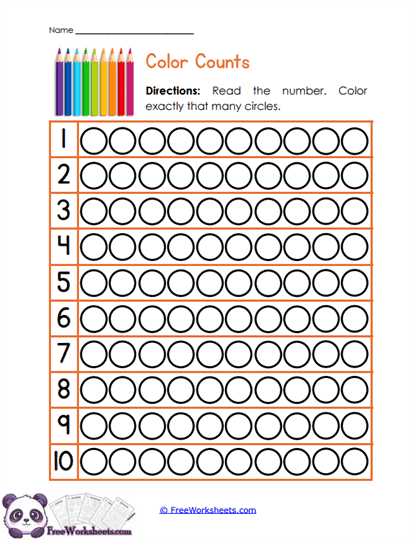
Circle Counts
What Kids Do: Children look at a target numeral from 1 through 10 and color exactly that many circles in a row of ten. They stop when they reach the target and leave the remaining circles uncolored.
Target Skill: This activity helps children build quantities within a full group of 10. Learners strengthen numeral recognition, one-to-one counting, and the understanding that each written number represents an exact amount.
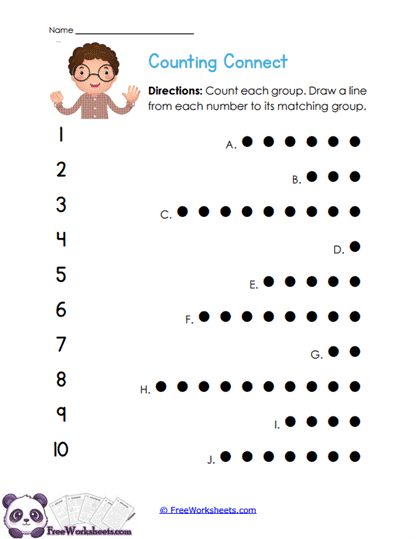
Counting Matches
What Kids Do: Children count lettered dot groups and draw lines to the matching numerals from 1 through 10. Every group uses the same type of dot, so the focus stays on quantity rather than picture differences.
Target Skill: Learners connect written numerals with counted sets across the full 1-to-10 range. This strengthens counting accuracy, visual matching, and the idea that each numeral stands for a specific quantity.
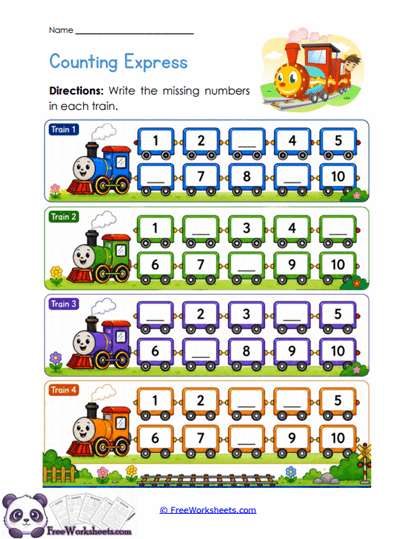
Counting Trains
What Kids Do: Children study colorful train cars containing number sequences with missing numerals. They use the numbers before and after each blank to complete counting paths through 10.
Target Skill: This worksheet develops number order and sequencing. Children practice understanding what comes before, after, and between other numbers instead of treating numerals as unrelated symbols.
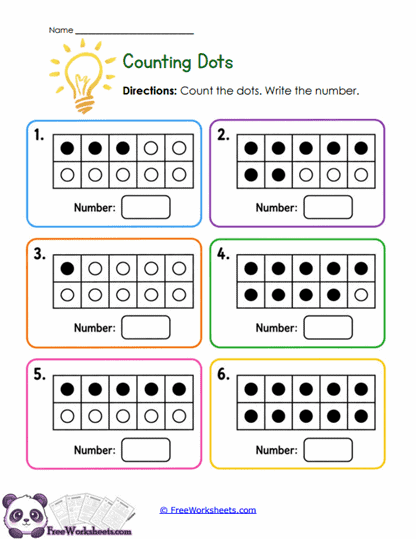
Dot Frames
What Kids Do: Children count black dots arranged inside structured ten-frames and write the matching numeral. Six different frames provide practice with several quantities within 10.
Target Skill: Learners begin seeing numbers as organized visual patterns. Ten-frames help children notice filled and empty spaces and prepare them to recognize some quantities more quickly without counting every dot separately.
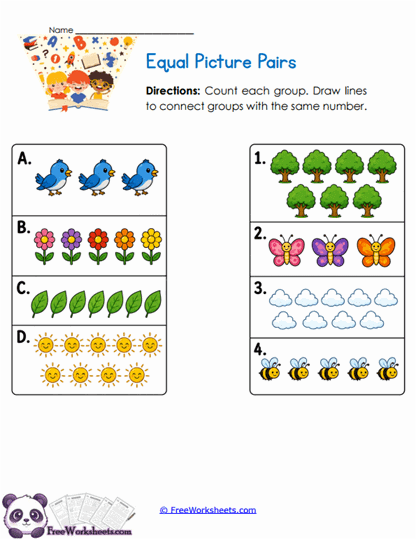
Equal Pictures
What Kids Do: Children count colorful picture groups on opposite sides of the page and draw lines between pairs showing equal quantities. The pictures may be birds, flowers, leaves, suns, trees, butterflies, clouds, or bees.
Target Skill: This activity builds equality and number sense by showing that different-looking groups can still contain the same number of objects. Children focus on quantity instead of appearance.
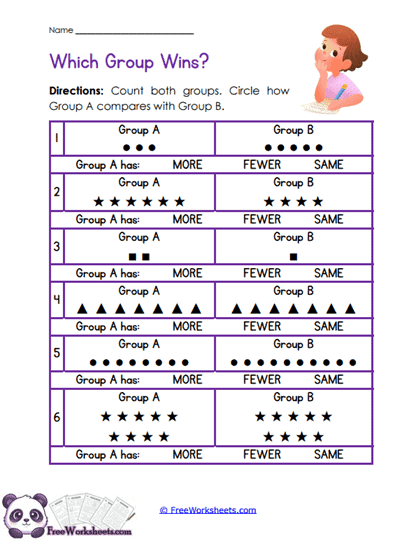
Group Compare
What Kids Do: Children count the symbols in Group A and Group B and decide whether Group A has MORE, FEWER, or the SAME amount. They circle the correct comparison word for each row.
Target Skill: Learners connect counting with comparison vocabulary. The activity prepares children to compare written numerals later by first building a clear understanding of quantity relationships.
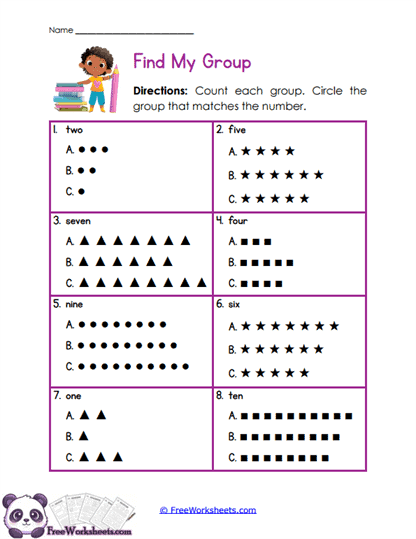
Group Match
What Kids Do: Children look at a target number and count the shapes in three answer choices. They circle the group that contains exactly the amount named by the target.
Target Skill: This worksheet strengthens quantity matching and careful counting. Children learn to compare every choice rather than selecting the group that merely appears largest or fullest.
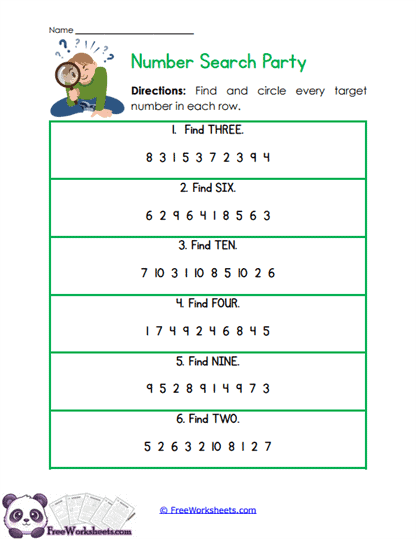
Number Search
What Kids Do: Children look for target numerals hidden among mixed rows of numbers. They scan carefully and circle every matching example they find within the number range through 10.
Target Skill: This activity develops numeral recognition and visual discrimination. Learners practice spotting written numbers quickly without needing picture groups as clues.
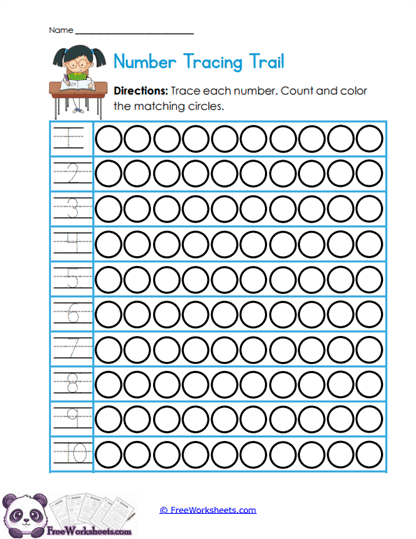
Number Tracing
What Kids Do: Children trace dotted numerals from 1 through 10 and then color the same number of circles in each row. The repeated format connects number writing with quantity practice.
Target Skill: Learners strengthen numeral formation while reinforcing what each written number means. Tracing, saying, and showing the number with objects helps connect symbol and quantity.
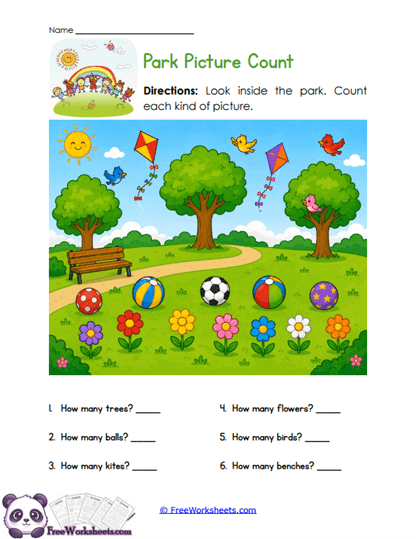
Park Counts
What Kids Do: Children search a colorful park scene for trees, balls, kites, flowers, birds, and benches. They count each type of object and write the total on the matching answer line.
Target Skill: This worksheet develops counting in a more natural visual setting. Learners practice scanning a scene, keeping track of counted objects, and writing numerals that represent each total.
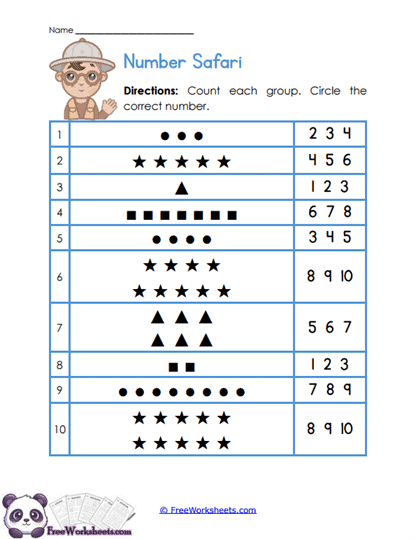
Safari Counts
What Kids Do: Children count groups of dots, stars, triangles, squares, and other simple symbols, then choose the matching numeral from three answer choices. Ten problems provide practice across the full counting range.
Target Skill: This activity strengthens one-to-one counting and numeral recognition as groups grow larger. Children practice finishing the count before using the final number to choose the correct written answer.
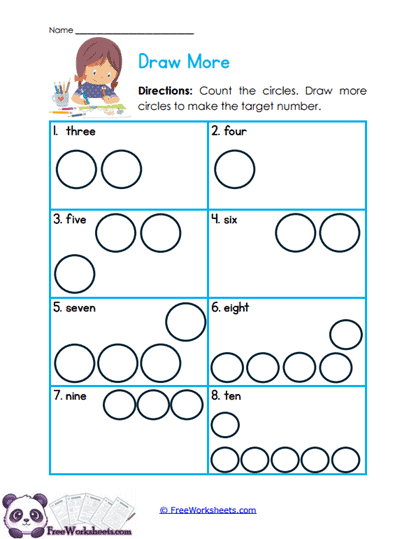
Target Circles
What Kids Do: Children count the circles already shown, look at a target number, and draw only enough extra circles to reach that amount. They recount the finished group to check their work.
Target Skill: Learners begin thinking about missing parts within numbers through 10. This builds flexible number sense and provides early preparation for simple missing-addend and addition problems.