
Shapes in the Real World Worksheets
Preschool early math learners can use these shapes in the real world worksheets to connect basic geometry with familiar everyday objects. These free, ready-to-print activities come in PDF format for immediate classroom use during centers, small groups, or home learning. Children strengthen shape recognition, classification, visual comparison, and geometry vocabulary aligned with early math skills.
About This Collection of Worksheets
Recognizing shapes in everyday life helps preschool children understand that geometry is part of the world around them. These worksheets connect circles, squares, triangles, rectangles, cubes, spheres, cylinders, cones, and other forms with familiar objects such as clocks, doors, balls, food, blocks, and household items. By seeing shapes in meaningful settings, children can move beyond memorizing shape names and begin understanding how geometry describes real objects.
The collection includes shape hunts, matching activities, sorting tasks, picture scenes, coloring pages, counting challenges, and simple classification problems. Children may search a kitchen or park for shapes, pair objects with similar forms, sort pictures into shape families, identify an odd object, or use clues to find a matching shape. Several activities also introduce the difference between flat and solid shapes in an age-appropriate way.
Across the collection, children strengthen visual discrimination, shape recognition, sorting, matching, counting, and descriptive geometry language. They learn that objects can share the same basic shape even when their colors, sizes, uses, and details are different. These experiences provide early preparation for Common Core geometry skills including K.G.A.1, K.G.A.2, K.G.A.3, K.G.B.4, and K.G.B.5.
Paul’s Teacher Tip
Before using these worksheets, invite children to find examples of shapes in the classroom or at home. A plate, window, block, ball, box, or party hat can make abstract geometry words much easier to understand. When a child identifies a shape, ask what feature helped them decide, such as straight sides, corners, curves, or a solid form. For three-dimensional shapes, letting children hold real objects can make the difference between circles and spheres or squares and cubes much clearer. Encourage children to focus on an object’s overall form rather than its color, purpose, or small decorative details.
Worksheet Collection Skill Spotlights
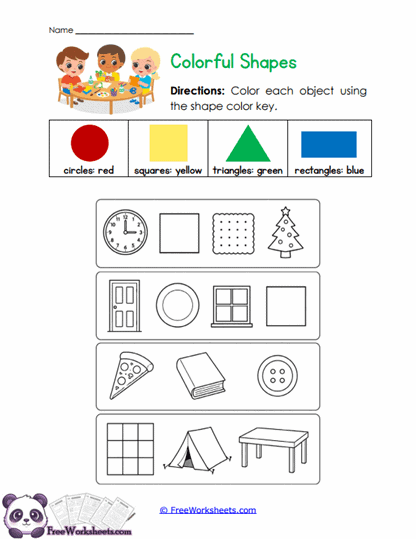
Color Shapes
What Kids Do: Children use a color key for circles, squares, triangles, and rectangles and then study familiar objects such as clocks, windows, doors, pizza slices, books, buttons, tents, and tables. They identify the basic shape represented by each object and color it according to the matching rule.
Target Skill: This activity strengthens recognition of common two-dimensional shapes inside real-world objects while also building visual discrimination and direction-following. It supports preparation for Common Core K.G.A.1 and K.G.A.2 by helping children name shapes and identify them in familiar surroundings.
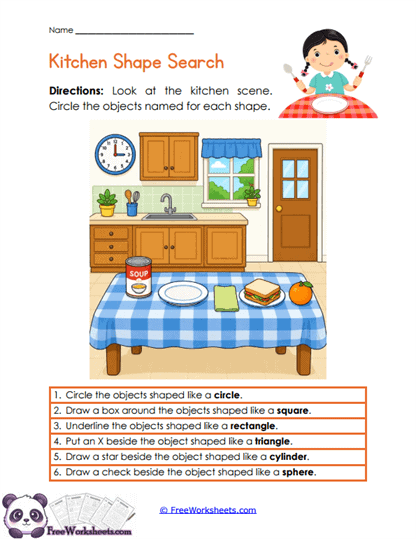
Kitchen Shapes
What Kids Do: Children explore a detailed kitchen scene and search for examples of circles, squares, rectangles, triangles, cylinders, and spheres. They follow several marking directions to identify each shape type, turning the familiar room into a guided geometry hunt.
Target Skill: Learners practice identifying both flat and solid shapes in everyday surroundings while strengthening geometry vocabulary and careful observation. The activity prepares children for Common Core K.G.A.1, K.G.A.2, and K.G.A.3 by introducing shape recognition and the difference between two- and three-dimensional figures.
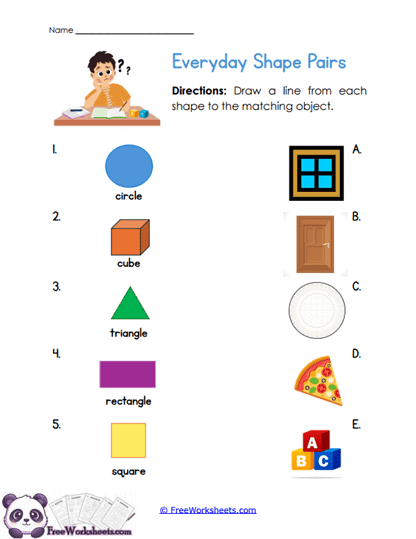
Object Pairs
What Kids Do: Children look at labeled shapes such as a circle, cube, triangle, rectangle, and square and match each one with a familiar object that shares its basic form. They draw connecting lines between the geometry examples and real-world pictures.
Target Skill: This page builds the connection between formal shape names and recognizable objects from daily life. It supports Common Core preparation for K.G.A.1 and K.G.A.2 by helping children identify shapes regardless of the object, color, size, or setting in which the shape appears.
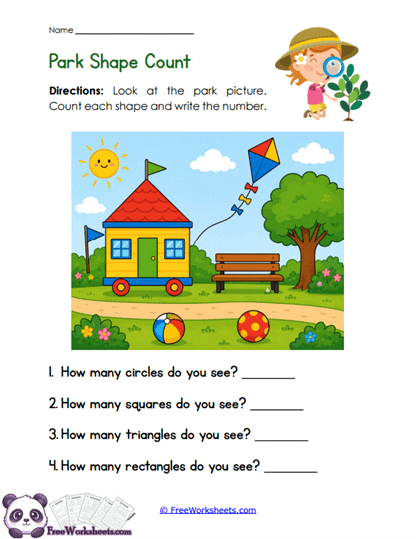
Park Shapes
What Kids Do: Children search a colorful park scene for circles, squares, triangles, and rectangles hidden within objects such as the sun, windows, roofs, benches, wagons, and balls. They count each shape type and record the total on the corresponding answer line.
Target Skill: Learners combine shape recognition with counting and visual scanning as they locate geometry inside a larger real-world picture. The activity supports early preparation for Common Core K.G.A.1 and K.G.A.2 while reinforcing numeral writing and careful one-to-one counting.
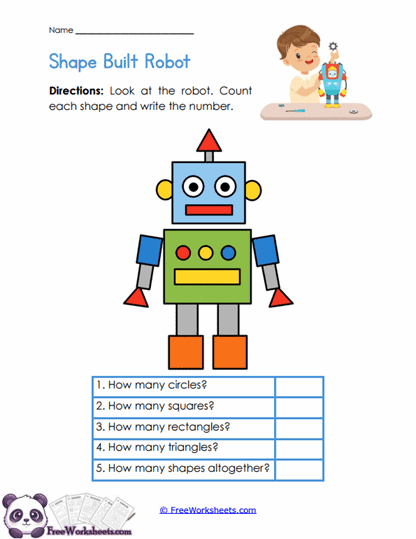
Robot Shapes
What Kids Do: Children study a robot made from circles, squares, rectangles, and triangles and count how many examples of each shape appear in the design. They record the totals and then determine how many shapes were used to build the robot altogether.
Target Skill: This activity strengthens shape identification, visual organization, and counting while showing how simple forms can combine to create a larger picture. It supports preparation for Common Core K.G.A.2 and K.G.B.5 by connecting shape recognition with early shape composition.
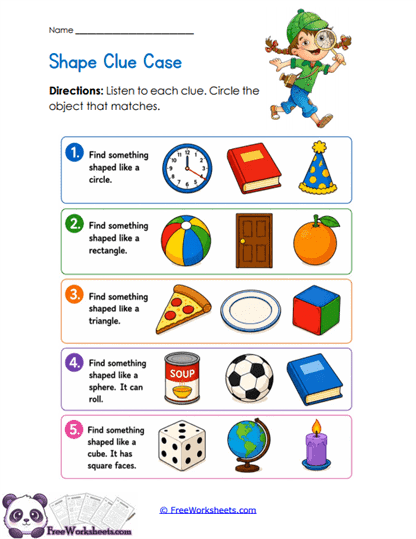
Shape Clues
What Kids Do: Children listen to or read clues asking them to find an object shaped like a circle, rectangle, triangle, sphere, or cube. For each clue, they compare three familiar pictures and circle the object whose overall form best matches the named shape.
Target Skill: Learners connect geometry vocabulary with real-world examples while comparing flat and solid shapes. The activity supports Common Core preparation for K.G.A.1, K.G.A.2, and K.G.A.3 by asking children to identify familiar objects according to their geometric form.
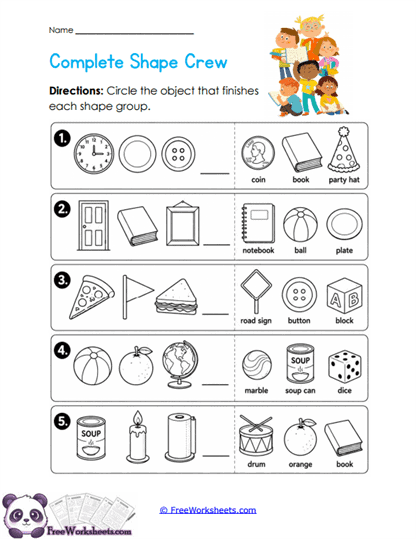
Shape Crew
What Kids Do: Children study groups of familiar objects that share the same basic shape and then choose which of three additional objects belongs with the group. They must determine the hidden shape rule before selecting the picture that completes each set.
Target Skill: This page develops shape classification, visual reasoning, and the ability to identify shared geometric features across different objects. It supports preparation for Common Core K.G.B.4 by helping children compare shapes and explain how objects are alike based on form.
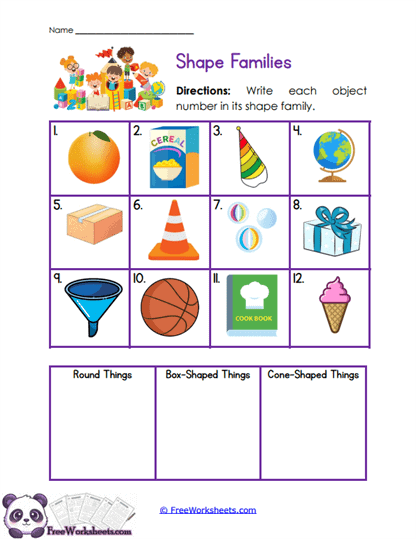
Shape Families
What Kids Do: Children examine twelve numbered real-world objects and sort them into Round Things, Box-Shaped Things, or Cone-Shaped Things. They record each picture number in the correct category while comparing objects such as balls, boxes, fruit, party hats, gifts, funnels, and cones.
Target Skill: Learners strengthen solid-shape recognition and classification by grouping familiar objects according to broad three-dimensional features. This activity supports early preparation for Common Core K.G.A.2 and K.G.A.3 while building vocabulary for describing solid forms.
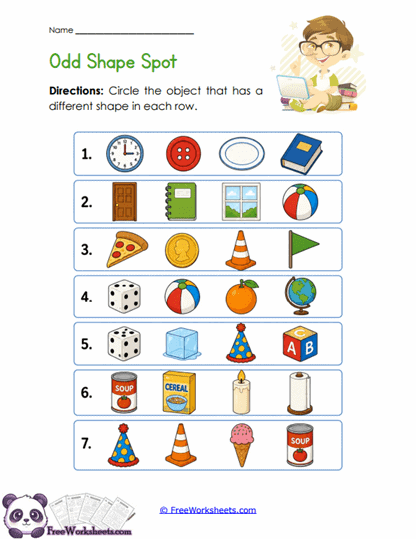
Shape Oddity
What Kids Do: Children inspect rows containing four familiar objects and decide which picture has a different basic shape from the other three. They circle the odd object after comparing overall forms instead of relying on color, purpose, or other distracting details.
Target Skill: This activity builds visual comparison, classification, and shape-feature awareness by requiring children to recognize similarities and differences among real-world objects. It supports early preparation for Common Core K.G.A.2 and K.G.B.4 through careful comparison of geometric forms.
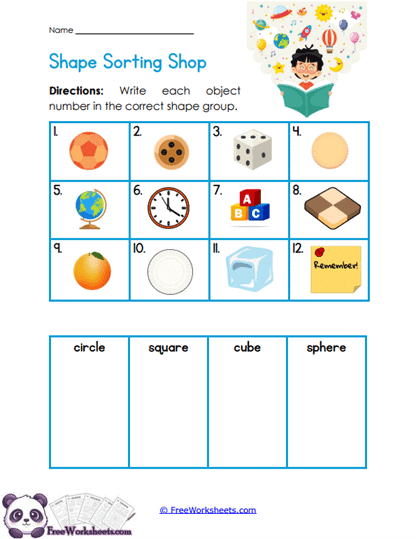
Shape Sorting
What Kids Do: Children study twelve numbered pictures of objects such as balls, cookies, dice, clocks, blocks, plates, ice cubes, and fruit. They decide whether each example belongs in the circle, square, cube, or sphere category and record its number in the correct box.
Target Skill: Learners practice distinguishing flat shapes from solid shapes while sorting real-world objects by their geometric form. The activity supports preparation for Common Core K.G.A.2 and K.G.A.3 by strengthening identification and classification of two- and three-dimensional shapes.
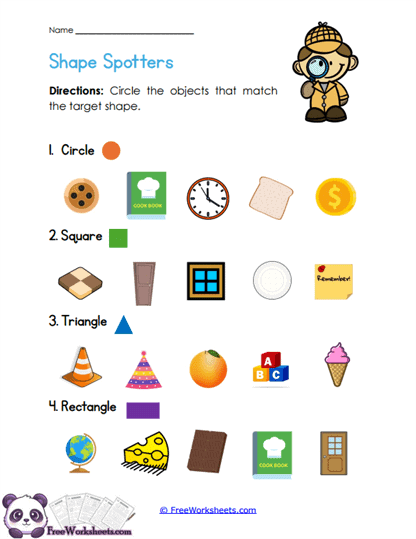
Shape Spotters
What Kids Do: Children search groups of everyday pictures for objects that match a named circle, square, triangle, or rectangle. They may find more than one correct answer in each section, so they must inspect every object instead of stopping after the first matching example.
Target Skill: This page strengthens shape recognition, classification, and visual scanning by asking children to identify basic geometry within familiar objects. It supports Common Core preparation for K.G.A.1 and K.G.A.2 by showing that the same shape can appear in many different real-world settings.
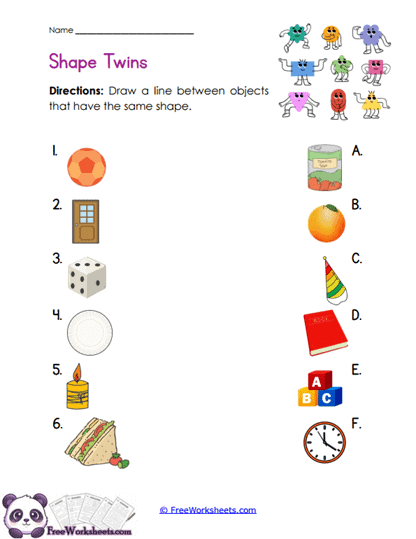
Shape Twins
What Kids Do: Children compare familiar objects on opposite sides of the page and draw lines between pairs that share the same basic flat or solid shape. Items such as balls, oranges, doors, plates, dice, candles, sandwiches, and other pictures encourage children to look past surface details.
Target Skill: Learners develop shape recognition and visual comparison by identifying when two different objects belong to the same geometric family. The activity supports preparation for Common Core K.G.A.1, K.G.A.2, and K.G.A.3 while reinforcing distinctions between flat and solid forms.