
Solving Mazes Worksheets
Solving mazes for preschool fine motor skills helps young children practice pencil control, visual planning, attention, and careful movement through changing paths. These free, ready-to-print PDF worksheets are prepared for immediate classroom use, fine motor centers, homeschool lessons, quiet work, or practice at home. Children strengthen path planning, hand-eye coordination, and controlled turning while working toward important preschool fine motor goals.
About This Collection of Worksheets
Mazes give preschool children a fun reason to slow down, look ahead, and guide a pencil with purpose. Instead of tracing a single obvious line, children must choose among possible routes, recognize blocked paths, make turns, and sometimes backtrack after reaching a dead end. That mix of movement and decision-making supports fine motor development while also encouraging patience, visual attention, and early problem solving.
This collection uses playful themes to make maze practice feel like a small adventure. Children help a cat reach a mouse, guide a puppy to a bone, lead a bee to its hive, search for pirate treasure, navigate a rocket route, return a sheep to the barn, reach a candy castle, explore a jungle, guide a butterfly to a flower, help a knight reach a castle, find an ice cream treat, and return an alien to its spaceship. Each activity combines route planning with controlled pencil movement through straight sections, corners, and dead ends.
Teachers can use these worksheets in preschool fine motor centers, problem-solving stations, themed units, morning work, or quiet independent practice. Parents and homeschool educators can let children test a route with a finger before using a pencil or crayon, especially on pages with more branching choices. Because mistakes are easy to correct by backing up and trying another path, maze activities also give children a natural way to practice persistence without making the task feel like a formal lesson.
Paul’s Teacher Tip
Encourage children to look one or two turns ahead before moving the pencil. Finger tracing first can help them test possible routes without worrying about extra marks on the page. If they reach a dead end, show them how to return to the last choice and try another path rather than starting over. For tighter passages, a crayon or thicker pencil may be easier for children who are still developing control. Keep the focus on careful planning and steady movement instead of racing to the finish.
Worksheet Collection Skill Spotlights
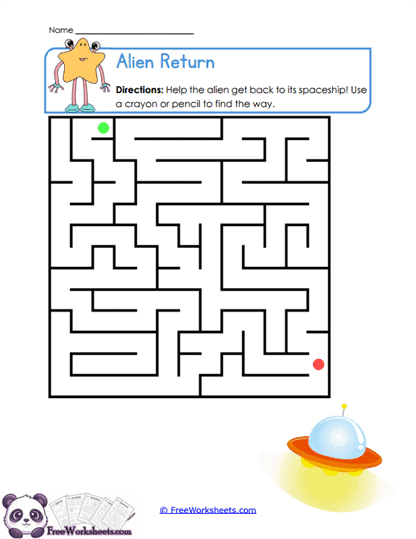
Alien Escape
What Kids Do:
Children guide an alien from a green starting dot through a rectangular maze toward a red finishing point near its spaceship. They explore connected passages, avoid walls, make careful turns, and backtrack when a chosen route ends.
Target Skill:
This activity strengthens hand-eye coordination, spatial planning, and controlled pencil movement. Children practice remembering where they have already traveled, identifying dead ends, and adjusting their route while keeping the pencil inside narrow pathways.
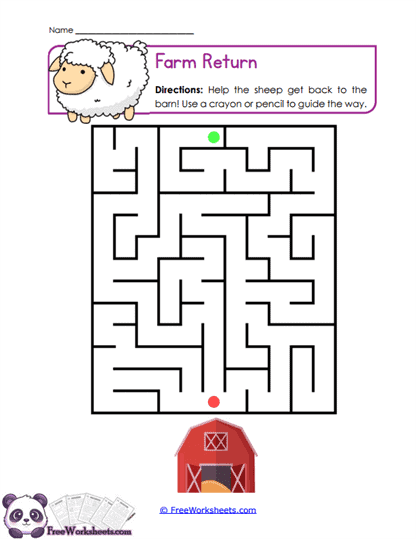
Barn Journey
What Kids Do:
Children help a sheep travel through a maze and return to the barn. They begin at the green dot, follow open passages, change direction at corners, and choose new routes when a path becomes blocked.
Target Skill:
The worksheet develops visual tracking, route planning, and fine motor control. Children strengthen early problem-solving skills while coordinating straight pencil movements with careful turns and learning to backtrack instead of crossing maze walls.
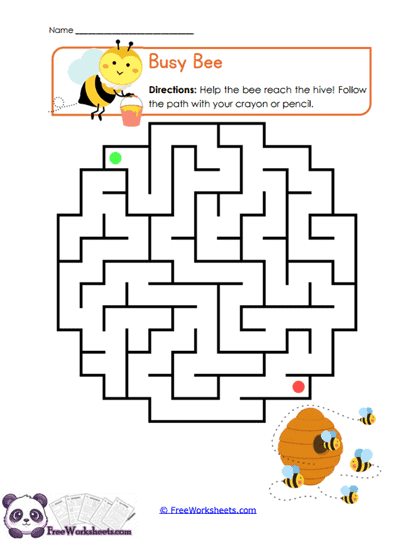
Bee Journey
What Kids Do:
Children lead a bee through a rounded maze toward its hive. They scan several nearby paths, pause at intersections, decide which openings connect, and retrace their route when they reach a dead end.
Target Skill:
This activity builds visual scanning, concentration, spatial awareness, and controlled hand movement. Children practice making decisions within a more compact maze while maintaining enough pencil control to navigate close passages and frequent turns.
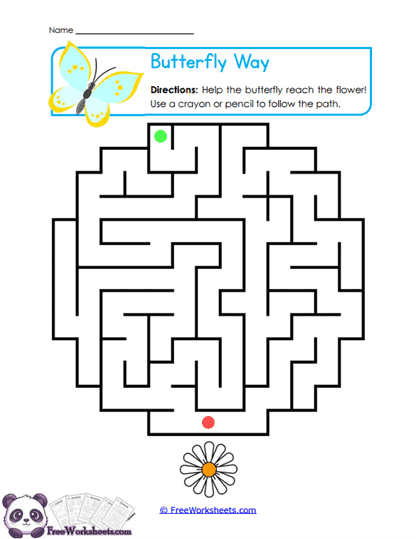
Butterfly Path
What Kids Do:
Children guide a butterfly through a rounded maze until it reaches a flower. They begin at the top, work through interior passageways, avoid following the outside edge, and choose among several turns before reaching the finish.
Target Skill:
The worksheet strengthens visual tracking and spatial reasoning within an unusual maze shape. Children practice distinguishing connected passages from surrounding boundaries while improving corner control, route planning, and steady pencil movement.
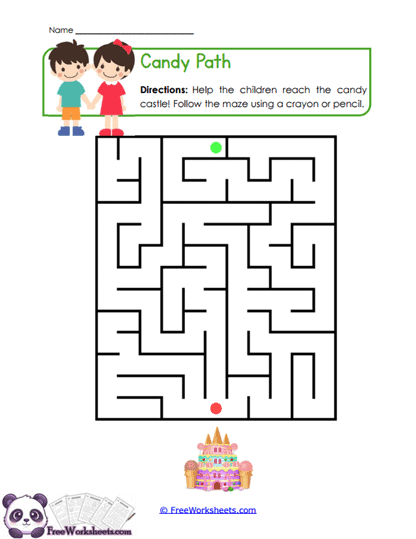
Candy Maze
What Kids Do:
Children help two characters travel through a maze toward a colorful candy castle. They follow open passages from the green starting point, avoid blocked sections, make repeated turns, and return to earlier choices when a route fails.
Target Skill:
This activity develops early planning, attention, and maze-solving persistence while reinforcing fine motor control. Children learn to scan before moving, remember previous choices, and guide a pencil through narrow passages without rushing across walls.
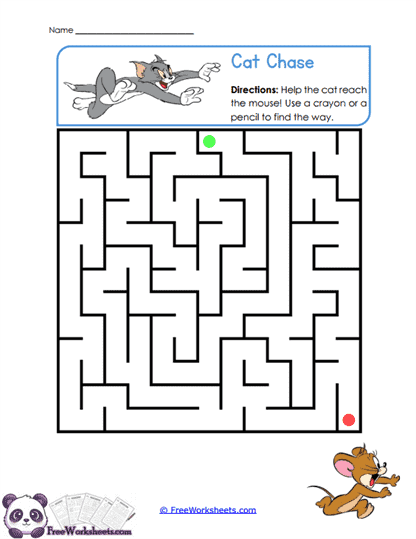
Cat Chase
What Kids Do:
Children begin at a green dot and guide a cat through a maze toward a red dot near a mouse. They choose between possible pathways, navigate corners, recognize dead ends, and keep their pencil inside the open maze spaces.
Target Skill:
This beginner maze activity strengthens pencil control, hand-eye coordination, and visual planning. Children practice looking ahead before making a turn and learn that changing direction or backtracking is part of solving a visual problem.
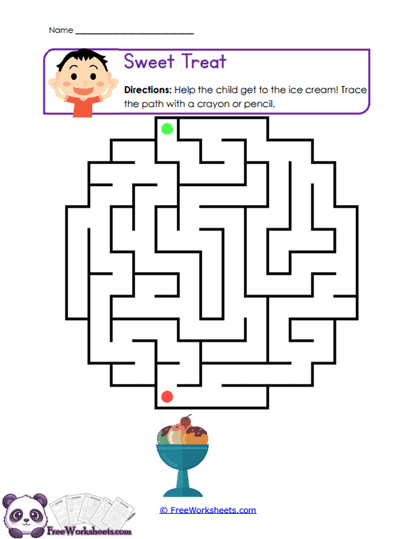
Ice Cream
What Kids Do:
Children guide a character through a maze toward an ice cream treat at the bottom of the page. They follow connected horizontal and vertical paths, stop at intersections, choose an open direction, and avoid drawing directly toward the reward.
Target Skill:
The worksheet develops controlled turning, visual scanning, and simple route decision-making. Children practice keeping their attention on the maze structure rather than the destination while strengthening the pencil movements needed for later writing tasks.
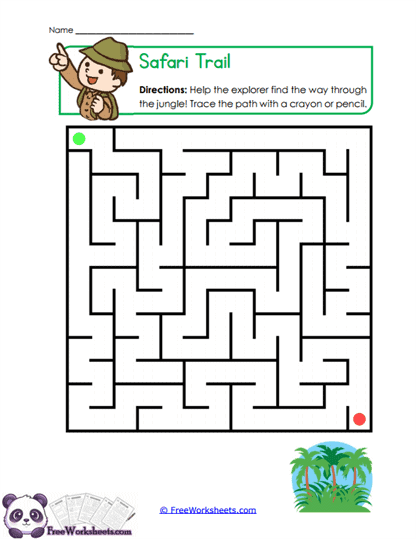
Jungle Trail
What Kids Do:
Children help an explorer find a route through a larger jungle maze. They begin at the green dot, work through many branching paths, solve one section at a time, and backtrack when a route ends before reaching the red finish.
Target Skill:
This activity offers more advanced visual-planning practice by requiring children to manage several possible routes. It strengthens concentration, spatial awareness, problem solving, and controlled pencil movement across a maze with more decision points.
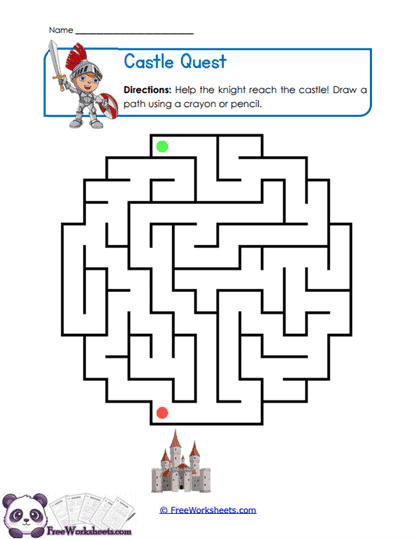
Knight Journey
What Kids Do:
Children guide a knight through a maze toward a castle. They move from the green starting dot through open spaces, pause before turns, avoid blocked passages, and try a different direction whenever a route leads to a dead end.
Target Skill:
The worksheet strengthens route planning, visual attention, and careful corner movement. Children practice using trial and error constructively while coordinating their eyes and hands to remain within the maze boundaries.
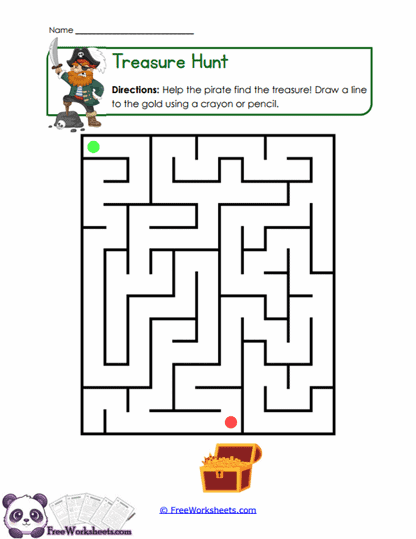
Pirate Treasure
What Kids Do:
Children help a pirate navigate from the green starting point toward a treasure chest near the red finish. They follow open passageways, make careful turns, avoid maze walls, and backtrack whenever the path they selected becomes blocked.
Target Skill:
This activity combines fine motor control with early strategic thinking. Children strengthen pencil accuracy, visual scanning, and persistence while learning to compare route options and adjust their plan instead of continuing into an incorrect path.
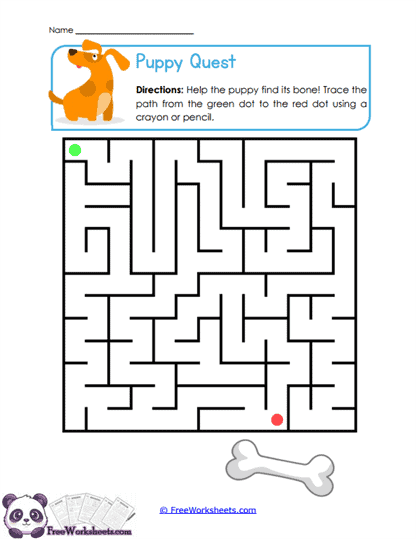
Puppy Path
What Kids Do:
Children guide a puppy through a rectangular maze until it reaches its bone. They move through straight paths and sharp turns, watch for blocked sections, and retrace their route when necessary instead of crossing through the maze walls.
Target Skill:
The worksheet develops horizontal and vertical pencil control, careful turning, and simple route memory. Children also practice pausing at decision points and using visual information to determine whether a pathway continues or ends.
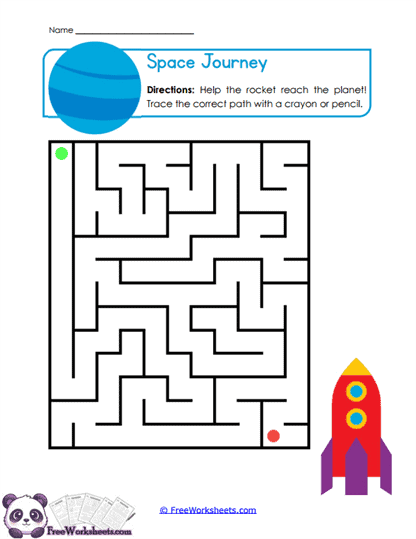
Rocket Route
What Kids Do:
Children help a rocket travel through a maze toward its destination. Starting at the green dot, they move through horizontal and vertical passages, stop at intersections, choose the next open path, and continue until they reach the red finish.
Target Skill:
This activity strengthens visual scanning, path planning, and controlled fine motor movement. Children practice resisting the urge to draw directly toward the goal and instead follow the actual maze structure one section at a time.