
Shape Tracing Worksheets
Shape tracing for preschool fine motor skills helps young children practice circles, squares, triangles, and other forms while building controlled pencil movements. These free, ready-to-print PDF worksheets are prepared for immediate classroom use, fine motor centers, homeschool lessons, quiet work, or practice at home. Children strengthen shape recognition, pencil control, and visual-motor coordination while working toward important preschool fine motor goals.
About This Collection of Worksheets
Shape tracing gives preschool children a practical way to connect early geometry with fine motor development. Circles encourage smooth continuous movement, squares require straight sides and clear corners, and triangles add angled strokes and sharper turns. Repeatedly following these outlines helps children become more comfortable controlling a pencil or crayon while also learning what makes each shape visually distinct.
This collection moves beyond simple tracing by asking children to work with shapes in several different ways. They trace basic outlines, practice circles around familiar objects, connect colors with triangles, match shapes to real-world pictures, finish incomplete forms, trace and color, draw shapes independently, continue patterns, build a rocket from shapes, copy models, adjust movements for different sizes, and complete a final tracing review.
Teachers can use these worksheets during preschool shape units, fine motor centers, handwriting-readiness activities, small groups, or independent practice. Parents and homeschool educators can begin with large guided shapes before moving toward partial outlines, smaller forms, patterns, and independent copying. Because the activities gradually reduce support, the collection also makes it easier to see when a child is ready to move from tracing toward drawing shapes without a guide.
Paul’s Teacher Tip
Have children name the shape and point to its starting place before they begin tracing. For circles, encourage one smooth movement all the way around until the line closes; for squares and triangles, remind children to slow down at each corner before changing direction. Finger tracing can help children feel the path before they use a pencil or crayon. As shapes become smaller, encourage shorter and more controlled hand movements rather than using the same broad motion. When children begin copying shapes independently, focus on whether they remember the basic structure instead of expecting a perfect drawing.
Worksheet Collection Skill Spotlights
Circle Tracing
What Kids Do:
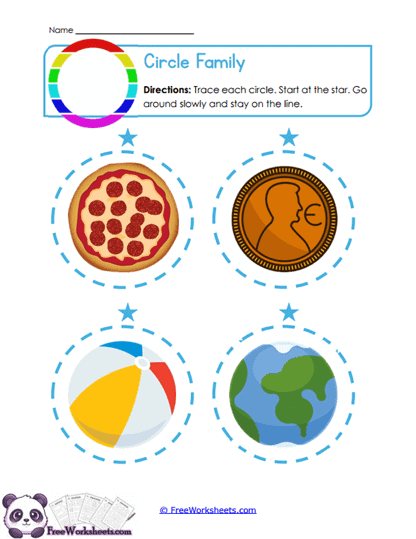
Children trace four large circles placed around familiar round objects such as a pizza, coin, beach ball, and Earth. They begin at a marked star, follow each dashed curve all the way around, and try to return to the starting point without leaving a large gap.
Target Skill:
This activity strengthens smooth circular motion, shape closure, and hand-eye coordination. Children also connect the abstract idea of a circle with real-world objects while developing the curved pencil movements used later in drawing and writing rounded forms.
Color Triangles
What Kids Do:
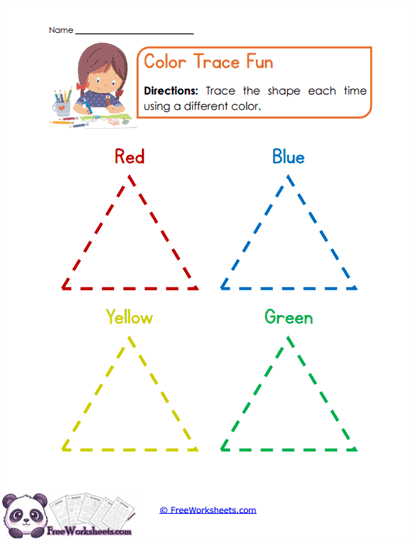
Children trace four large triangles labeled with different colors, including red, blue, yellow, and green. They follow each angled side, pause at the corners, complete all three edges, and can say the color name while tracing each shape.
Target Skill:
The worksheet develops control over diagonal lines and pointed turns while reinforcing triangle recognition and basic color vocabulary. Repeated practice helps children learn to stop at corners, change direction deliberately, and close an angular shape accurately.
Pattern Shapes
What Kids Do:
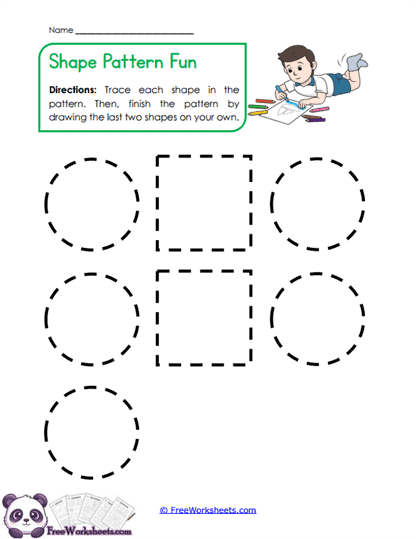
Children trace a repeating circle-and-square pattern and study the order of the shapes as they move across the row. In the unfinished section, they decide which shapes come next and draw the missing forms independently to complete the sequence.
Target Skill:
This activity combines fine motor practice with early pattern recognition and sequencing. Children strengthen visual attention, memory, shape discrimination, and motor planning while switching between rounded circle movements and straight-sided square movements.
Rocket Shapes
What Kids Do:
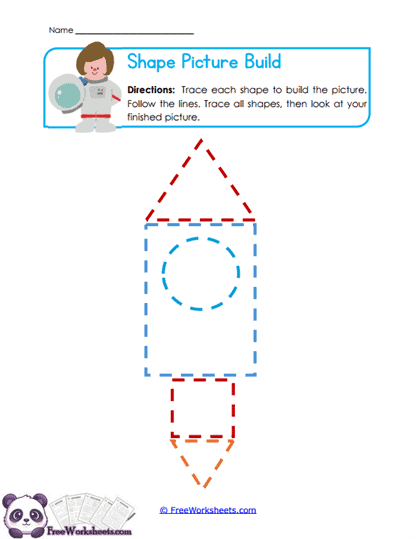
Children trace the individual geometric shapes that combine to form a rocket, including a triangle, rectangle, circle, square, and smaller angled pieces. After tracing each section, they look at the completed picture and identify the different shapes used to build it.
Target Skill:
The worksheet develops shape recognition and visual construction while giving children varied practice with curves, corners, straight lines, and angled sides. It also helps them understand that larger familiar objects can be created from several simple geometric forms.
Shape Copying
What Kids Do:
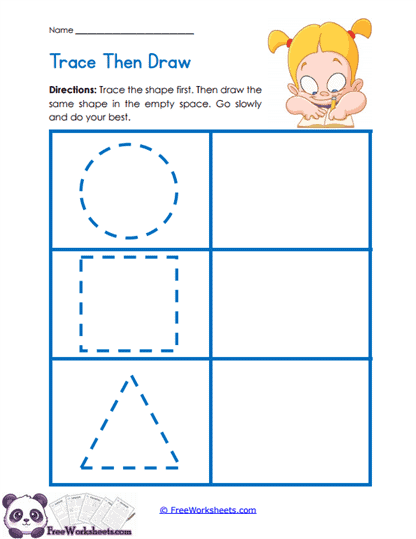
Children trace a circle, square, and triangle shown in the left column, then move to the blank box beside each model and draw the same shape independently. They can look back at the traced example whenever they need help remembering the form.
Target Skill:
This activity moves children from guided tracing toward independent drawing. They strengthen visual memory, motor planning, spatial awareness, and pencil control by studying a model and recreating its overall structure without relying on a dashed outline.
Shape Drawing
What Kids Do:
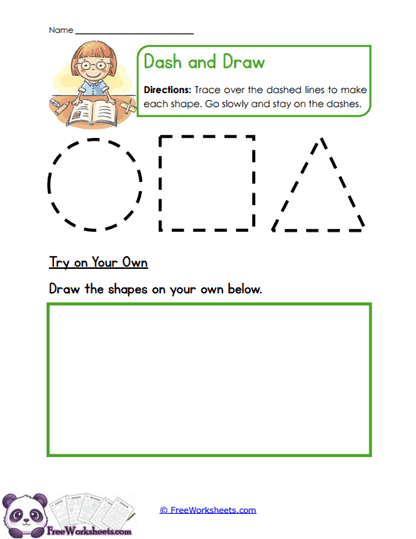
Children first trace a circle, square, and triangle using dashed guides at the top of the page. They then use a larger blank area to draw the same three shapes on their own, referring back to the models whenever needed.
Target Skill:
The worksheet helps children transfer familiar tracing movements into freehand shape formation. It develops visual recall, independent motor planning, confidence with pencil use, and understanding of the curves, sides, and corners that define each basic shape.
Shape Finish
What Kids Do:
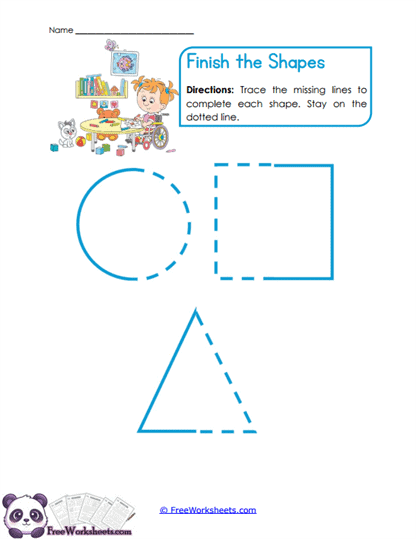
Children examine partially completed circles, squares, and triangles and identify which dashed section is missing from each outline. They trace only that missing portion and connect it smoothly with the solid lines already provided to complete the full shape.
Target Skill:
This activity strengthens visual planning and understanding of whole-shape structure. Children learn to recognize what part of a familiar form is absent, control a targeted pencil movement, and connect new strokes accurately with existing lines.
Shape Matches
What Kids Do:
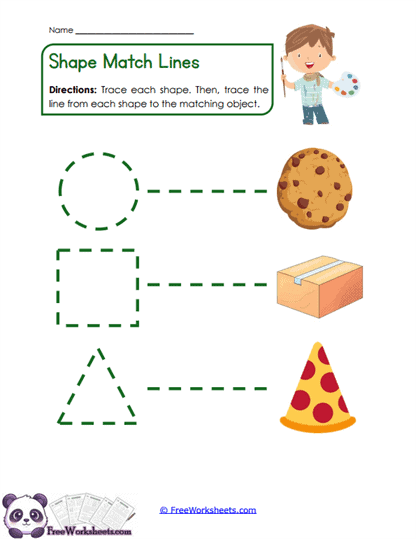
Children trace a circle, square, and triangle and then look across the page for a familiar real-world object with the same basic shape. They draw a line from each traced form to its matching picture after deciding which object belongs with it.
Target Skill:
The worksheet combines shape tracing with visual discrimination and real-world classification. Children strengthen pencil control while learning to recognize the defining features of basic shapes even when those forms appear inside everyday objects.
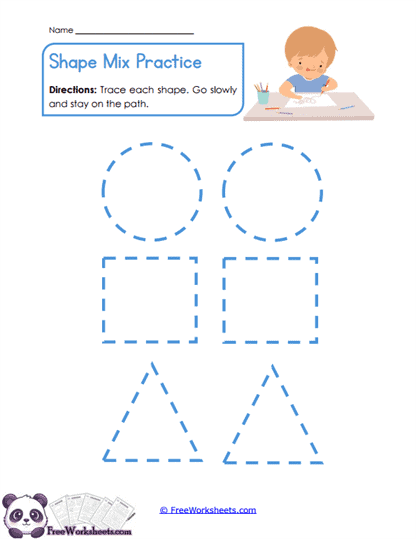
Shape Review
What Kids Do:
Children trace two circles, two squares, and two triangles arranged in clear rows. They complete each outline from beginning to end, compare repeated attempts, and name the shapes as they work through the page.
Target Skill:
This review activity reinforces the main tracing movements used throughout the collection. Children practice smooth curves, straight sides, angled strokes, shape closure, and controlled corners while building consistency and confidence through repetition.
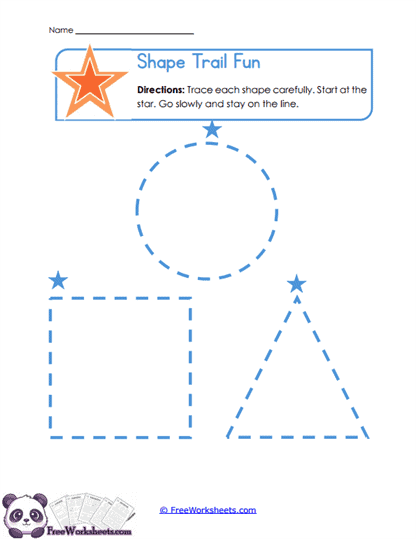
Shape Trails
What Kids Do:
Children trace a large circle, square, and triangle, beginning at a star that marks where each path starts. They move carefully around the dashed outlines, adjusting their hand movement for curves, straight sides, corners, and slanted edges.
Target Skill:
This introductory activity builds basic shape recognition and pencil-path control. Children learn that different shapes require different movements while practicing how to begin at a clear starting point, follow a boundary, and return to where the shape closes.
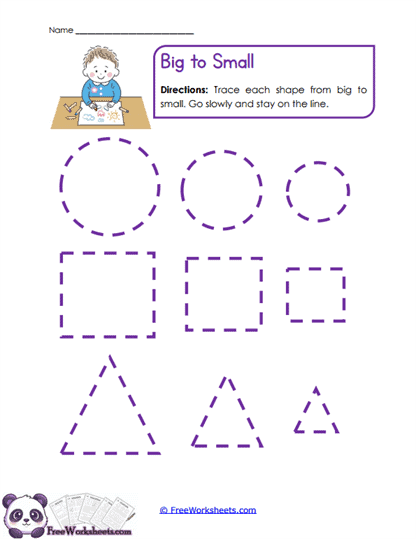
Size Tracing
What Kids Do:
Children trace circles, squares, and triangles shown in large, medium, and small sizes. They begin with broader outlines and then adjust their hand movements as each version becomes smaller and requires more precise control.
Target Skill:
The worksheet strengthens fine motor flexibility and early size comparison. Children learn to scale their movements to fit the available space while reinforcing shape recognition and understanding descriptive size words such as big, medium, and small.
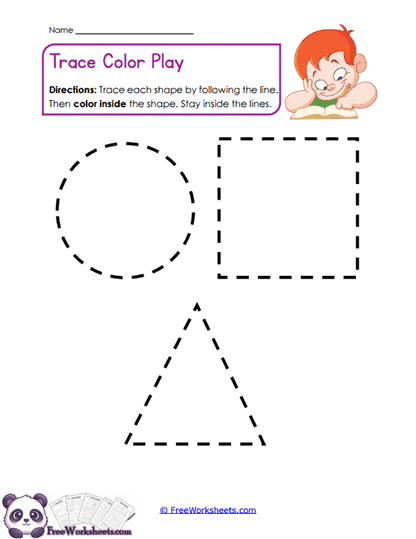
Trace Coloring
What Kids Do:
Children trace a large circle, square, and triangle and then color inside each completed outline using colors of their choice. They first focus on following the dashed boundary and then switch to broader coloring strokes while trying to remain inside the traced shape.
Target Skill:
This activity combines precise line tracing with crayon control and boundary awareness. Children strengthen hand muscles, visual-motor coordination, and shape recognition while learning to adjust between careful edge work and larger movements inside an enclosed area.