
Addition Up to 10 Worksheets
These Preschool Early Math worksheets introduce Addition Up to 10 through counting, visual models, drawing, matching, and simple number sentences. Every activity is Free, Ready-to-print, available in PDF format, and designed for Immediate classroom use. Children strengthen counting, number recognition, addition fluency, and early problem-solving skills aligned with beginning Common Core addition concepts.
About This Collection of Worksheets
This collection helps preschool children understand how two groups can be joined to make a larger total. Learners count shapes, pictures, dots, marks, and familiar objects while keeping every answer within 10. The visual support makes addition easier to understand because children can see what is being combined instead of relying only on written numbers.
The worksheets give children many ways to practice the same core skill. Some pages ask learners to write totals, while others use drawing, matching, multiple-choice answers, picture stories, framed marks, missing parts, or color keys. This variety keeps practice interesting while helping children recognize addition in several different forms.
These printable activities work well during math centers, small-group instruction, homeschool lessons, early intervention, and short independent practice. The collection builds toward Common Core kindergarten skills involving representing addition with objects, pictures, drawings, and equations, while also introducing simple addition stories and missing-addend ideas. As children become more comfortable with totals up to 10, they are better prepared for less visual addition work later.
Paul’s Teacher Tip
Let children use their fingers, counters, or small objects before expecting them to solve every problem on paper. When picture groups become larger, encourage them to point to each item so they do not skip or count something twice. Ask the child to say the total aloud before writing, circling, matching, or coloring an answer. For missing-part problems, use the phrase, “You have this many. How many more do you need?” Most importantly, keep the focus on understanding how groups join rather than rushing to finish the page.
Worksheet Collection Skill Spotlights
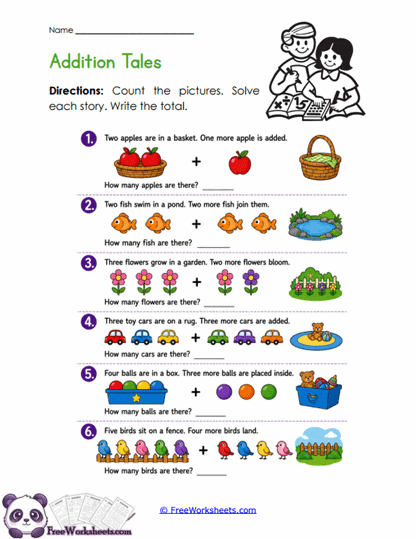
Addition Stories
What Kids Do: Children listen to or read short addition situations involving familiar objects such as apples, fish, flowers, cars, balls, and birds. They count what was there first, add the new group, and write the total.
Target Skill: This activity connects addition with everyday situations and useful math language such as more, added, and altogether. Children begin preparing for simple word problems while still having picture support to guide their counting.
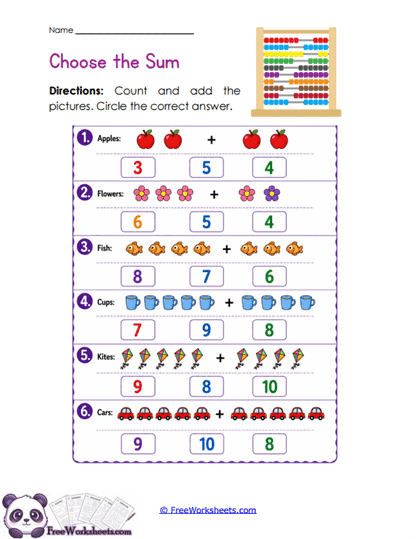
Answer Picks
What Kids Do: Children count two picture groups, combine them, and compare the total with three printed answer choices. They circle the numeral that correctly represents the sum for each problem.
Target Skill: Learners strengthen addition and number recognition without needing to write every answer. The multiple-choice format provides support while still requiring children to count carefully and understand that both groups must be combined.
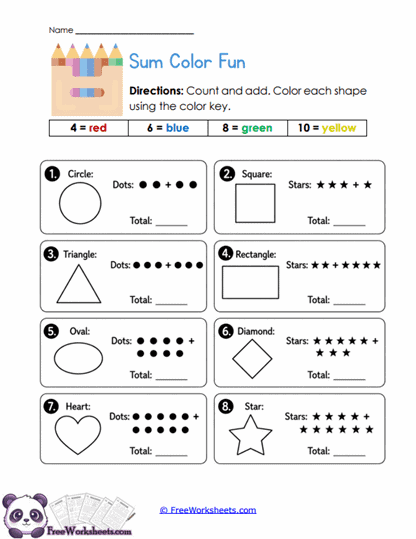
Color Sums
What Kids Do: Children count groups of dots or stars, find each total, and then use a color key to determine how a matching shape should be colored. The page combines math with a simple puzzle-like coloring task.
Target Skill: This worksheet develops addition, number matching, shape recognition, and direction-following. Children practice completing the math first and then using the total as information for the next step.
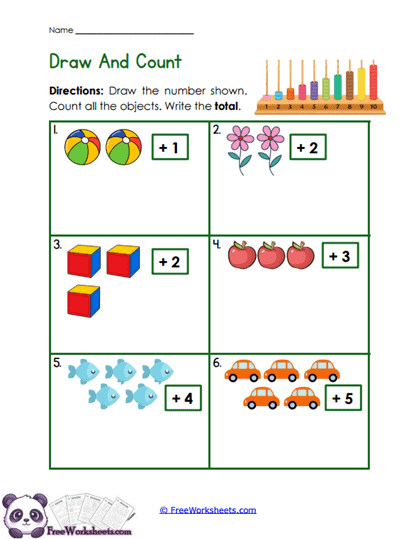
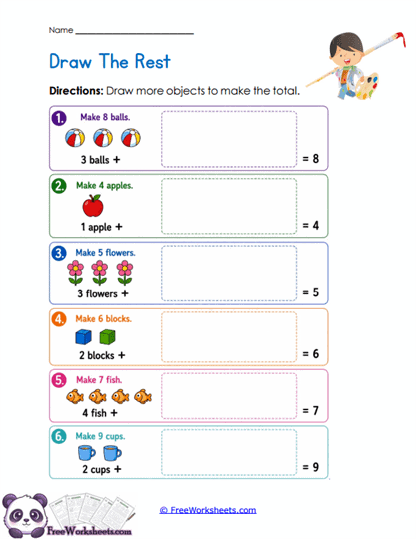
Draw Counts
What Kids Do: Children look at a starting group and a number showing how many more objects should be added. They draw the extra amount themselves and then count the full group to find the new total.
Target Skill: This activity shows addition as an action that makes a group larger. Drawing the added objects strengthens counting, early addition understanding, and fine-motor control while helping children see exactly what “more” means.
Finish Totals
What Kids Do: Children count the objects already shown, look at a target total, and figure out how many more items are needed. They draw only the missing amount and then recount the complete group to check their work.
Target Skill: Learners begin understanding that a whole can be made from two smaller parts. This is an early step toward missing-addend equations such as 3 + __ = 8 and builds flexible number sense within 10.
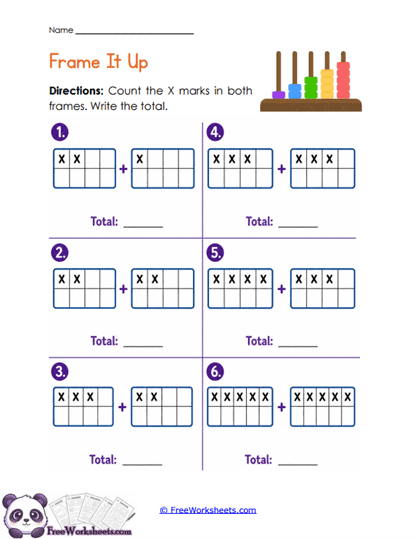
Frame Totals
What Kids Do: Children count X marks arranged inside two separate frames, combine the groups, and write the sum. The organized boxes help them keep track as the quantities become larger.
Target Skill: This page bridges loose picture counting and more structured visual math models. Children practice counting only the marked spaces, continuing across two groups, and connecting an organized model with an addition total.
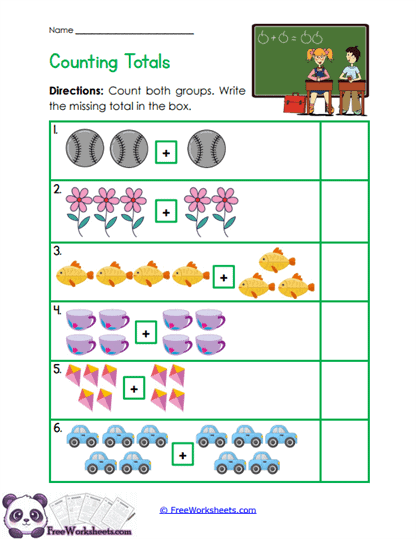
Group Totals
What Kids Do: Children count two groups of familiar pictures, join the amounts mentally, and write the total in a large answer box. Six repeated problems give them practice with the same process using different objects.
Target Skill: Learners strengthen one-to-one counting, combining quantities, number recognition, and numeral writing. The consistent layout helps children focus on the core addition process rather than learning new directions.
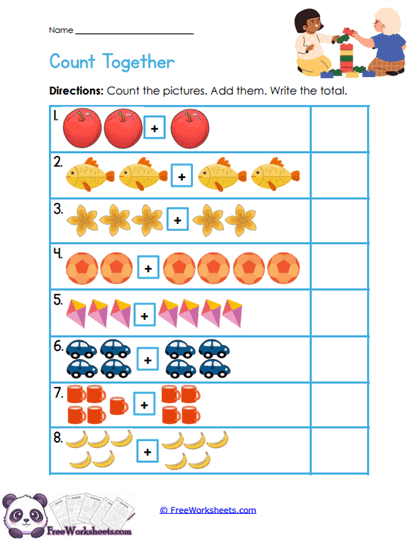
Picture Adding
What Kids Do: Children count colorful groups of apples, fish, flowers, balls, kites, cars, cups, bananas, and other familiar objects. They combine both sides of the plus sign and write each total.
Target Skill: This activity builds the basic understanding that addition joins two groups into one larger amount. Familiar pictures keep the math concrete while children practice totals that gradually extend toward 10.
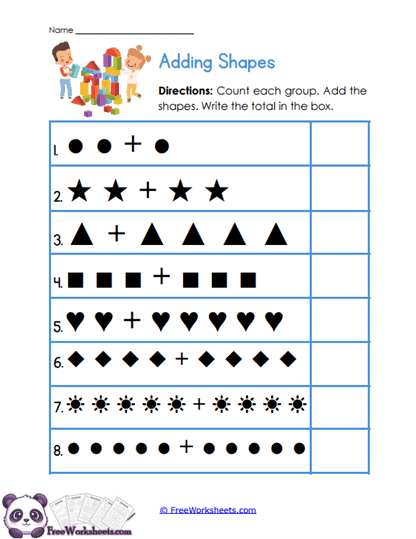
Shape Sums
What Kids Do: Children count simple shapes on both sides of a plus sign and write the combined total. Circles, stars, triangles, squares, hearts, diamonds, suns, and dots provide repeated counting practice without distracting details.
Target Skill: Learners practice careful counting and early addition with clear visual models. The simple shapes help children focus on quantity and understand that different-looking objects can still represent numbers in the same way.
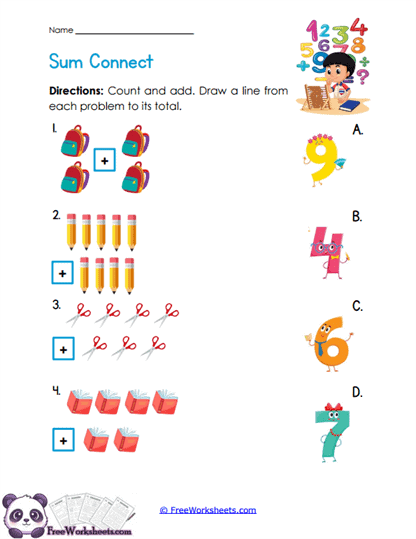
Sum Lines
What Kids Do: Children solve picture addition problems involving school-themed objects and then draw a line to the matching numeral on the opposite side of the page. They say or find the total before making each connection.
Target Skill: This worksheet connects visual sums with written number symbols. It also builds scanning and matching skills while supporting children who can recognize answers more easily than they can write them.
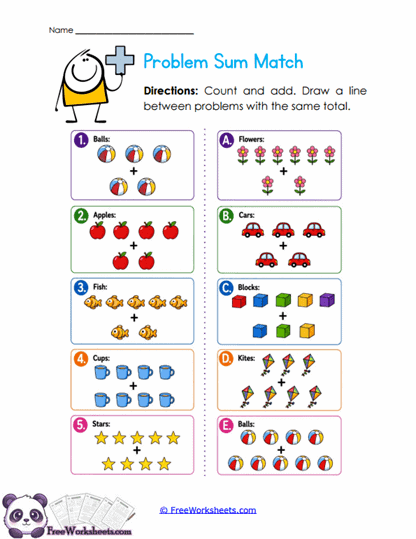
Sum Partners
What Kids Do: Children solve picture addition problems on both sides of the page and search for pairs that have equal totals. They draw connecting lines between different-looking sums that produce the same answer.
Target Skill: Learners discover that different groups and different addends can still make the same total. This builds early number flexibility and prepares children for later work with equivalent addition expressions.
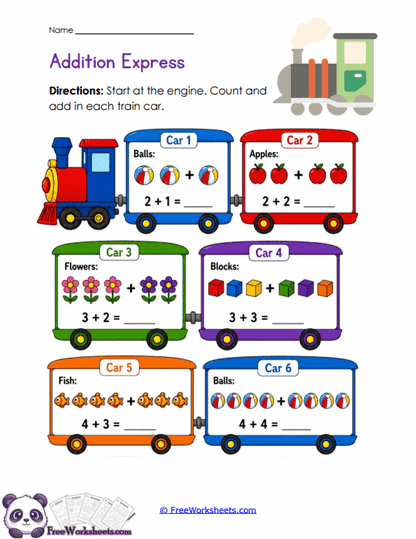
Train Sums
What Kids Do: Children move from one train car to the next, counting picture groups and comparing them with written number sentences. They complete each equation by writing the missing total after the equal sign.
Target Skill: This activity bridges picture-based addition and symbolic equations. Children connect real quantities with numerals, plus signs, and equal signs while still having strong visual support for every problem.