
Addition Up to 5 Worksheets
These Preschool early math worksheets introduce Addition Up to 5 through pictures, counting, matching, drawing, and simple number sentences. Every activity is Free, Ready-to-print, available in PDF format, and designed for immediate classroom use. Children strengthen counting, number recognition, visual addition, and early problem-solving skills aligned with beginning curriculum aligned addition concepts.
About This Collection of Worksheets
This collection helps preschoolers understand that addition means joining two small groups to make a new total. Children count familiar pictures, combine groups, choose answers, complete simple equations, and draw missing objects. The visual approach gives young learners something concrete to count before they are expected to work with numbers and symbols alone.
The worksheets offer several ways to practice the same early math idea. Some pages ask children to circle or color the correct total, while others use matching lines, picture stories, frames, drawing tasks, or missing-part problems. This variety keeps practice interesting while helping children see that addition can be shown in many different ways.
These printable activities work well during math centers, small-group instruction, homeschool lessons, early intervention, or short independent practice. Most of the pages build toward Common Core kindergarten skills involving representing addition with objects, drawings, and equations, while some begin introducing simple word problems and missing-addend thinking. Because all totals stay within 5, children can focus on understanding the meaning of addition without being overwhelmed by larger numbers.
Paul’s Teacher Tip
Let children touch or point to each picture while they count. This simple habit can prevent skipped objects and double-counting. Before introducing the worksheet, model addition with blocks, counters, toys, or fingers so the pictures connect to something children can move and see. If answer choices are provided, ask the child to say the total before looking at the choices to reduce guessing. When a learner struggles, return to the pictures and ask, “How many do we have altogether?” rather than simply giving the answer.
Worksheet Collection Skill Spotlights
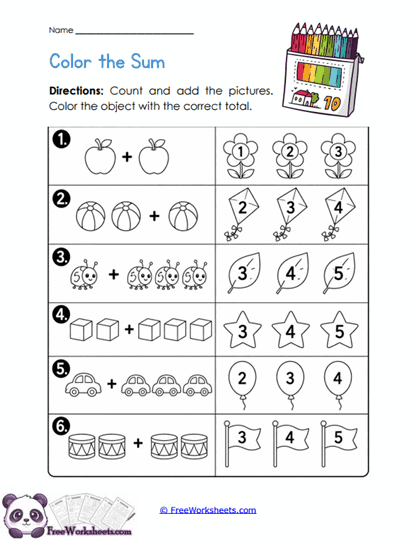
Color Totals
What Kids Do: Children count two picture groups, combine them, and then look at three numbered choices. Instead of writing the answer, they color the picture that contains the correct total, adding a simple hands-on element to early addition practice.
Target Skill: This activity strengthens counting, addition, and numeral recognition at the same time. Children practice connecting a visual quantity with its written number, which supports the early understanding needed for representing addition with pictures and symbols.
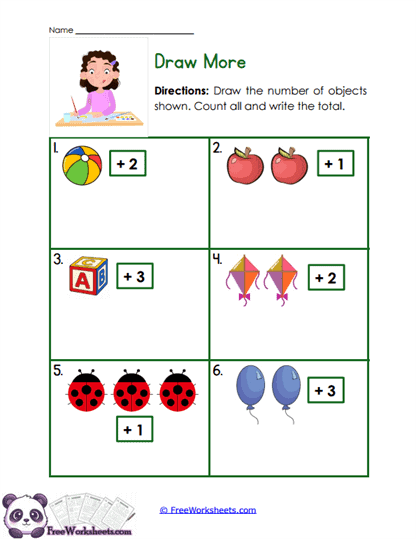
Draw More
What Kids Do: Children begin with a small group of pictured objects and follow a direction showing how many more to add. They draw the extra items themselves and then count the complete group to see the new total.
Target Skill: Learners see addition as an action that makes a group larger. Drawing the missing objects builds a concrete understanding of joining quantities while also giving preschoolers useful fine-motor and counting practice.
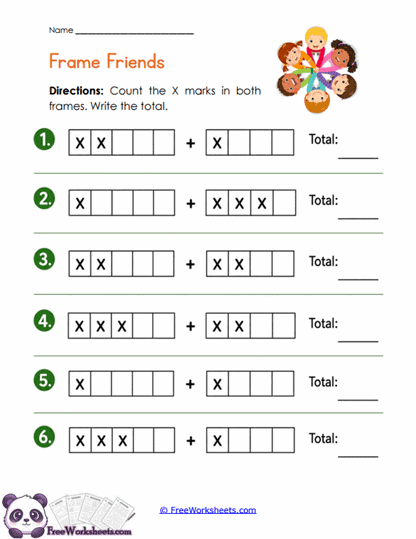
Frame Addition
What Kids Do: Children count X marks inside two separate frames, combine the quantities, and write the total. The repeated box format helps them keep track of the two groups without relying on colorful object pictures.
Target Skill: This page bridges informal picture counting and more organized visual math models. Students practice combining quantities across separate spaces while beginning to connect structured representations with written addition.
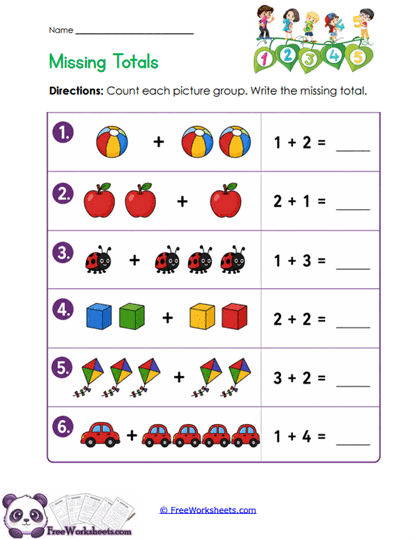
Missing Totals
What Kids Do: Children count two picture groups and compare what they see with a simple written equation. They use the total from the pictures to fill in the missing number after the equal sign.
Target Skill: Learners begin connecting objects with numerals, plus signs, equal signs, and equations. This helps move addition from a purely visual activity toward simple symbolic math while keeping picture support available.
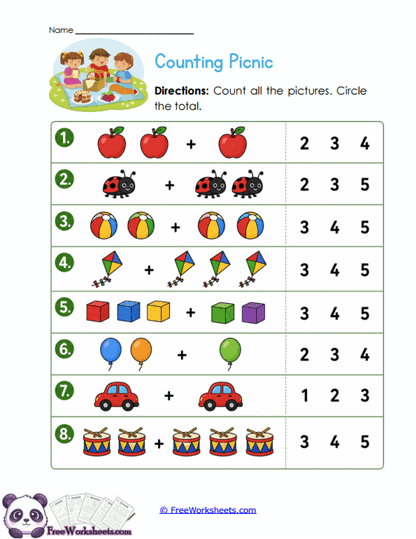
Picnic Totals
What Kids Do: Children count two groups of familiar objects, put the amounts together, and choose the correct total from three printed numbers. Apples, ladybugs, balls, kites, blocks, balloons, cars, and drums keep the counting friendly and recognizable.
Target Skill: This worksheet develops early addition alongside number recognition. The multiple-choice format supports children who understand the quantity but may not yet be confident writing numerals independently.
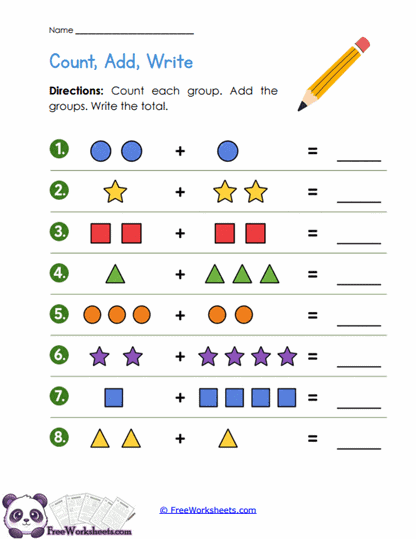
Picture Sums
What Kids Do: Children count the objects on both sides of each plus sign, combine the groups, and write the total on the answer line. The same simple structure repeats across the page so attention stays on the math.
Target Skill: This activity builds the basic idea that two quantities can be joined to make one sum. Preschoolers practice one-to-one counting, beginning addition, and writing small-number answers through 5.
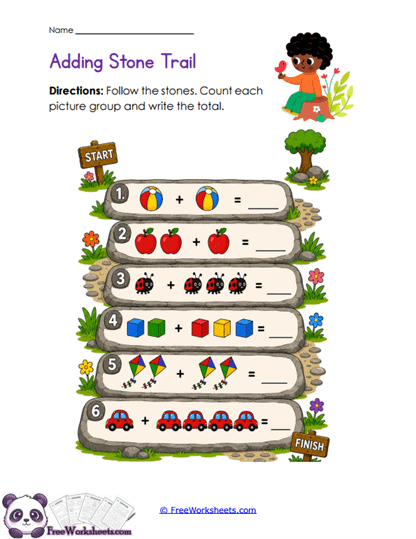
Stone Sums
What Kids Do: Children follow a decorative stone path from start to finish, solving one picture addition problem at each step. They count both groups, combine the amounts, and write the total before moving along the trail.
Target Skill: Learners strengthen addition fluency with a playful sequence that encourages steady progress. The visual path adds engagement while children repeatedly practice counting groups and recording sums.
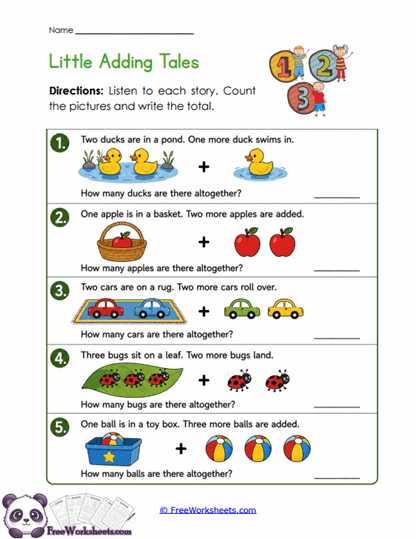
Story Sums
What Kids Do: Children listen to or read short addition stories involving familiar objects such as ducks, apples, cars, bugs, and balls. They use the pictures to find the starting amount, count what is added, and write the total.
Target Skill: This activity connects addition with real situations and simple math language such as more, added, and altogether. It builds early preparation for solving addition word problems with pictures and objects.
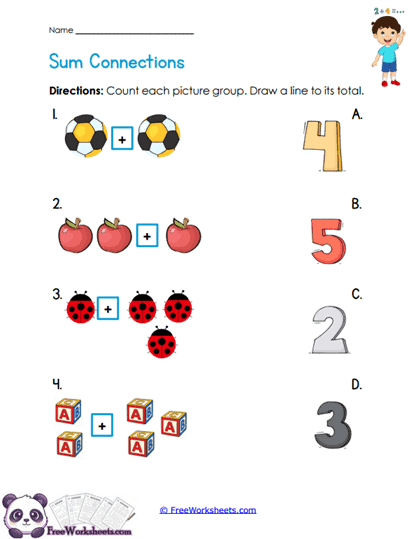
Sum Matches
What Kids Do: Children solve picture addition problems and then draw lines to the large numerals that match each total. They must count accurately and visually track the correct answer across the page.
Target Skill: Learners connect a visual addition model with its written numeral. The matching format also supports attention and number recognition without requiring children to write every answer.
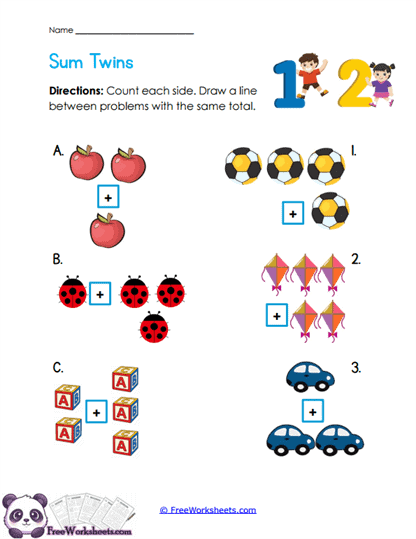
Sum Partners
What Kids Do: Children solve picture addition problems on both sides of the page and look for problems that have the same total. They draw lines between sums that are equal even when the pictures or addends look different.
Target Skill: This activity builds early number sense by showing that different combinations can make the same amount. Children begin noticing equal totals and flexible ways numbers can be composed.
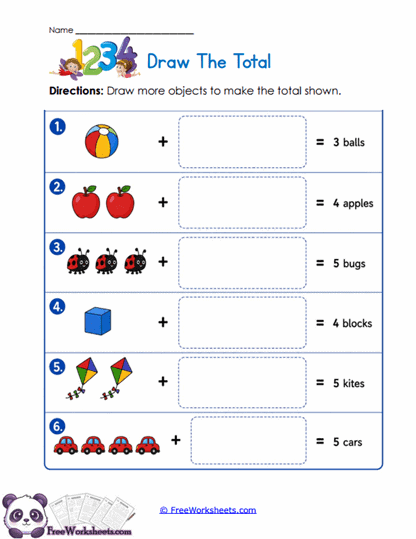
Target Drawing
What Kids Do: Children count a starting group, look at a target total, and figure out how many more objects must be drawn to reach that number. They add only the missing amount and then recount the completed group.
Target Skill: This page introduces missing-part thinking and helps children see that a total can be made from two smaller parts. It provides early preparation for missing-addend problems such as 2 + __ = 4.
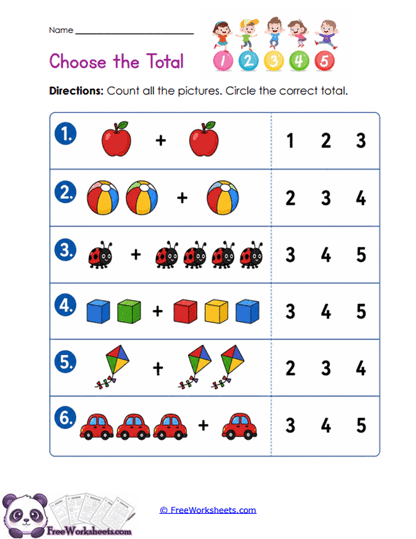
Total Choices
What Kids Do: Children count two groups of pictures, combine the quantities, and circle the correct answer from three number choices. Familiar objects and repeated rows give them several chances to practice the same addition process.
Target Skill: Learners strengthen counting, addition, and numeral recognition while receiving support from answer choices. The activity is especially useful for children whose number-writing skills are still developing.