
About This Worksheet
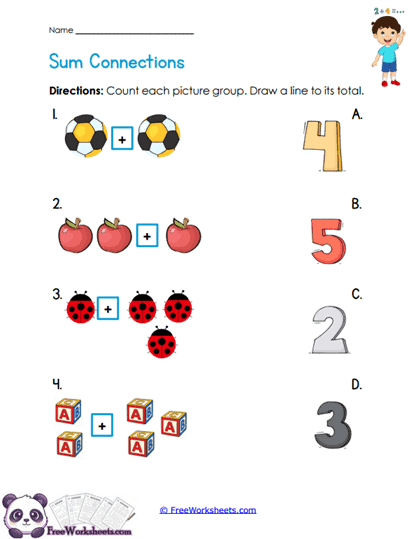
Sum Matches is a visual addition activity that teaches children to connect a picture problem with its correct total. Each problem shows two groups of familiar objects with a plus sign between them, while several large number choices appear on the other side of the page. Children count both groups, find how many there are altogether, and draw a line to the matching number. For example, 2 soccer balls together become a total of 2. This helps young learners understand that an addition problem and its answer are connected, even when the answer is placed somewhere else on the page.
Curriculum and Grade Alignment
This worksheet is designed for preschool children who are learning to combine small groups and recognize written numbers. The main goal is to help children find a sum and match that amount to the correct numeral. Before beginning, your child should be able to count small picture groups and recognize numbers from 1 through 5. The next step is writing those totals independently and solving simple addition equations without matching choices. The activity supports early work toward Common Core K.OA.A.1 by connecting visual addition models with written number representations.
Student Tasks
On this worksheet, students will count the picture groups shown on the left side of the page. They will combine the objects in each problem to figure out the total. Children then look across the page for the large number that matches their answer and draw a line between the problem and that number. The pictures include soccer balls, apples, ladybugs, and blocks, giving children familiar objects to count. This matching format lets students practice addition without needing to write every answer themselves.
Common Challenges and Misconceptions
Some children may count only the group before or after the plus sign instead of counting both groups together. Others may find the correct total but accidentally connect the problem to the wrong number because several answer choices are spread across the page. Crossing lines can also become confusing if children work too quickly. Ask your child to say the total aloud before drawing each line. It may also help to complete one problem at a time and trace the matching path slowly with a finger first.
Implementation Guidance
Teachers can use this page as a math-center activity after students have practiced joining objects with hands-on materials. The matching design also makes it useful as a quick check to see whether children can recognize an answer without needing help writing the numeral. At home, parents can have the child count the pictures aloud and point to the answer before drawing the line. If a mistake happens, go back to the pictures instead of simply telling the child the correct number. This keeps the focus on understanding how the total was found.
Details and Features
This worksheet includes four picture addition problems and four large answer choices labeled with letters. Each problem uses colorful, easy-to-count images with a clear plus sign separating the groups. The large printed numerals make answer choices easy for preschool children to recognize. Drawing connecting lines adds a simple motor activity while also checking number understanding. The clean page design gives young learners enough space to work without feeling crowded.