
Cutting Practice (Scissor Skills) Worksheets
Cutting practice for preschool fine motor skills helps young children strengthen hand control, coordination, and confidence while learning to use scissors safely. These free, ready-to-print PDF worksheets are designed for immediate classroom use, fine motor centers, homeschool lessons, intervention, or practice at home. Children strengthen scissor control, bilateral coordination, and visual tracking while working toward important preschool fine motor goals.
About This Collection of Worksheets
Learning to use scissors takes much more than simply opening and closing the blades. Preschool children need to strengthen their hands, coordinate both sides of the body, hold and turn paper, follow printed paths, and learn when to stop or change direction. This collection introduces those skills gradually so children can move from tiny snips and straight lines toward curves, corners, full shapes, and more involved cut-and-paste activities.
The worksheets offer a thoughtful mix of cutting paths and hands-on challenges. Children make short fringe snips, follow long straight roads, cut ladder lines, separate matching strips, trace waves and rainbow curves, work through a spiral, navigate zigzags and mountain paths, cut around complete shapes, and finish with a shape-matching activity that adds pasting and visual discrimination. The progression gives young learners practice with both simple repeated movements and increasingly controlled turns.
Teachers can use these pages in preschool fine motor centers, scissor-skill lessons, morning work, small groups, or craft preparation. Parents and homeschool educators can choose an activity based on the child’s current comfort level, beginning with short snips before moving toward longer or more complicated paths. Because each worksheet focuses on a specific type of movement, adults can easily identify which skill needs more practice without overwhelming beginning cutters.
Paul’s Teacher Tip
With preschool scissor practice, focus on control before accuracy. Make sure children use child-safe scissors, keep the thumb pointing upward, and let the helping hand turn the paper while the cutting hand stays relatively steady. Begin with short snips and straight paths before introducing curves, corners, and full shapes. If a child’s hand becomes tired, stop and return later rather than encouraging rushed cutting. For tricky paths, tracing the line first with a finger can help children understand where the scissors need to travel.
Worksheet Collection Skill Spotlights
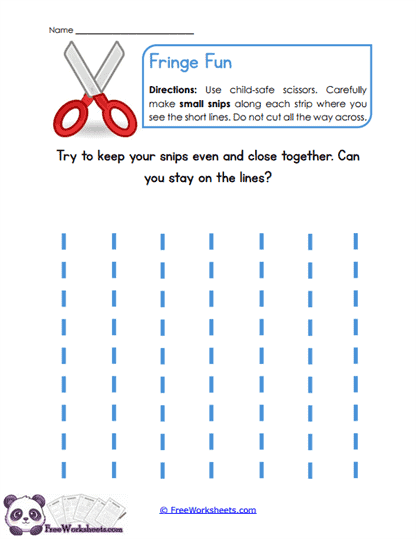
Fringe Snips
What Kids Do:
Children make a series of short cuts along small vertical lines rather than cutting all the way across the paper. They practice opening and closing child-safe scissors, stopping at the end of each printed line, and moving systematically from one snip to the next.
Target Skill:
This beginner activity develops the basic squeeze-and-release motion needed for scissor use. Children strengthen small hand muscles, improve hand-eye coordination, and learn to control where a cut begins and ends before tackling longer cutting paths.
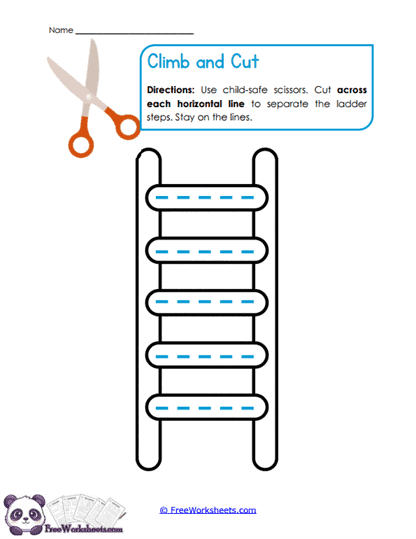
Ladder Cuts
What Kids Do:
Children cut across the short horizontal lines that form the rungs of a large ladder. They begin at one side of each rung, follow the dashed path, stop at the opposite edge, and reset their hands before moving down to the next cutting line.
Target Skill:
This worksheet helps children progress from tiny snips to short straight cuts that require several controlled scissor movements. The repeated horizontal paths strengthen consistency, paper stabilization, and the ability to stop deliberately at a clear endpoint.
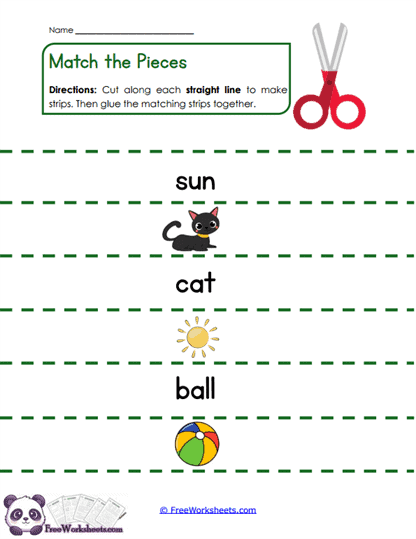
Match Strips
What Kids Do:
Children cut along straight dashed lines to separate several word and picture strips, then compare the pieces and match each word with its corresponding picture. After matching, they can glue the correct pairs together to complete the activity.
Target Skill:
The page combines straight-line cutting with visual matching, early vocabulary, and multi-step task completion. Children strengthen scissor control while also practicing how to keep loose pieces organized, compare information, position materials, and use glue carefully.
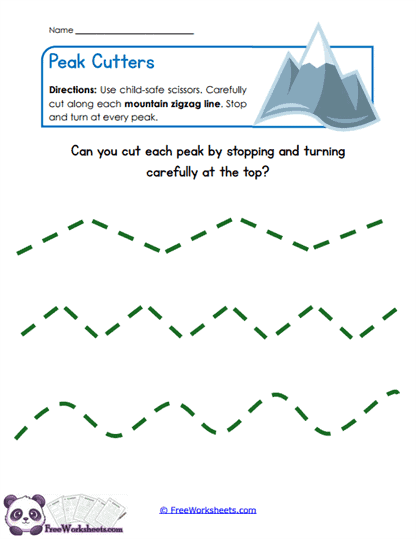
Mountain Turns
What Kids Do:
Children follow several mountain-style cutting trails that include both pointed peaks and gentler curved sections. They stop and turn the paper at sharper corners, then switch to smoother continuous movements when the path becomes rounded.
Target Skill:
This activity teaches children to adjust their cutting technique when the line changes shape. They practice corner turns, curved motion, visual tracking, and bilateral coordination while learning that different paths require different hand and paper movements.
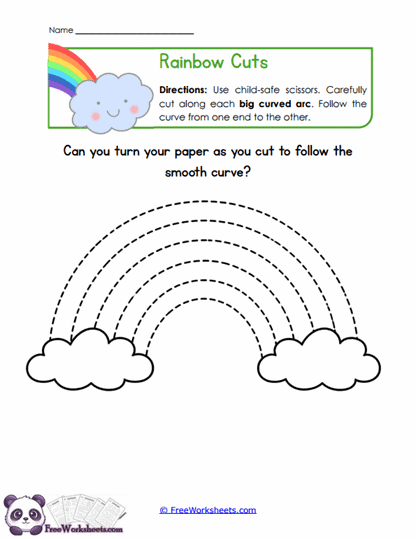
Rainbow Curves
What Kids Do:
Children cut along large rainbow-shaped arcs from one side of the page to the other. They begin with broad curves and gradually work through smaller arcs, turning the paper gently as the cutting path bends.
Target Skill:
The worksheet develops smooth curved cutting and coordinated use of both hands. Children learn to keep the scissors moving forward while the opposite hand rotates the page, an important skill for later cutting circles, rounded pictures, and curved craft pieces.
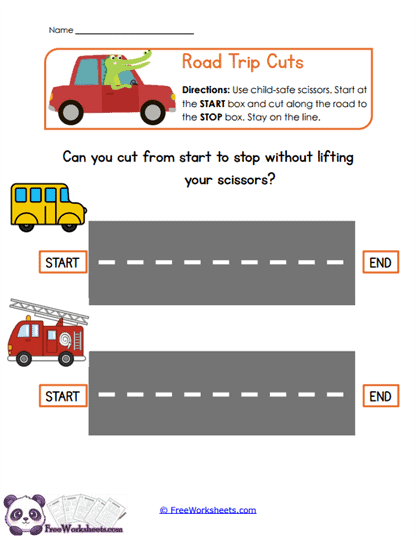
Road Cutting
What Kids Do:
Children begin at a clearly marked START box and cut along two dashed road paths until reaching the END box. The school bus and fire truck themes turn the cutting task into a simple journey while encouraging children to follow the complete path in order.
Target Skill:
This page strengthens continuous straight-line cutting, attention, and beginning-to-end sequencing. Children practice maintaining a forward scissor position while the helping hand steadies the paper and guides it through a longer controlled cut.
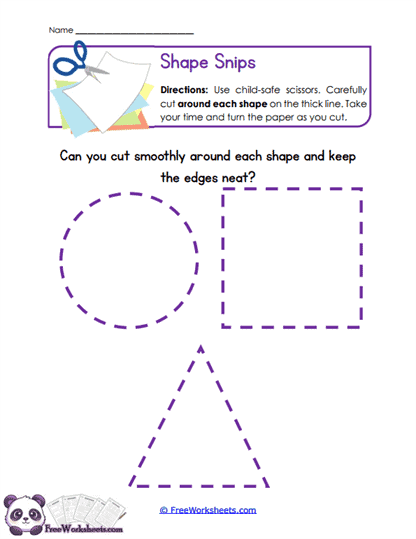
Shape Cutting
What Kids Do:
Children cut around the full outlines of a circle, square, and triangle. They use smooth turning movements around the circle and stop-and-turn motions at the corners of the square and triangle while rotating the paper as needed.
Target Skill:
This activity combines basic shape recognition with more advanced scissor coordination. Children practice maintaining a path around complete figures, handling both curved and pointed edges, and using the helping hand to position the paper throughout the cut.
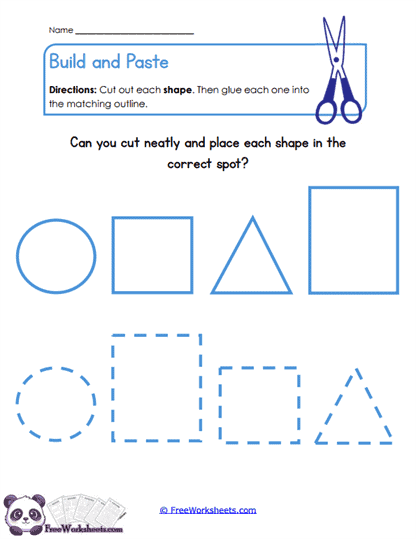
Shape Matching
What Kids Do:
Children cut out a circle, square, rectangle, and triangle, then compare each piece with matching outlines on the worksheet. Once the shapes are correctly placed, they glue each cutout into its corresponding space.
Target Skill:
The worksheet combines cutting, visual discrimination, spatial matching, positioning, and pasting in one multi-step task. Children strengthen scissor control while also learning to compare shape features and complete a hands-on activity in the correct sequence.
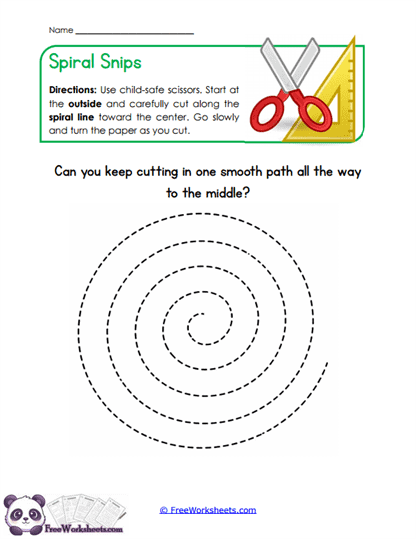
Spiral Cutting
What Kids Do:
Children start at the outside edge of one long spiral and carefully follow the dashed line toward the center. As the path becomes tighter, they pause when needed, reposition the page, and continue cutting without jumping across nearby parts of the spiral.
Target Skill:
This advanced preschool activity develops sustained scissor control, concentration, and continuous turning. Children practice making frequent small paper adjustments while following a long path that gradually demands greater precision and hand-eye coordination.
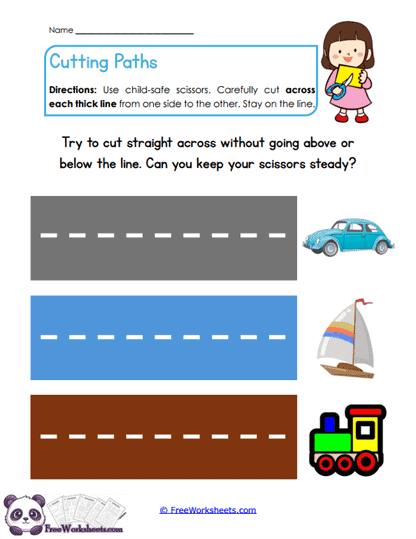
Straight Cutting
What Kids Do:
Children cut across three long road-like strips by following dashed lines from one side to the other. They repeatedly open and close the scissors while trying to stay close to each path and guide the paper steadily with the opposite hand.
Target Skill:
The activity helps children transition from single snips to longer continuous cuts. They strengthen forward scissor movement, hand endurance, paper control, and bilateral coordination while learning to maintain a straighter path across a larger section of paper.
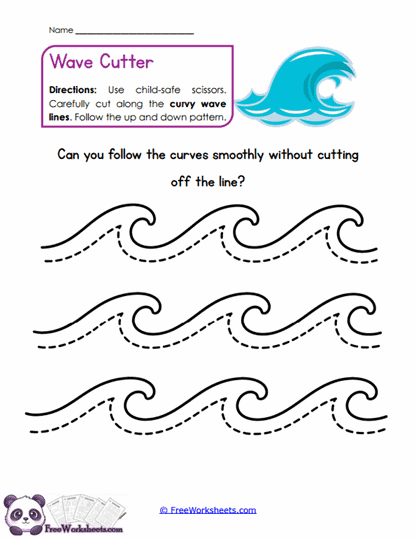
Wave Cutting
What Kids Do:
Children follow several dashed wave paths that rise and fall across the page. They move the scissors steadily forward while turning the paper little by little to stay near each smooth curve from beginning to end.
Target Skill:
This worksheet develops curved-line cutting after children have become comfortable with straighter paths. It strengthens coordinated two-hand use, gradual turning, visual tracking, and the ability to adjust direction smoothly rather than making abrupt scissor movements.
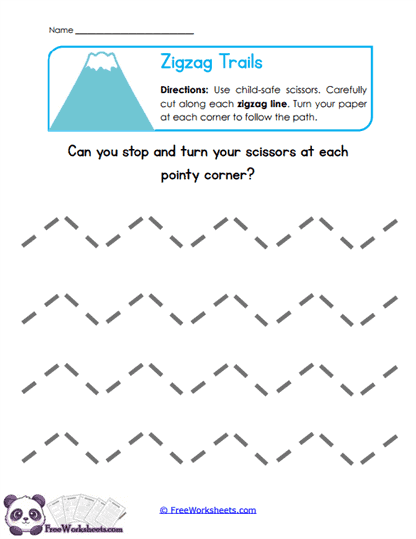
Zigzag Turns
What Kids Do:
Children cut across several zigzag trails made from repeated angled sections and sharp points. At each corner, they pause, turn the paper, and then continue along the next segment instead of rounding off the point or cutting straight through it.
Target Skill:
The activity teaches precise stop-turn-cut control needed for shapes with corners. Children strengthen visual attention, direction changes, paper rotation, and scissor accuracy while preparing for triangles, stars, and other more detailed cutting tasks.