
About This Worksheet
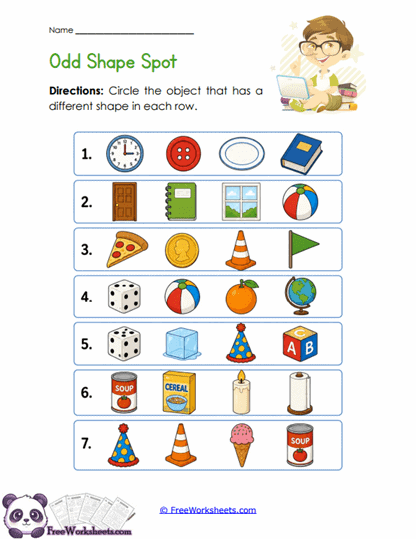
Shape Oddity is a preschool geometry activity that helps children find the one object in each row that has a different shape from the others. Each row shows four familiar items, and three of them share the same basic form while one does not. Children compare the pictures and circle the object that stands out. For example, if three objects are round and one is rectangular, the rectangle is the odd one. This helps young learners notice shape similarities inside real-world objects.
Curriculum and Grade Alignment
This worksheet is made for preschool learners who are ready to compare everyday objects by shape. The main goal is to help children recognize when several objects belong to the same shape family and identify the one that does not fit. Before using this page, your child should be familiar with basic flat and solid shapes. The next step is explaining why an object does not belong by using shape words such as round, square, rectangle, cube, or cone. This activity supports early preparation for Common Core K.G.A.2 and K.G.B.4 by helping children identify and compare shapes by their features.
Student Tasks
On this worksheet, students will study each row of four everyday objects. They will decide which three objects share a similar shape and which one is different. Children then circle the odd object in each row. Seven rows give them practice with items such as clocks, buttons, books, doors, balls, cones, dice, cans, and party hats. This builds shape recognition, comparison, classification, and visual attention.
Common Challenges and Misconceptions
Some children may choose an object because its color or purpose is different instead of looking at its shape. Others may focus on small details inside the picture and miss the overall form. A child may also struggle when both flat and solid objects appear in the same row. Encourage your child to name the basic shape of each object before choosing. Asking, “Which three are shaped alike?” can make the odd one easier to spot.
Implementation Guidance
Teachers can use this worksheet after children have practiced sorting real-world objects into shape groups. It works well in a small group because students can explain why one item does not belong. Parents can gather three similarly shaped objects and one different object at home and make a quick sorting game before beginning the page. Let your child describe what the matching objects have in common. This helps make the worksheet feel like a thinking activity instead of a guessing task.
Details and Features
This worksheet includes seven rows with four colorful real-world objects in each one. The pictures are familiar enough for preschool children to recognize and discuss. Each row focuses on shape rather than color or object use. The simple circling response keeps the activity easy to complete. The printable supports shape recognition, classification, observation, and early geometry reasoning.