
About This Worksheet
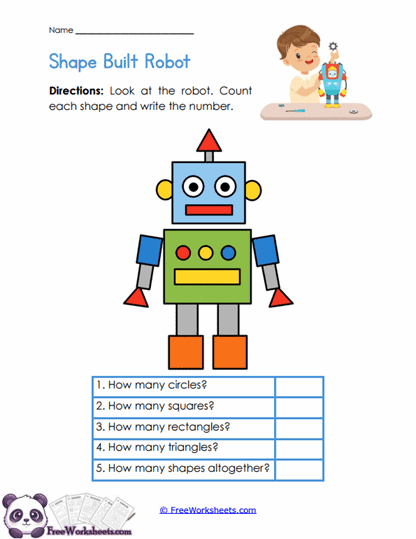
Robot Shapes is a preschool geometry and counting activity that helps children find basic shapes inside a picture of a robot. The robot is built from circles, squares, rectangles, and triangles, giving children a fun way to see how shapes can be combined to make something familiar. Children count each type of shape and write the total in the chart below. For example, the robot’s eyes and side pieces can be counted as circles, while its body parts include rectangles and squares. This helps young learners connect shape recognition with counting in one playful activity.
Curriculum and Grade Alignment
This worksheet is made for preschool learners who are ready to identify and count flat shapes inside a larger picture. The main goal is to help children recognize circles, squares, rectangles, and triangles and keep track of how many of each appear. Before using this page, your child should be able to identify these basic shapes by sight. The next step is using simple shapes to build or draw their own pictures and describing how the parts fit together. This activity supports early preparation for Common Core K.G.A.2 and K.G.B.5 by combining shape identification with composing real-world pictures from basic shapes.
Student Tasks
On this worksheet, students will study the robot and look for one type of shape at a time. They will count the circles, squares, rectangles, and triangles they can find. Children write each total in the answer chart. A final question asks how many shapes are shown altogether, giving an extra counting challenge. This builds shape recognition, counting, visual scanning, and number-writing skills.
Common Challenges and Misconceptions
Some children may count the same shape twice while moving around the robot. Others may confuse squares and rectangles because both have four sides. A child may also count decorative lines or parts that are not meant to be separate shapes. Encourage your child to search for only one shape type at a time and point to each example as it is counted. Starting with the easiest shape, such as circles, can make the page feel less busy.
Implementation Guidance
Teachers can use this worksheet after children have practiced building pictures from paper shapes or pattern blocks. It works well as a review because students must identify several shape types inside one larger design. Parents can ask the child to name the robot’s shapes before any counting begins. If needed, use a different finger or small marker to track each shape type while counting. This helps children stay organized and makes the activity more manageable.
Details and Features
This worksheet includes one large colorful robot made from several basic flat shapes and a five-question answer table. Children count circles, squares, rectangles, triangles, and then the total number of shapes. The simple robot design makes the shapes easy to see while still feeling like a real picture. Clear answer spaces provide room for preschool number writing. The printable supports shape recognition, counting, visual organization, and early geometry skills.