
About This Worksheet
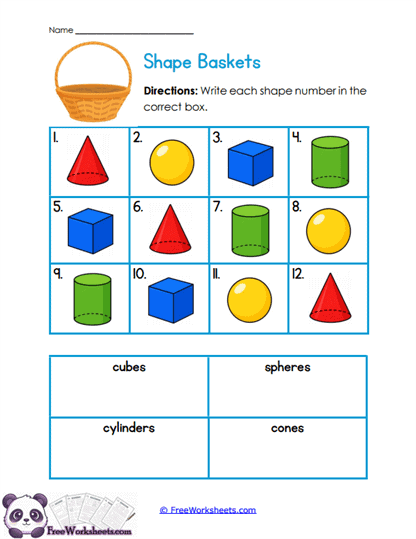
Shape Baskets is a preschool sorting activity that helps children group solid shapes by type. The page shows twelve numbered solids, including cubes, spheres, cylinders, and cones, in different colors and positions. Children look at each one and decide which shape family it belongs to. For example, a yellow round solid belongs with spheres, while a red pointed solid belongs with cones. This helps young learners practice noticing the overall form of a solid instead of relying on color.
Curriculum and Grade Alignment
This worksheet is intended for preschool learners who are ready to sort common three-dimensional shapes into groups. The main goal is to help children recognize cubes, spheres, cylinders, and cones and classify them correctly. Before beginning, your child should be familiar with these four solid-shape names. The next step is describing the features that make each solid different and finding examples in everyday objects. This activity supports early preparation for Common Core K.G.A.2 and K.G.A.3 by strengthening identification and classification of solid shapes.
Student Tasks
On this worksheet, students will look at each numbered solid shape in the grid. They will decide whether it is a cube, sphere, cylinder, or cone. Children then write the matching number in the correct basket box at the bottom of the page. Twelve examples give repeated practice with the same four shape groups. This builds classification, solid-shape recognition, number writing, and geometry vocabulary.
Common Challenges and Misconceptions
Some children may sort by color instead of by shape. Others may confuse a cylinder with a cube because both can stand upright. A child may also call a sphere a circle because it looks round in the picture. Encourage your child to say the shape name before writing the number. Comparing each picture to a real ball, box, can, or cone can make the categories easier to remember.
Implementation Guidance
Teachers can use this worksheet after children have handled real or plastic solid shapes. It works well as independent practice once the four categories are familiar. Parents can place a ball, box, can, and cone-shaped item on the table and let the child sort a few household objects first. Then move to the worksheet and use the same group names. This gives children a strong hands-on connection before they sort the pictures.
Details and Features
This worksheet includes twelve numbered solid shapes and four large sorting areas. The categories are cubes, spheres, cylinders, and cones. Different colors and positions encourage children to focus on the solid form rather than surface details. Large boxes provide plenty of room for writing the picture numbers. The printable supports classification, shape recognition, number writing, and early geometry thinking.