
About This Worksheet
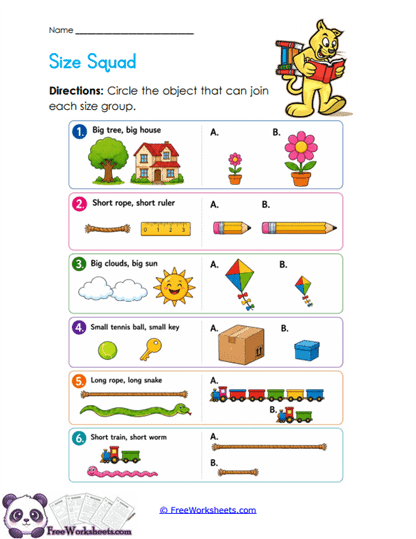
Size Groups is a preschool classification activity that asks children to choose which object fits with a group based on size. Each problem shows a pair of examples that share a size clue, such as big, small, long, or short. Children then look at two choices and decide which one belongs with that group. For example, a big tree and a big house should be matched with another big object. This helps young learners use size as a sorting rule instead of only comparing two objects.
Curriculum and Grade Alignment
This worksheet is made for preschool learners who are ready to use size words as part of a classification task. The main goal is to help children recognize a size pattern and choose the object that follows it. Before using this page, your child should understand basic words such as big, small, long, and short. The next step is sorting several objects into size groups and explaining the rule in their own words. This activity supports early measurement and classification skills at the same time.
Student Tasks
On this worksheet, students will study the example objects in each row and decide what size feature they share. They will then look at choices A and B and choose the item that matches the same rule. Children circle the correct picture. The problems use ideas such as big objects, short objects, large objects, small objects, long objects, and short objects. This gives students practice with size vocabulary, sorting, and visual reasoning.
Common Challenges and Misconceptions
Some children may focus on the type of object instead of the size rule. Others may notice color or shape and choose based on that instead. A child may also mix up words such as long and big because both can describe larger-looking objects. Encourage your child to say the size word for the example group before looking at the choices. Asking, “Which choice is also big?” or “Which one is also short?” can help keep attention on the correct feature.
Implementation Guidance
Teachers can use this worksheet after children have practiced comparing objects by size in simpler pair activities. It works well in a small group because students can explain what the examples have in common before choosing an answer. Parents can gather a few objects at home and make a simple group such as two small items, then ask the child to find another small item to join them. This makes the worksheet idea easier to understand. Talking through the rule before circling also helps reduce guessing.
Details and Features
This worksheet includes six size-based classification problems with two choices in each row. Each row gives children clear example objects before asking them to choose a matching item. The pictures are colorful and familiar, making the activity easy to discuss. A and B labels keep the answer choices organized. The printable builds size vocabulary, classification, comparison, and early reasoning skills.