
About This Worksheet
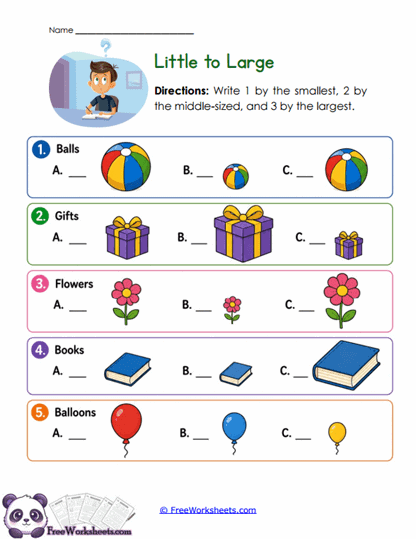
Size Order is a preschool comparison activity that helps children put three objects in order from smallest to largest. Each row shows the same kind of object in three different sizes, including balls, gifts, flowers, books, and balloons. Children study the pictures and decide which one is smallest, which is in the middle, and which is largest. For example, the tiniest ball gets 1, the middle-sized ball gets 2, and the biggest ball gets 3. This helps young learners understand that size can be ordered, not just compared as big or small.
Curriculum and Grade Alignment
This worksheet is made for preschool learners who are ready to compare more than two objects at a time. The main goal is to help children arrange three items by size using smallest, middle-sized, and largest. Before using this page, your child should be able to tell which of two objects is bigger or smaller. The next step is ordering larger groups of objects by size or length. This activity supports early measurement thinking by helping children compare and sequence objects by a visible attribute.
Student Tasks
On this worksheet, students will look at each set of three matching objects and compare their sizes. They will write 1 by the smallest picture, 2 by the middle-sized picture, and 3 by the largest picture. Five rows give children practice with balls, gifts, flowers, books, and balloons. The repeated number code keeps the directions the same from one row to the next. This gives students practice with size comparison, ordering, and number writing.
Common Challenges and Misconceptions
Some children may understand smallest and largest but have trouble choosing the middle-sized object. Others may write the numbers from left to right instead of using them to show size order. A child may also confuse 1 with biggest because they think first means best or largest. Encourage your child to find the smallest object first, then the largest, and leave the remaining one as the middle size. Comparing one pair at a time can make the task much easier.
Implementation Guidance
Teachers can use this worksheet after children have practiced sorting objects into big and small groups. It works well in a small group because adults can model how three objects can be put in size order. Parents can gather three similar household objects in different sizes and line them up before starting the page. Ask your child to point to the smallest, middle, and largest before writing any numbers. This helps separate the size thinking from the number-writing part of the activity.
Details and Features
This worksheet includes five rows with three size choices in each one. Familiar objects make the comparisons easy to understand while still giving children practice with several different examples. Blank lines beside each picture provide a clear place for writing 1, 2, or 3. The boxed rows keep each size set organized and separate. The printable builds comparison, sequencing, measurement vocabulary, and early number-writing skills.