
About This Worksheet
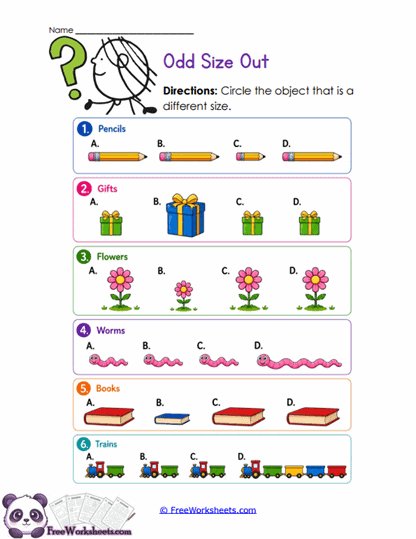
Size Oddity is a preschool comparison activity that helps children find the object that is a different size from the others in a group. Each row shows four similar objects, such as pencils, gifts, flowers, worms, books, or trains. Three pictures are about the same size, while one stands out as larger or smaller. For example, if three pencils are long and one is short, the short pencil is the odd one out. This helps young learners pay attention to size differences while keeping the object type the same.
Curriculum and Grade Alignment
This worksheet is intended for preschool learners who can already compare objects as big or small and are ready to notice a size pattern. The main goal is to help children identify which object does not match the size of the rest of the group. Before beginning, your child should be able to compare two similar objects and notice obvious differences in length or overall size. The next step is ordering several objects from smallest to largest or explaining the size rule in words. This activity supports early measurement and classification skills through visual comparison.
Student Tasks
On this worksheet, students will study each row of four matching objects. They will compare the sizes and decide which one does not fit with the other three. Children then circle the picture that is a different size. Six rows give practice with pencils, gifts, flowers, worms, books, and trains. This helps students strengthen observation, size comparison, and pattern recognition.
Common Challenges and Misconceptions
Some children may choose an object because its color or design looks different instead of comparing size. Others may notice the odd item but have trouble explaining whether it is bigger or smaller. A child may also rush before checking all four choices. Encourage your child to compare the pictures one by one and say, “These three are the same size, but this one is different.” That simple sentence can make the rule much clearer.
Implementation Guidance
Teachers can use this page after children have practiced finding the biggest and smallest object in a set. It works well in a small group where students can explain why one picture does not match the others. Parents can make a similar game at home by lining up four objects with one that is clearly larger or smaller. Ask your child to find the odd one before starting the worksheet. This makes the idea of a size pattern easier to understand.
Details and Features
This worksheet includes six rows with four similar objects in each one. Each row keeps the object type the same so children can focus only on size. Letter labels make the choices easy to discuss with an adult. The pictures are colorful and clearly separated to support careful comparison. The printable builds size recognition, observation, classification, and early reasoning skills.