
About This Worksheet
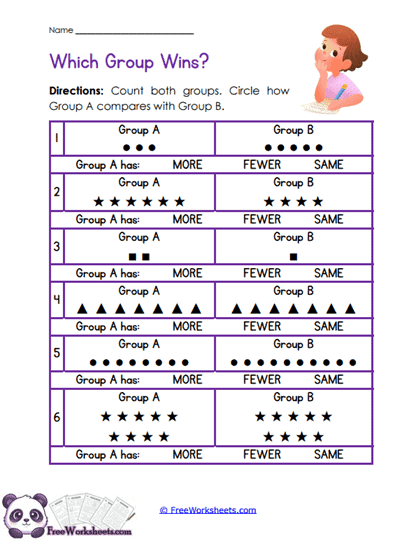
Group Compare is a preschool comparison activity that helps children decide whether Group A has more, fewer, or the same number of objects as Group B. Each row shows two small groups made with simple symbols such as dots, stars, squares, and triangles. Children count both groups and then choose the comparison word that correctly describes Group A. For example, if Group A has 3 dots and Group B has 5 dots, Group A has fewer. This helps young learners connect careful counting with the words used to compare amounts.
Curriculum and Grade Alignment
This worksheet is intended for preschool learners who are becoming comfortable counting groups through 10. The main goal is to help children compare two quantities and use the words more, fewer, and same correctly. Before beginning, your child should be able to count small groups accurately. The next step is comparing written numerals without picture support. This activity supports early preparation for Common Core K.CC.C.6, which asks children to compare groups of objects.
Student Tasks
On this worksheet, students will count the symbols in Group A and Group B for each problem. They will compare the totals and decide how Group A relates to Group B. Children then circle MORE, FEWER, or SAME. Six rows give students repeated practice with several different symbol groups. This builds counting, comparison vocabulary, and early number reasoning.
Common Challenges and Misconceptions
Some children may count both groups correctly but forget that the question is asking about Group A. Others may mix up the meanings of more and fewer. A child may also look at how much space a group takes up instead of counting the objects. Encourage your child to say a full sentence such as, “Group A has fewer than Group B.” This can make the comparison word much easier to choose.
Implementation Guidance
Teachers can use this worksheet after children have practiced comparing two groups with counters or blocks. It works well during guided math because students can explain why one group has more or fewer. Parents can count both groups with the child and say the totals aloud before choosing a word. If needed, line up small objects one to one to show whether one group has extras. This makes the comparison more concrete.
Details and Features
This worksheet includes six comparison problems with clearly labeled Group A and Group B sections. Each row offers the same three choices, MORE, FEWER, and SAME, which keeps the routine easy to learn. Simple black symbols keep attention on quantity rather than color. The table layout keeps each comparison separate and organized. The printable supports counting, quantity comparison, vocabulary, and early number sense.