
About This Worksheet
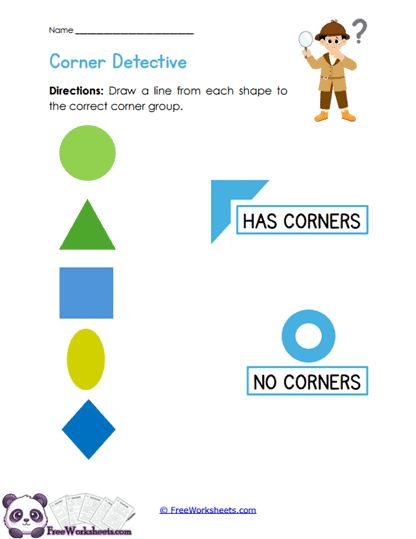
Corner Sort is a preschool geometry activity that helps children decide whether a shape has corners or no corners. The worksheet shows several shapes on one side and two clear groups on the other: HAS CORNERS and NO CORNERS. Children study each shape and connect it to the group that describes it. For example, a triangle has corners, while a circle has no corners. This helps young learners begin describing shapes by one important feature instead of only memorizing their names.
Curriculum and Grade Alignment
This worksheet is intended for preschool children who are learning to notice the parts of flat shapes. The main goal is to help children tell the difference between shapes that have corners and shapes with smooth curved edges. Before beginning, your child should be familiar with simple shapes such as circles, triangles, squares, ovals, and diamonds. The next step is counting how many corners and sides a shape has. This activity supports early work toward Common Core K.G.B.4 by helping children compare two-dimensional shapes using their visible features.
Student Tasks
On this worksheet, students will look at each shape on the left side of the page and decide whether it has corners. They will then choose between the HAS CORNERS and NO CORNERS groups. Children draw a line from each shape to the correct category. The shapes include a circle, triangle, square, oval, and diamond. This gives students repeated practice focusing on corners as the sorting rule.
Common Challenges and Misconceptions
Some children may confuse a curved point or narrow end with a true corner. Others may know the shape name but not yet understand what the word corner means. A child may also sort by color instead of checking the outline of the shape. Encourage your child to trace around each shape and stop whenever the edge changes direction sharply. Counting those stopping points together can make corners much easier to understand.
Implementation Guidance
Teachers can use this worksheet after letting children feel or trace foam shapes with their fingers. It works well as a follow-up to a lesson where students compare smooth edges with sharp corners. Parents can use household objects such as a plate and a book to show the difference before starting the page. Ask your child to point to the corners on the book and then look for corners on the plate. This makes the worksheet language much more concrete.
Details and Features
This worksheet includes five colorful shapes and two large visual sorting areas. Clear labels show children whether each shape belongs with HAS CORNERS or NO CORNERS. The open page design gives plenty of room for drawing connecting lines. Familiar basic shapes keep the task appropriate for preschool learners. The printable supports geometry vocabulary, classification, visual comparison, and feature recognition.