
About This Worksheet
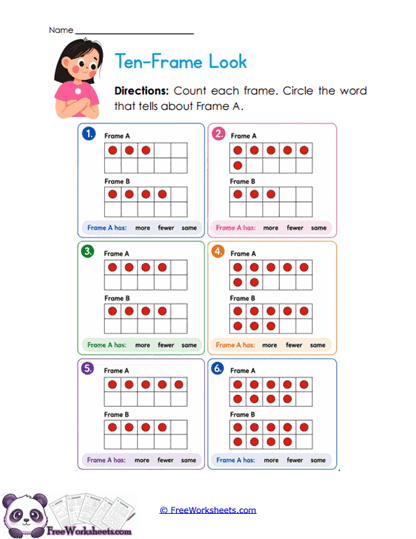
Frame Compare is a preschool math activity that uses simple ten-frames to help children compare two amounts. Each problem shows Frame A and Frame B filled with red dots, and children count how many dots appear in each one. They then decide whether Frame A has more, fewer, or the same number as Frame B. For example, if Frame A has 5 dots and Frame B has 3 dots, Frame A has more. The frame layout helps children see quantities in an organized way instead of counting scattered pictures.
Curriculum and Grade Alignment
This worksheet is made for preschool learners who are ready to compare organized groups of objects. The main goal is to help children use ten-frames to decide whether one group has more, fewer, or the same amount. Before beginning, your child should be able to count small groups and understand basic comparison words. The next step is using ten-frames to recognize quantities more quickly without counting every dot one at a time. This activity supports early preparation for Common Core K.CC.C.6 by helping children compare two groups of objects.
Student Tasks
On this worksheet, students will count the red dots in Frame A and Frame B for each problem. They will compare the two amounts and decide how Frame A relates to Frame B. Children then circle the word more, fewer, or same. Six problems give them repeated practice with the same comparison skill. The ten-frame setup also helps students begin noticing number patterns and empty spaces.
Common Challenges and Misconceptions
Some children may count the empty boxes along with the red dots. Others may mix up whether the question is asking about Frame A or Frame B. A child may also understand which side is larger but choose the wrong comparison word. Encourage your child to point only to the filled spaces while counting. Then use a full sentence such as, “Frame A has more than Frame B,” before circling the answer.
Implementation Guidance
Teachers can use this worksheet after introducing ten-frames with counters or magnetic dots. It works well for guided practice because adults can show children how the filled and empty spaces help compare amounts. Parents can draw a quick ten-frame at home and place small objects inside it to copy a problem. Ask your child which frame looks fuller before counting. This encourages children to begin seeing quantities as groups instead of always counting from one.
Details and Features
This worksheet includes six paired ten-frame comparison problems. Each problem clearly labels Frame A and Frame B and gives three comparison choices underneath. Red dots provide a simple visual that is easy for preschool children to count. The boxed format keeps every comparison separate and organized. The printable supports counting, ten-frame understanding, comparison vocabulary, and early number sense.