
About This Worksheet
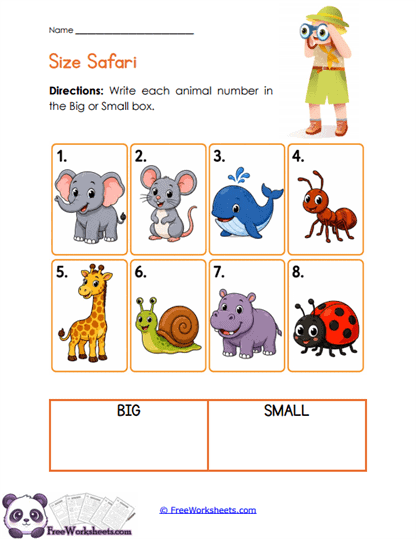
Size Groups is a preschool sorting activity that helps children classify animals as big or small. The worksheet shows eight animals, including an elephant, mouse, whale, ant, giraffe, snail, hippo, and ladybug. Children compare the usual real-life size of each animal and decide which group it belongs in. For example, an elephant belongs in the big group, while an ant belongs in the small group. This helps young learners practice comparing objects by size instead of by color, shape, or animal type.
Curriculum and Grade Alignment
This worksheet is made for preschool children who are learning to compare and sort objects by size. The main goal is for children to understand the ideas of big and small and use those words as a sorting rule. Before using the page, your child should have some experience comparing two objects and noticing which one is larger or smaller. The next step is working with more detailed size words such as bigger, smaller, tallest, shortest, or ordering several objects by size. This activity supports early math skills involving comparison, measurement language, and classification.
Student Tasks
On this worksheet, students will look at each numbered animal and think about whether that animal is usually big or small. They will then write each animal’s number inside the matching box at the bottom of the page. One box is labeled BIG and the other is labeled SMALL. Children must use what they know about the animals rather than judging only by how large each picture is printed on the worksheet. This encourages both classification skills and simple real-world reasoning.
Common Challenges and Misconceptions
Some children may judge the size of the printed picture instead of thinking about the animal’s actual size. For example, a mouse picture may look almost as large as the elephant picture on the page even though the real animals are very different in size. Children may also be unsure about animals they do not know well. Remind your child to think about the animal in real life rather than the drawing. Comparing two familiar animals aloud can also make the big-and-small idea easier to understand.
Implementation Guidance
Teachers can introduce this worksheet after sorting classroom objects into big and small groups. It can also be used during a lesson about animals, giving children a chance to connect science knowledge with early math thinking. Parents can ask simple questions such as, “Which is bigger, an elephant or a mouse?” before the child writes any numbers. If a child is unsure, talk about where the animal lives or what it might look like next to a person. This kind of conversation helps children make the classification based on meaning rather than guessing.
Details and Features
This worksheet includes eight colorful animal pictures and two large sorting boxes labeled BIG and SMALL. Each animal is numbered so children can record their choices without cutting out the pictures. The simple two-group setup keeps the classification rule clear for preschool learners. Familiar and interesting animals make the comparison activity easier to talk about with an adult. The printable builds size vocabulary, classification, observation, number writing, and early comparison skills.