
About This Worksheet
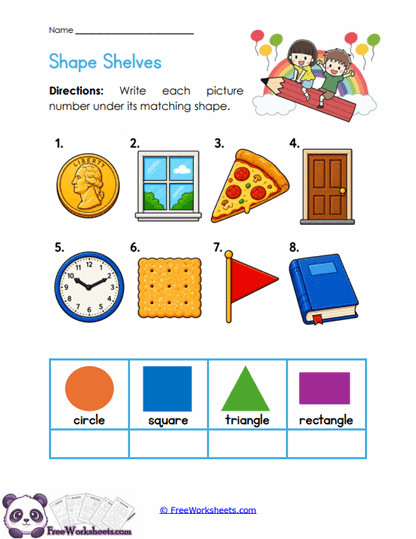
Shape Matching is an early classification activity that helps preschool children connect everyday objects with the basic shapes they resemble. Children look at pictures such as a coin, window, pizza slice, door, clock, cracker, flag, and book. They decide whether each item best matches a circle, square, triangle, or rectangle. For example, a round clock belongs with the circle, while a pizza slice belongs with the triangle. This helps children see that shapes are not only drawings in a math lesson-they can also be found in real objects around them.
Curriculum and Grade Alignment
This worksheet is intended for preschool learners who are beginning to recognize and classify common two-dimensional shapes. The main goal is for children to identify the shape of an everyday object and match it to the correct shape group. Before beginning, your child should be familiar with circles, squares, triangles, and rectangles. The next step is comparing shapes by features such as sides, corners, and overall form. This activity supports early geometry learning and prepares children to describe and sort shapes more carefully.
Student Tasks
On this worksheet, students will study each numbered picture and decide which basic shape it most closely matches. They will then write the picture number under the correct shape at the bottom of the page. The four groups are circle, square, triangle, and rectangle. Children must look closely at the main outline of each object rather than focusing on small details inside the picture. This gives students practice with shape recognition, matching, and organizing objects into groups.
Common Challenges and Misconceptions
Some children may become distracted by the details in a picture instead of noticing its overall shape. A window, for example, may contain several smaller sections even though the whole object is shaped like a square. Children can also confuse squares and rectangles because both have four sides. Encourage your child to trace the outside edge of the picture with a finger and compare it with the shape choices. Talking about the number of sides and corners can also help when two choices seem similar.
Implementation Guidance
Teachers can use this page after introducing basic shapes with blocks, cutouts, or classroom objects. It works well as a follow-up activity because children must apply what they know about shapes to real pictures. Parents can walk around the home with the child first and look for things shaped like circles, squares, triangles, and rectangles. Then return to the worksheet and ask the child to explain each match before writing the number. This makes the lesson more meaningful because children can see that shapes are part of everyday life.
Details and Features
This worksheet includes eight familiar objects and four clearly labeled shape groups. Large shape examples at the bottom give children a visual reminder of circle, square, triangle, and rectangle. Each picture is numbered so children can sort the objects without needing to cut or paste. The bright pictures keep the activity friendly while the organized layout makes each task easy to follow. The printable combines shape recognition, classification, number writing, and visual comparison.