
About This Worksheet
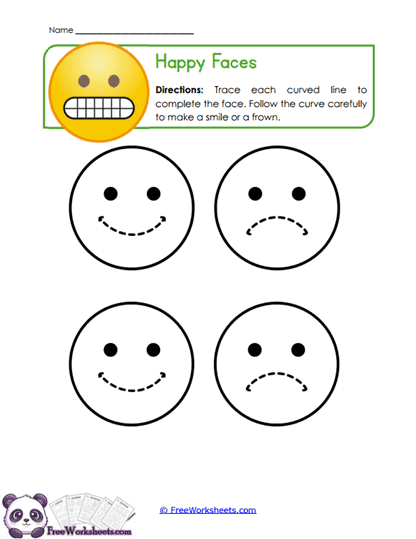
This preschool worksheet helps children practice tracing curved lines by completing happy and sad mouths. Each face already has eyes and a round outline, so children can focus on following the curved mouth path. Some curves turn upward to make a smile, while others turn downward to make a frown. This gives children simple fine motor practice while also introducing the idea that different curves can show different expressions.
Learning Goals
The main goal is to help children control smooth curved pencil movements. They practice following upward and downward arcs without turning the line into sharp corners. The activity also supports visual attention because children need to notice which direction each curve goes. These early skills can help with later letter formation, drawing, and other pre-writing work.
Student Tasks
Children trace each dashed mouth line to complete the face. They follow the curve carefully from one side to the other and try to stay close to the path. The happy and sad faces give them two different curve directions to practice. Children can also name the expression they see after tracing each one.
Common Challenges
Some children may flatten the smile or frown and make the line too straight. Others may reverse the direction of the curve if they are not watching the path closely. Starting and stopping neatly at both ends can also be difficult. A parent or teacher can have the child trace the mouth with a finger first and then repeat the movement with a pencil.
Teaching Suggestions
Teachers can use this worksheet during a lesson about feelings as well as fine motor skills. Parents and homeschool educators can ask whether each face looks happy or sad before the child begins tracing. It may help to draw a smile and frown in the air first to practice the motion. Encourage slow, smooth curves instead of quick scribbling.
Worksheet Features
The worksheet includes four large faces with easy-to-see curved tracing lines. Two smiles and two frowns give children repeated practice with opposite curve directions. The simple layout keeps the focus on the pencil movement without adding too many distractions. This page works well for fine motor centers, feelings lessons, homeschool practice, or pre-writing review.