
About This Worksheet
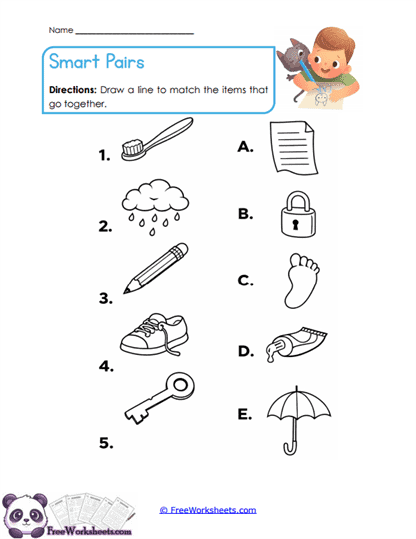
This preschool worksheet helps children think about which everyday objects naturally belong together. They see items such as a toothbrush, rain cloud, pencil, shoe, and key and match each one with its partner. The activity combines early reasoning with the fine motor practice of drawing lines across the page. It is a simple way to help children connect familiar objects with how they are used.
Learning Goals
The main goal is to help children recognize meaningful relationships between common objects. Children think about pairs such as a toothbrush and toothpaste, rain and an umbrella, or a key and lock. This supports early logic, vocabulary, and real-world understanding. Drawing each connection also strengthens visual tracking and control of the hand and pencil.
Student Tasks
Children look at each numbered picture on the left and decide which lettered picture on the right belongs with it. They draw a line between the two items that go together. The matches require children to think about purpose rather than simply looking for identical pictures. Children can explain why each pair belongs together after they finish.
Common Challenges
Some children may focus on what the objects look like instead of thinking about how they are used. Others may know the pair but have trouble drawing a line that reaches the correct choice. A few items may also be less familiar to children depending on their experience. A teacher or parent can give a simple clue about what an object does without immediately telling the answer.
Teaching Suggestions
Teachers can begin with one example and ask children what the two objects have in common. Parents and homeschool educators can turn each match into a short conversation, such as asking what someone might use when it rains. Letting children explain their thinking can help build language as well as reasoning. Encourage them to point to both matching items before drawing the connecting line.
Worksheet Features
The worksheet includes five everyday object relationships presented in two clear columns. Familiar pictures make the activity approachable while still asking children to think beyond simple visual matching. The open space between the columns provides room for children to practice controlled line drawing. This page works well for fine motor centers, vocabulary building, early reasoning lessons, or homeschool practice.