
About This Worksheet
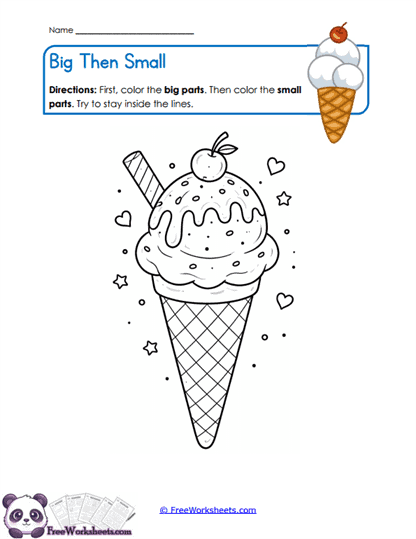
This preschool worksheet helps children notice the difference between big and small parts while they practice coloring. The ice cream picture includes large areas, such as the scoops and cone, along with smaller details around the picture. Children color the big parts first and then move on to the smaller ones. This gives them a simple way to practice size awareness while building better control with a crayon.
Learning Goals
The main goal is to help children understand the ideas of big and small while strengthening fine motor skills. Children learn to compare parts of a picture and decide which areas take up more or less space. They also practice changing the size of their coloring movements depending on the area. These skills support visual awareness, hand control, and early comparison language.
Student Tasks
Children begin by finding and coloring the large parts of the ice cream picture. After that, they color the smaller details while trying to stay inside the lines. This change from large spaces to small spaces encourages them to adjust how they move the crayon. Children can also point to different parts and say whether each one is big or small.
Common Challenges
Some children may not be sure which parts should be considered big and which are small. Others may use the same wide coloring motion in every area, even when the space is tiny. Small decorations can also be harder to fill without crossing the outlines. A parent or teacher can help by pointing out one large part and one small part before the child begins.
Teaching Suggestions
Teachers can use this worksheet during a lesson about size words such as big, small, larger, and smaller. Before coloring, children can compare two parts of the picture and decide which one is bigger. Parents can do the same thing at home by asking simple questions while the child works. Encourage slower, shorter strokes when children move into the smaller spaces.
Worksheet Features
The worksheet includes one large ice cream picture with a mix of broad and detailed areas. The directions give children a clear order by having them color the big parts before the small ones. This adds a simple thinking task to regular coloring practice. The page works well for fine motor centers, size comparison practice, homeschool lessons, or quiet independent work.