
About This Worksheet
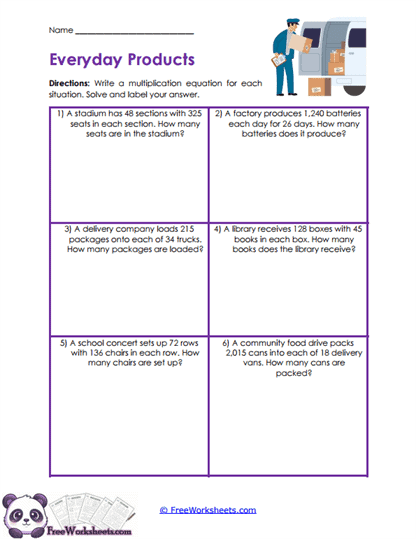
Everyday Products demonstrates how multiplication can be used to calculate quantities in familiar situations involving seating, manufacturing, deliveries, and community activities. Six real-world word problems require learners to translate written information into multiplication equations and determine meaningful totals. This 6th grade math worksheet emphasizes both numerical computation and the interpretation of quantities within practical contexts. Unlike exercises that provide the multiplication expression, these problems require students to identify the factors independently and explain their answers through appropriate numerical labels.
Curriculum and Grade Alignment
Applying multiplication to contextual problems reinforces mathematical modeling and whole-number computation in 6th grade. Students practice recognizing equal groups, interpreting numerical relationships, and representing situations with appropriate multiplication equations. The larger quantities also provide opportunities to revisit regrouping and the standard algorithm when solving multi-digit multiplication problems. Including units in final answers strengthens mathematical communication by connecting numerical results to the specific quantities described in each scenario.
Student Tasks
Learners read six word problems, write a multiplication equation for each situation, solve it, and label the resulting quantity. The opening scenario describes a stadium containing 48 sections with 325 seats in each section, while another problem asks for the total number of batteries produced at a rate of 1,240 per day for 26 days. Additional exercises involve delivery packages, library books, concert seating, and canned food packed into delivery vans. Students must determine which quantities to multiply, complete the calculation, and record answers using labels such as seats, batteries, packages, books, chairs, or cans.
Common Challenges and Misconceptions
Some students may struggle to recognize that the situations describe equal groups and therefore require multiplication rather than addition. Others may identify the appropriate operation but reverse the meaning of the factors when explaining their equations. Calculations involving numbers such as 1,240 and 2,015 can introduce place-value errors, particularly when multiplying by a two-digit factor. Requiring a labeled answer encourages learners to reconsider whether their calculated total actually addresses the question being asked.
Implementation Guidance
Introduce the activity by having students identify the repeated quantity in the stadium seating problem before writing 48 × 325. Discuss how the two factors represent sections and seats per section, while the product represents the total number of seats. For learners who need additional structure, encourage them to underline important quantities and organize the information into an equal-groups statement before calculating. As an extension, invite students to write a new multiplication word problem based on a familiar setting and exchange it with a partner for solving and labeling.
Details and Features
Six word problems are arranged in a two-column grid containing three rows of large response areas. Each section presents a brief real-world scenario followed by a question requiring a total quantity. The problems feature three-digit and four-digit values multiplied by two-digit factors, with contexts ranging from commercial production to community events. Large blank spaces beneath the questions provide room for writing multiplication equations, organizing calculations, and labeling final answers without prescribing a particular computational layout.