
About This Worksheet
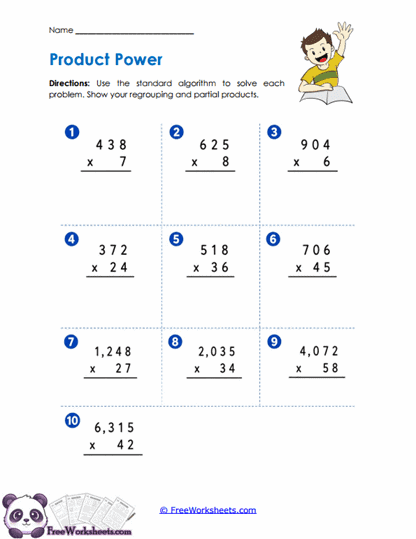
Product Power emphasizes accurate multi-digit multiplication through the standard algorithm, with particular attention to regrouping and partial products. This 6th grade math worksheet challenges learners to multiply increasingly large whole numbers while maintaining correct place-value alignment. The exercises include three-digit numbers multiplied by single-digit factors and four-digit numbers multiplied by two-digit factors. Students must demonstrate their calculations rather than simply supplying final answers, making the activity useful for examining both computational procedures and mathematical understanding.
Curriculum and Grade Alignment
Fluent multiplication of multi-digit whole numbers provides an important computational foundation for 6th grade mathematics. The worksheet reinforces the standard multiplication algorithm while connecting regrouping procedures to place-value relationships and partial-product calculations. Students revisit multiplication involving hundreds and thousands, including situations where zeros appear within the multiplicand. This practice supports readiness for more complex calculations involving whole-number operations, decimal multiplication, and multi-step mathematical problems.
Student Tasks
Ten numbered multiplication problems require students to calculate exact products using the standard algorithm. The first three exercises involve three-digit multiplicands and single-digit multipliers, including 438 × 7, 625 × 8, and 904 × 6. Subsequent problems introduce two-digit multipliers, progressing to calculations such as 1,248 × 27, 2,035 × 34, and 4,072 × 58. Students must show their regrouping and partial products before recording the final answers in the available workspace.
Common Challenges and Misconceptions
Regrouping across multiple place-value columns can create difficulties when students lose track of carried digits or add them at the wrong stage. Numbers containing zeros, such as 904 and 2,035, may lead to skipped positions or incorrectly aligned intermediate calculations. When multiplying by two-digit factors, learners may also forget to shift the second partial product into the tens position. Encouraging students to identify the value represented by each multiplier digit before calculating can help prevent these mistakes.
Implementation Guidance
Begin with a three-digit multiplication problem and review how regrouping preserves the value of each place-value column. When introducing the two-digit multiplier exercises, demonstrate how the first and second partial products represent multiplication by ones and tens. Students who need additional support can use a place-value chart or expanded expressions to organize their calculations before transitioning to the vertical algorithm. For enrichment, ask learners to verify one of the larger products using the distributive property and explain how the two methods produce equivalent results.
Details and Features
The worksheet contains ten vertically arranged multiplication problems distributed across a spacious three-column layout. Dotted horizontal and vertical lines separate the exercises while leaving room beneath each expression for regrouping, partial products, and final calculations. The first row focuses on single-digit multipliers, while the remaining problems involve two-digit factors and larger multiplicands. Each expression is presented without worked examples or intermediate values, requiring students to complete the multiplication process independently.