
About This Worksheet
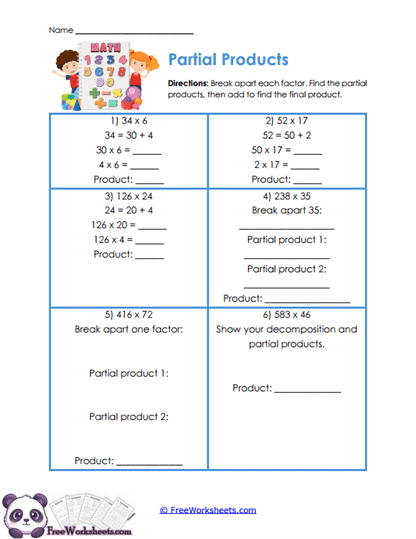
Breaking a multi-digit factor into smaller place-value parts is the central focus of this 6th grade math worksheet. Learners use the distributive property to transform multiplication expressions into simpler calculations before combining the partial products. The opening problems demonstrate this process with expressions such as 34 × 6, where 34 is separated into 30 + 4. As the activity progresses, students take greater responsibility for deciding how to decompose factors and organize their calculations.
Curriculum and Grade Alignment
Understanding partial products supports whole-number multiplication fluency and reinforces the relationship between place value and multiplication in 6th grade math. This activity revisits the distributive property through calculations involving two-digit and three-digit factors. It also connects expanded multiplication strategies to the standard algorithm, helping learners understand why intermediate products represent different place values. Teachers can use these exercises to assess whether students understand multiplication beyond memorizing procedural steps.
Student Tasks
Six multiplication problems guide learners through different levels of decomposition and calculation. Early exercises provide the expanded factor, allowing students to calculate the corresponding partial products and combine them to find the final answer. Later questions, including 238 × 35 and 416 × 72, require students to break apart a factor before multiplying. The final exercise, 583 × 46, asks learners to show their decomposition and partial products with minimal guidance.
Common Challenges and Misconceptions
Students may correctly decompose a number but forget to multiply each part by the remaining factor. Multiplication involving tens can create confusion when learners overlook the additional place-value position, particularly in calculations such as 126 × 20. Another difficulty occurs when combining partial products containing different numbers of digits. Writing the complete expanded expression before calculating can help learners identify missing terms and verify their reasoning.
Implementation Guidance
Begin by demonstrating how 34 × 6 can be rewritten as (30 × 6) + (4 × 6), emphasizing that both expressions represent the same quantity. Encourage students to explain why multiplying each component separately produces an equivalent result. Those needing additional support can organize partial products in a place-value chart before adding them together. For enrichment, invite students to decompose the other factor in a selected problem and compare the resulting calculations.
Details and Features
The worksheet contains six numbered exercises organized in a two-column grid with clearly separated response areas. Initial problems provide factor decompositions and partially completed multiplication expressions, while subsequent exercises offer increasingly open-ended spaces for calculations. Each problem includes a designated location for recording the final product. The structured layout allows students to distinguish decomposition, intermediate multiplication, and the completed answer.