
About This Worksheet
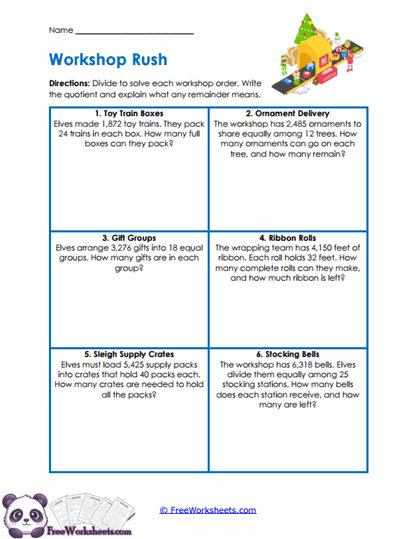
Fulfilling a workshop order sometimes requires more than reporting the result of a division calculation. Workshop Rush uses holiday production stories to practice dividing whole numbers in 6th grade math, with answers expressed as packed boxes, equal shares, leftover supplies, or enough crates to carry an entire shipment. Every problem pairs a four-digit dividend with a two-digit divisor. The sleigh-supply order, for instance, needs 136 crates because 135 crates hold only 5,400 of the 5,425 packs.
Curriculum and Grade Alignment
The central learning goal is to connect multi-digit division with the conditions stated in a word problem. This gives 6th grade learners practice distinguishing a complete group from a container that is still needed even when partly filled. Before independent work, an educator could check whether the child can identify what the divisor represents and label a quotient with its unit. A follow-up comparison could use one quantity of supplies to ask both how many containers can be filled completely and how many containers are needed to hold everything.
Student Tasks
Each of the six orders must be translated into a division calculation and answered in the terms requested by the story. Learners write the quotient and explain any remainder, distinguishing leftover ornaments, ribbon, or bells from the need for additional storage. Questions about equal gift groups and full train boxes require attention to what each resulting count represents.
Common Challenges and Misconceptions
The word “complete” in the ribbon order rules out counting a partly filled roll as a finished one. In contrast, reporting only full crates in the sleigh order would leave some supply packs unloaded. Another possible confusion is labeling a ribbon remainder as rolls when it represents feet of ribbon. Have learners finish an answer sentence that names both the counted groups and any leftover quantity.
Implementation Guidance
Before solving, invite the class to underline the part of each question that determines how to handle leftovers. Compare “complete rolls” with “hold all the packs” and discuss why these instructions lead to different final decisions. For home instruction, choose one order and ask the child to explain how the proposed answer would meet the workshop’s request. A sketch of filled containers and remaining supplies can make that explanation visible without changing the numbers on the page.
Details and Features
Six named scenarios fill a blue two-column grid beneath a small workshop illustration. Each panel leaves open space below the story for arithmetic and an explanation of the remainder. The situations cover trains, ornaments, gifts, ribbon, supply packs, and bells, with no prewritten division equations to copy.