
About This Worksheet
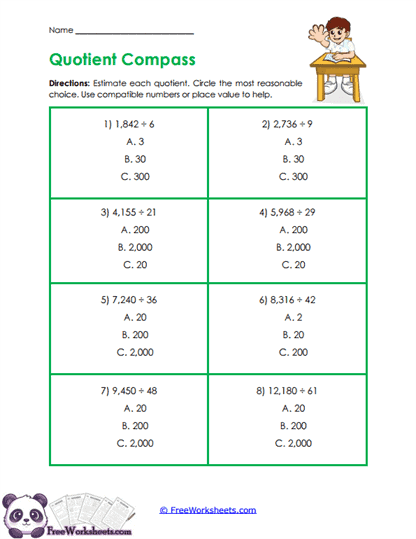
Quotient Compass asks for the approximate size of an answer rather than an exact long-division result. This 6th grade math activity presents answer choices that differ sharply in magnitude, making place-value reasoning central to each decision. A calculation such as 12,180 divided by 61 can be compared with 12,000 divided by 60 to point toward an estimate of 200. The task emphasizes selecting useful nearby numbers and recognizing when a proposed quotient is far too small or too large.
Curriculum and Grade Alignment
Estimation is the instructional focus of this page within the 6th grade math collection. Its directions identify compatible numbers and place value as ways to reason about division without requiring a particular written algorithm. Before assigning it independently, check whether learners can explain calculations such as 1,800 divided by 6 using known facts and the values of the digits. As a suggested follow-up, compare an estimate with an exact calculation and discuss why the two results need not match to serve their respective purposes.
Student Tasks
For each expression, learners choose among three lettered estimates and circle the most reasonable value. They can replace the original numbers with a convenient division pair or use place value to judge the answer’s size. The printed task does not require an exact quotient, a remainder, or a written explanation.
Common Challenges and Misconceptions
Working through full long division before considering the choices can sidestep the estimation practice requested by the directions. A misplaced zero may also lead to selecting 20 instead of 200, even when the underlying multiplication fact is familiar. Changing numbers simply because they look easier is not enough; the revised calculation must remain a sensible comparison with the original. Prompt the learner to multiply a proposed answer by the divisor and consider whether that product could be close to the dividend.
Implementation Guidance
Use one problem as an oral warm-up and invite more than one route to the same estimate. For 4,155 divided by 21, a class could compare reasoning from 4,200 divided by 21 with reasoning from 4,000 divided by 20. During home practice, ask the child to reject an unreasonable option aloud before circling a plausible one. Because the reasonable selections on this particular page all fall in the hundreds, request the reasoning as well as the circle so that recognizing an answer pattern does not replace estimation.
Details and Features
Eight green-outlined boxes fill a four-row, two-column layout. Each box displays one division expression and three vertically stacked options labeled A, B, and C. Seven dividends have four digits, while the final dividend, 12,180, has five. Responses are marked directly among the choices rather than entered on separate quotient lines.