
About This Worksheet
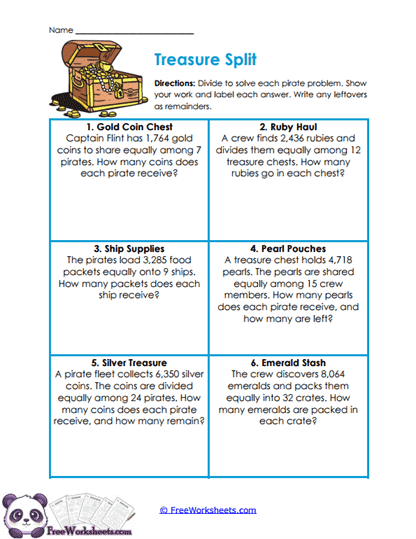
The pirate stories in Treasure Split ask how much belongs in each equal share, not merely which calculation produces an answer. This 6th grade math page uses whole-number division to distribute four-digit quantities of treasure and supplies among specified numbers of people or containers. Some quantities divide evenly, while others require both a per-group amount and a leftover count. The meaning of the quotient stays connected to the story, whether the answer describes coins per pirate or emeralds per crate.
Curriculum and Grade Alignment
Four-digit dividends and one- or two-digit divisors make this page an application of multi-digit division within the supplied 6th grade math context. The calculations can support Common Core 6.NS.B.2 when learners use the standard algorithm, although the printed directions do not specify a particular division method. A useful readiness check is whether a learner can distinguish the total amount from the number of equal shares in a story. For subsequent practice, contrast these leftover-count questions with a situation where an extra container is needed to hold everything.
Student Tasks
Learners identify the total quantity and the number of recipients or containers before setting up each division calculation. They show their work and label the resulting answer to explain what each pirate, ship, chest, or crate receives. Whenever a quantity does not divide evenly, the directions require the leftover amount to be written as a remainder. The pearl and silver problems explicitly request both the size of each share and the number of objects remaining.
Common Challenges and Misconceptions
A correct calculation can still produce an incomplete response when the answer omits a unit such as coins per pirate or rubies per chest. Leftover objects must also be kept separate from the amount distributed to each group. In the pearl problem, sharing 4,718 pearls among 15 crew members gives 314 pearls each and 8 left over; the remainder does not mean eight additional pearls for every person. Ask the learner to multiply one person’s share by the crew size, then add the leftover pearls to reconstruct the original total.
Implementation Guidance
Ask the class what the number 12 represents in the ruby problem before anyone begins calculating. Sketch 12 empty chests and label 2,436 as the shared total, then connect that representation to the division expression. During home instruction, have the child point to the words that establish equal sharing and explain what unit belongs with the answer. For additional reasoning practice, compare the ruby story with the pearl story and discuss why only one leaves objects undistributed.
Details and Features
Six story boxes sit in a two-column blue grid beneath a treasure-chest illustration. Short headings, including “Gold Coin Chest,” “Pearl Pouches,” and “Emerald Stash,” distinguish the scenarios. Each box leaves unruled space below the question for calculations and a labeled response. The page does not supply prewritten division equations or intermediate calculation steps, so learners must translate the stories into their own mathematical work.