
About This Worksheet
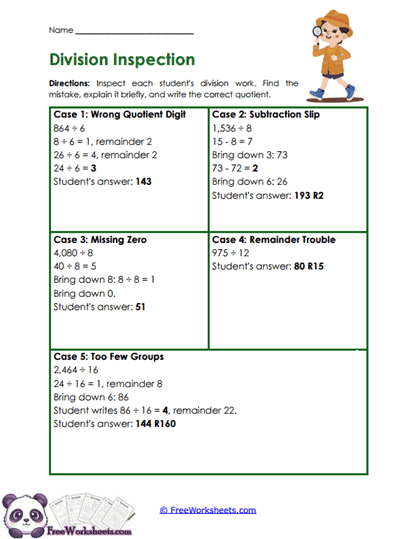
Division Inspection asks learners to investigate someone else’s arithmetic before repairing it. Five student-work cases bring different long-division difficulties into focus, including an incorrect quotient digit, a subtraction slip, an omitted zero, and invalid remainders. In this 6th grade math activity, identifying an error is only part of the job: the directions also require a brief explanation and the correct quotient. Comparing the printed answer of 80 R15 with the corrected answer of 81 R3 for 975 divided by 12 illustrates why a remainder cannot contain another complete group of the divisor.
Curriculum and Grade Alignment
The combination of procedural review and error explanation makes this a reasoning-focused option within 6th grade math. Its division content supports work toward Common Core 6.NS.B.2, although analyzing supplied work is not a stand-alone measure of standard-algorithm fluency. Explaining why another student’s reasoning fails also connects to MP.3, which includes identifying and explaining flaws in mathematical arguments. Before assigning the page, check whether learners can follow a long-division calculation and interpret the place value of each quotient digit. A useful extension is to have them create an incorrect solution and write feedback that would help a classmate repair it.
Student Tasks
Each case calls for an inspection of the displayed calculation or student answer. Learners locate the mistake and briefly explain what went wrong rather than replacing the answer without comment. They then write the corrected quotient, including a valid remainder when the division is not exact. Because the case headings already identify the type of difficulty, the task emphasizes explaining the error rather than discovering its category without a clue.
Common Challenges and Misconceptions
Correcting only the final answer can leave the earlier decision that caused the error unexplained. The “Missing Zero” case highlights how omitting a quotient digit changes the entire answer, turning 510 into 51. An oversized remainder may also seem acceptable when multiplying the quotient by the divisor and adding the remainder reproduces the dividend, even though more whole groups can still be formed. Ask learners to identify the earliest incorrect step and check that their corrected remainder is smaller than the divisor.
Implementation Guidance
Use the page as a discussion-based review after learners have practiced long division, rather than as their first introduction to the procedure. Invite pairs to agree on where a calculation first goes wrong before comparing corrected answers. At home, an adult can ask, “What would you tell this student to change, and why?” while the child points to the relevant work. For an additional challenge, cover the case headings so the printed labels do not reveal the error categories.
Details and Features
Green borders separate four smaller cases above a fifth panel that spans the page’s width. Each case has a bold heading naming the error type, providing a built-in clue for the investigation. Four cases include selected calculation steps, while “Remainder Trouble” presents a division expression and proposed answer without a worked sequence. Unruled space below the printed material allows room for corrections and brief explanations.