
About This Worksheet
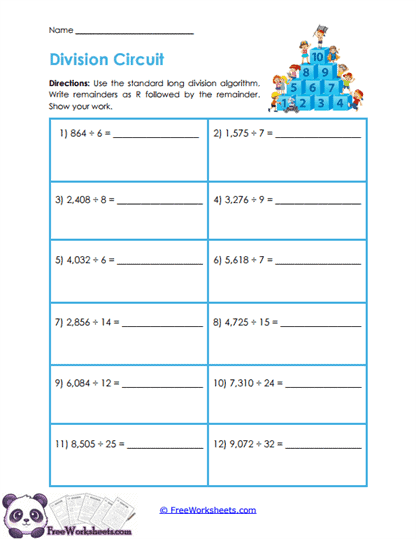
Division Circuit puts the standard long-division procedure at the center of 6th grade math practice. Three- and four-digit dividends are paired with one- and two-digit divisors, requiring learners to organize their calculations rather than complete supplied intermediate steps. The problem set includes exact quotients, answers with remainders, and quotients containing zeros, giving educators several opportunities to examine how accurately the procedure is carried out.
Curriculum and Grade Alignment
The central target is Common Core 6.NS.B.2, which calls for fluent division of multi-digit numbers using the standard algorithm. Use this page after instruction in multiplication facts, subtraction with regrouping, and place-value alignment within long division. Its first six problems use one-digit divisors, while the remaining six use two-digit divisors. Once these calculations are dependable, a suitable follow-up is to interpret quotients and remainders in situations where the context determines how the answer should be reported.
Student Tasks
Each expression requires a long-division calculation, with the working shown rather than only a final answer. Learners determine successive quotient digits, multiply and subtract to track the amount remaining, and bring down the next digit as needed. Completed quotients belong on the horizontal answer lines beside the original expressions. Whenever a division leaves a remainder, the directions require the letter R followed by that remainder instead of continuing into decimal places.
Common Challenges and Misconceptions
A missing zero can turn an otherwise accurate series of calculations into an incorrect quotient. In 2,408 divided by 8, the middle zero belongs in 301 and cannot be skipped. Choosing a quotient digit that is too small may also leave a subtraction result large enough for another group of the divisor. Remainder notation can become confusing when the leftover amount is written as though it were another quotient digit. Have learners identify the place value of each quotient digit and confirm that the final remainder is smaller than the divisor.
Implementation Guidance
Assign a few problems after demonstrating long division, then examine the written steps to locate where an incorrect answer began. A brief conference around a two-digit divisor can reveal whether the learner is estimating the next quotient digit or repeatedly guessing. For home practice, a parent can ask the child to explain one complete divide-multiply-subtract sequence before continuing alone. Provide squared paper when the worksheet boxes are too tight for a learner’s handwriting, using the page itself to record the final answers.
Details and Features
A blue-lined grid contains twelve numbered exercises across six rows and two columns. Each cell pairs a horizontal division expression and answer line with unruled space for calculation. No long-division brackets or worked steps are prefilled, so learners must arrange their own calculations. The directions explicitly identify the required algorithm, request visible work, and explain how to record remainders.