
About This Worksheet
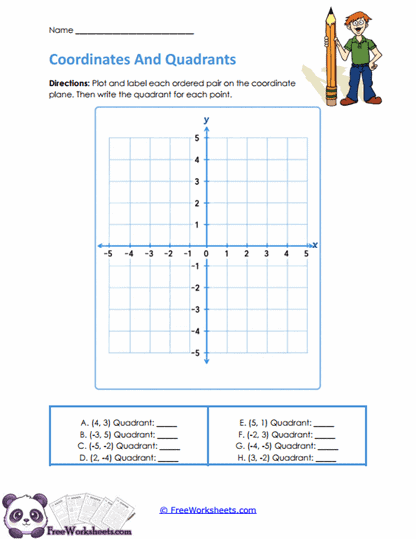
This worksheet helps sixth-grade students connect integers with locations on the coordinate plane. Students plot ordered pairs that include positive and negative coordinates and then identify the quadrant where each point belongs. The graph includes all four quadrants, so students must pay close attention to the signs of both the x-coordinate and y-coordinate. This activity brings together integer understanding and coordinate geometry in a clear visual format.
What Students Practice
Students plot ordered pairs on a four-quadrant coordinate grid and label each point. They then determine whether each point lies in Quadrant I, II, III, or IV. To do this correctly, students must remember that the first number shows horizontal movement and the second number shows vertical movement. They also practice using positive and negative directions on both axes.
Why This Matters
The coordinate plane is one of the most important ways students use integers visually. Understanding how signs affect horizontal and vertical movement prepares students for graphing equations, transformations, geometry, and data. It also strengthens the idea that positive and negative numbers represent opposite directions from zero. Students who understand quadrant patterns can often plot points more accurately and with greater confidence.
Teaching Tips
Remind students to move along the x-axis first and then move vertically using the y-coordinate. You may want to review the sign pattern of each quadrant before students begin plotting. If a student places a point incorrectly, ask them to trace the horizontal and vertical moves separately. Having students say “left or right” and then “up or down” can make the coordinate signs easier to manage.
Curriculum Standards
This worksheet supports CCSS.MATH.CONTENT.6.NS.C.6.C, which asks sixth-grade students to find and position pairs of integers and other rational numbers on a coordinate plane. It also reinforces CCSS.MATH.CONTENT.6.NS.C.6 by connecting signed values with location and direction. The activity is well suited for classroom instruction, independent practice, or review before students begin more advanced coordinate-plane work.