
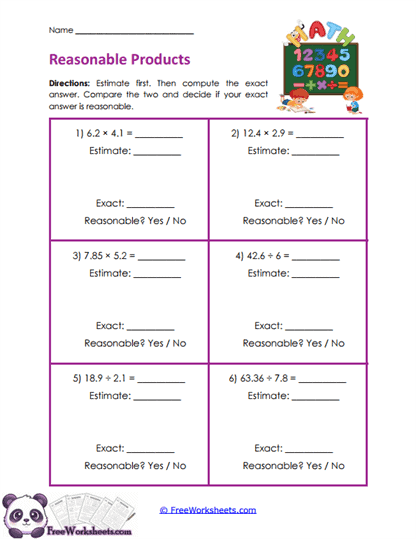
About This Worksheet
This worksheet helps sixth-grade students connect estimation with exact decimal multiplication. For each problem, students first estimate the product, then calculate the exact answer and decide whether the result is reasonable. The activity teaches students that estimation is not just a separate skill but a useful way to check their own work. It also encourages stronger number sense by asking students to think about the expected size of an answer before accepting it.
What Students Practice
Students estimate decimal multiplication problems using rounded or compatible numbers before finding the exact product. After computing, they compare the exact result with their estimate and decide whether the answer is reasonable. This process requires students to use both mental math and written computation. It also gives them practice explaining, even briefly, whether their final result makes sense.
Why This Matters
Students sometimes complete a multiplication problem correctly except for placing the decimal point in the wrong location. An estimate can quickly reveal that kind of error because the exact answer should be fairly close to the estimated one. Learning to check reasonableness also develops stronger mathematical independence. Instead of waiting for a teacher or answer key, students begin learning how to judge their own work.
Teaching Tips
Encourage students to round each factor to a friendly number before finding the estimate. Tell them that the estimate does not need to match the exact product, but it should be close enough to show whether the final answer makes sense. If a student marks an answer as reasonable when it is not, ask them to compare the size of the estimate and exact product. This can lead to a useful conversation about decimal placement and magnitude.
Curriculum Standards
This worksheet supports CCSS.MATH.CONTENT.6.NS.B.3 by reinforcing accurate multiplication of multi-digit decimals using the standard algorithm. It also strengthens mathematical reasoning and estimation skills that support broader problem solving across the Grade 6 curriculum. The activity works especially well after students have learned decimal multiplication and are ready to add a self-checking step to their computation.