
About This Worksheet
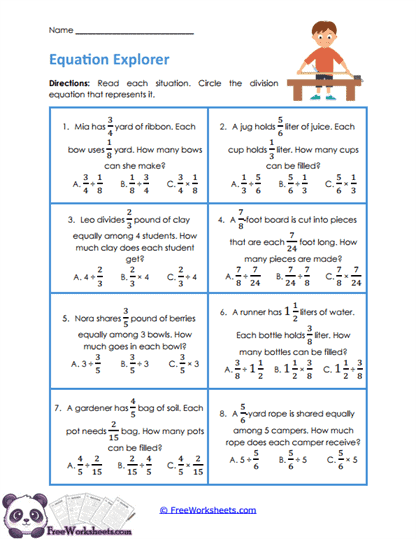
Division Expression Selection is a sixth grade reasoning activity that asks students to identify which fraction division expression correctly represents a written situation. Rather than beginning with an equation, students read a short scenario, analyze the relationship between the quantities, and choose the expression that models the problem. This helps learners distinguish between the total amount, the size of each group, and the number of groups being sought. The focus stays on mathematical interpretation rather than routine calculation.
Curriculum and Grade Alignment
This worksheet is appropriate for CCSS.MATH.CONTENT.6.NS.A.1, which expects students to interpret and solve fraction division problems in real-world contexts. The main goal is to help students translate contextual situations into correct division expressions. Before using this page, students should understand what the dividend and divisor represent in grouping and measurement situations. The next step is writing their own expressions independently and solving multi-step fraction word problems. This activity supports mathematical modeling, operation selection, fraction division, and quantitative reasoning.
Student Tasks
Students will read eight short real-world situations involving ribbon, juice, clay, boards, berries, water, soil, rope, and other measurable quantities. For each one, they examine multiple expression choices and circle the division equation that correctly represents the relationship described. The task requires students to distinguish between dividing a total by a group size and reversing those quantities.
Common Challenges and Misconceptions
Some students may select an expression simply because it contains the correct numbers without checking their order. Others may confuse “shared equally among” situations with “how many groups of this size” situations. Students may also be distracted by an answer choice that uses multiplication even though the problem asks how many equal portions can be formed. Encourage learners to identify what is known as the total and what is known as the size of one group before looking at the choices.
Implementation Guidance
Teachers can use this worksheet as a bridge between direct computation and independent word-problem solving. Parents can ask students to cover the answer choices and describe the needed operation in words first. A helpful prompt is, “What amount are we starting with, and how large is each group?” Once those roles are clear, students can choose the expression that matches the situation.
Details and Features
This worksheet includes eight blue-bordered multiple-choice situations arranged in a two-column format. Each problem provides several possible expressions, and students select the one that accurately models the stated division relationship. The printable supports equation interpretation, fraction division, quantitative reasoning, and real-world problem representation.