
About This Worksheet
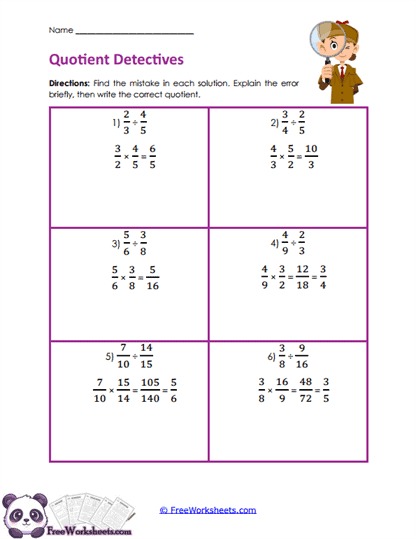
Division Error Analysis is a sixth grade reasoning activity that asks students to inspect incorrect fraction division work, identify the mistake, and explain how the solution should be corrected. Rather than completing a fresh set of routine problems, students examine another person’s mathematical process and decide exactly where it breaks down. The errors involve reciprocal use, multiplication, and simplification, helping students become more careful with each stage of fraction division.
Curriculum and Grade Alignment
This worksheet is made for sixth grade learners who are ready to analyze fraction division rather than only perform it. The main goal is to help students recognize common procedural errors and explain the correct reasoning clearly. Before using this page, students should understand reciprocals, fraction multiplication, and simplifying quotients. The next step is applying the same checking habits to their own independent work and explaining mathematical reasoning with greater precision.
Student Tasks
Students will analyze six worked fraction division solutions that contain errors. For each one, they determine what went wrong, briefly explain the mistake, and then write the correct quotient. The examples require students to inspect whether the reciprocal was used properly, whether the multiplication was completed accurately, and whether the final answer was simplified correctly.
Common Challenges and Misconceptions
Some students may notice that an answer is wrong but struggle to identify the first incorrect step. Others may focus only on arithmetic and overlook a reciprocal mistake that occurred earlier in the solution. Students can also correct the final result without explaining the misunderstanding that caused it. Encourage learners to check the work in order: divisor, reciprocal, multiplication, then simplification.
Implementation Guidance
Teachers can use this worksheet as a formative assessment after students have practiced fraction division independently. Parents can have students cover the worked solution and solve the original problem on their own first, then compare the two methods. Asking, “Where does the shown work first stop matching yours?” makes the error easier to locate and explain. This approach helps students develop stronger self-checking habits.
Details and Features
This worksheet includes six purple-bordered error-analysis problems with large spaces for written explanations and corrected work. The examples target several common fraction division mistakes instead of repeating one error type. Students must both diagnose and repair each solution. The printable supports mathematical reasoning, error detection, reciprocal understanding, and computation accuracy.