
About This Worksheet
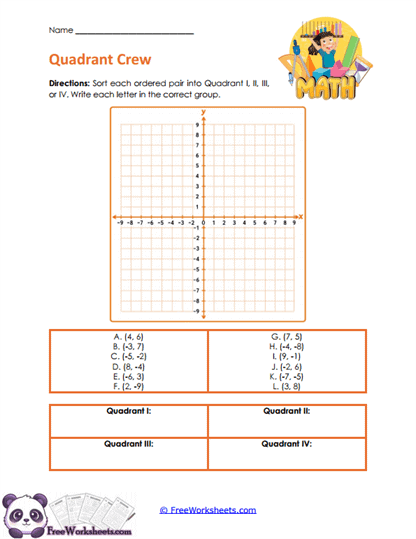
This worksheet helps students understand how the signs of an ordered pair tell which quadrant contains a point. A quadrant is one of the four sections created when the x-axis and y-axis divide the coordinate plane. For example, an ordered pair with a positive x-value and negative y-value belongs in Quadrant IV. Students sort a group of ordered pairs instead of plotting every point, which encourages them to recognize the sign patterns that define each quadrant.
Curriculum and Grade Alignment
This activity is designed for fifth-grade coordinate-plane practice and builds on the ideas found in CCSS.MATH.CONTENT.5.G.A.1. Students should already understand ordered pairs, the origin, and the positive and negative sides of both axes. The main learning goal is to connect the signs of x and y with Quadrants I, II, III, and IV. This prepares students to locate points more quickly and later reason about reflections, geometric figures, and movements across the coordinate plane.
Student Tasks
On this worksheet, students will study twelve ordered pairs labeled A through L and decide which quadrant contains each one. They write each letter into the correct Quadrant I, II, III, or IV box at the bottom of the page. The coordinates use different combinations of positive and negative x- and y-values, forcing students to pay close attention to both signs. A coordinate plane is also shown so students can use the visual layout if they need help deciding where a point belongs.
Common Challenges
Students may remember the location of the quadrants but mix up their Roman numeral names. Another common mistake is looking only at the sign of the x-coordinate instead of checking both values. Children can also assume that Quadrants I through IV move clockwise starting somewhere other than the upper-right section. Teachers can help by reminding students that Quadrant I begins in the upper right and the quadrant numbers then move counterclockwise around the graph.
Teaching Tips
This page works especially well after students have already practiced reading and plotting ordered pairs. A teacher can write the four sign patterns on the board as a simple reference: positive-positive, negative-positive, negative-negative, and positive-negative. At home, parents can ask the child to describe each point using words such as “left and up” or “right and down” before choosing a quadrant. That small conversation helps connect negative and positive signs with actual movement on the graph instead of making quadrant names something students simply memorize.
Worksheet Features
The worksheet provides twelve ordered pairs along with a large four-quadrant coordinate plane for visual support. Four clearly labeled sorting areas at the bottom give students a simple place to organize the letters for each quadrant. The activity focuses on quadrant recognition rather than lengthy calculations, making it a strong concept-building exercise. It can be used for independent work, partner practice, homework, intervention, or a quick review of coordinate-plane vocabulary.