
About This Worksheet
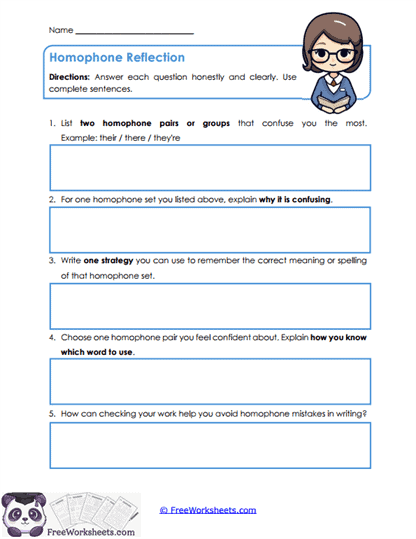
Homophone Reflection encourages learners to examine their own understanding of commonly confused words and identify strategies for improving spelling accuracy. This 6th grade vocabulary worksheet moves beyond selecting correct answers by asking students to reflect on which homophones they find difficult, why confusion occurs, and how they can remember the differences. Five open-ended questions guide learners through identifying challenges, explaining their reasoning, and considering effective proofreading habits. The reflective format emphasizes awareness of personal learning needs and the ability to describe how vocabulary knowledge can support more accurate writing.
Curriculum and Grade Alignment
Reflecting on homophone knowledge supports vocabulary development, spelling awareness, and written communication within the 6th grade language arts curriculum. Students practice explaining why words with identical pronunciations may be difficult to distinguish when spelling or interpreting sentences. The activity encourages metacognitive thinking as learners identify areas of uncertainty, recognize vocabulary they understand confidently, and describe strategies for improving accuracy. Writing complete responses also reinforces explanatory language and the ability to communicate reasoning about spelling and word meanings.
Student Tasks
Learners respond to five numbered reflection questions about their experiences with homophones. The first question asks them to identify two homophone pairs or groups they find confusing, using examples such as their, there, and they’re as a reference. Subsequent questions require students to explain why one selected group is difficult, describe a strategy for remembering the correct meanings or spellings, and identify a homophone pair they feel confident using. The final question asks learners to explain how checking their written work can help them recognize and prevent homophone mistakes.
Common Challenges and Misconceptions
Some students may find it easier to select the correct homophone in an exercise than to explain why they confuse particular words. Others may identify a difficult pair without recognizing whether their errors result from spelling, meaning, or grammatical usage. Learners may also provide vague strategies such as “study more” without describing a specific approach that could help them distinguish the words. Encouraging students to refer to an actual sentence or familiar homophone mistake can help them develop more meaningful explanations and practical strategies.
Implementation Guidance
Begin by discussing how recognizing a spelling difficulty is different from simply getting an answer wrong, emphasizing that reflection can help learners choose a useful strategy. Invite students to review earlier homophone exercises and identify a pair they frequently confuse, such as their and there or your and you’re. For individual support, encourage learners to describe one specific reminder, such as recognizing that you’re can be replaced with you are, and explain when that reminder would be useful. After the reflections are complete, teachers can use the responses to identify commonly reported difficulties and select appropriate follow-up practice without treating students’ self-assessments as a substitute for demonstrated spelling accuracy.
Details and Features
The worksheet presents five numbered reflection questions arranged vertically, each followed by a large rectangular writing box. The prompts guide learners from identifying confusing homophones to explaining their difficulties, describing a memory strategy, recognizing a successful distinction, and evaluating proofreading habits. The first question supplies their, there, and they’re as an example, but the worksheet does not require students to work with a fixed vocabulary list. The open-response design provides space for complete sentences and personal explanations rather than matching letters, choosing answers, or rewriting predetermined sentences.