
About This Worksheet
Field Trip Email places homophone correction in a realistic written communication task rather than a collection of unrelated sentences. Students examine a mock email from a teacher reminding families and classmates about an upcoming school field trip. Several commonly confused words appear with incorrect spellings for their intended meanings, requiring learners to use the message’s context to identify and repair the errors. This 6th grade vocabulary worksheet connects homophone knowledge with practical proofreading and the importance of clear communication in everyday writing.
Curriculum and Grade Alignment
Editing homophones within authentic communication supports spelling proficiency, vocabulary comprehension, and written language conventions in the 6th grade curriculum. Students practice distinguishing possessive words from contractions and recognizing when identical pronunciations represent different meanings. The activity reinforces frequently confused forms such as were and we’re, your and you’re, right and write, and there and their. Revising an email also provides supporting practice with proofreading complete messages while preserving their intended purpose, organization, and professional tone.
Student Tasks
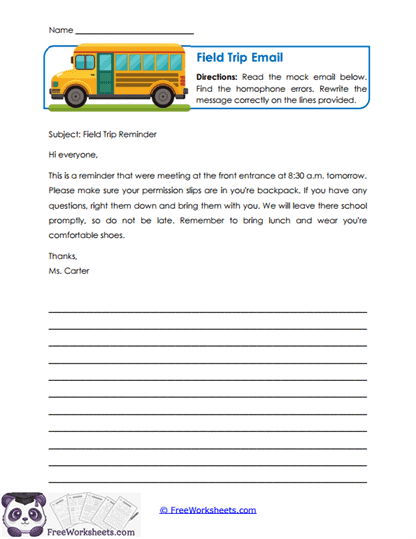
Learners read a mock email titled “Field Trip Reminder” that provides instructions about meeting times, permission slips, questions, and appropriate clothing for an upcoming trip. They identify incorrectly used homophones within the message, including expressions such as “were meeting,” “you’re backpack,” and “right them down.” Students determine the appropriate replacements by considering the meaning and grammatical structure of each sentence. After finding the errors, they rewrite the complete email correctly on the writing lines provided beneath the original message.
Common Challenges and Misconceptions
Students may understand the email’s message without noticing that certain words have been spelled incorrectly for their intended meanings. Contractions and possessive forms can be particularly confusing because we’re and were or your and you’re may sound identical in ordinary speech. Learners may also focus on correcting individual words without checking whether the revised sentences remain natural and grammatically complete. Rereading the edited email sentence by sentence can help students evaluate both the accuracy of their corrections and the clarity of the overall message.
Implementation Guidance
Begin by reviewing the purpose of the email and asking students why spelling accuracy matters when communicating important field trip instructions. Model how “were meeting” should become “we’re meeting” because the sentence means “we are meeting,” then demonstrate how “you’re backpack” requires the possessive your. Before assigning the activity, clarify the sentence “We will leave there school promptly,” because their would correct the homophone but create an awkward reference from a teacher addressing the group; “We will leave our school promptly” provides a more natural revision, although it changes the intended homophone exercise. After students rewrite the message, encourage partners to compare their corrections and explain how each replacement changes the sentence’s meaning.
Details and Features
The worksheet displays a complete mock email with a subject line, greeting, informational paragraph, closing, and teacher signature. The message describes a field trip meeting time of 8:30 a.m. and includes reminders about permission slips, questions, lunch, and comfortable shoes. Homophone errors appear throughout the email without highlighting or underlining, requiring students to locate them independently. A large response area containing multiple horizontal writing lines appears beneath the message, allowing learners to rewrite the entire corrected email while maintaining its original format.