
About This Worksheet
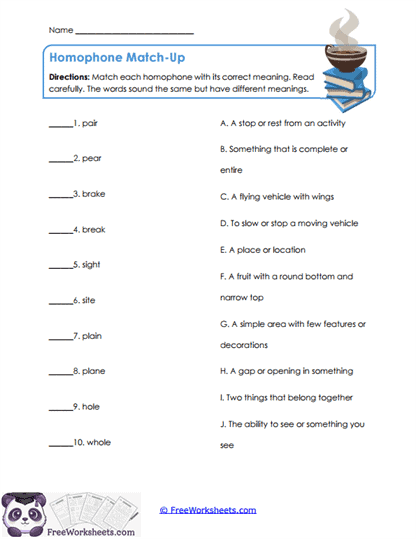
Homophone Match-Up introduces learners to words that sound alike but differ in spelling and meaning. This 6th grade vocabulary worksheet presents ten homophones that students must connect with their correct definitions through a matching activity. The featured words include pair and pear, brake and break, sight and site, plain and plane, and hole and whole. By comparing these easily confused terms, learners develop a clearer understanding of how spelling and meaning distinguish words that share the same pronunciation.
Curriculum and Grade Alignment
Understanding homophones supports vocabulary development, spelling accuracy, and reading comprehension within the 6th grade language arts curriculum. Students practice recognizing that words with identical pronunciations can represent different objects, actions, or concepts depending on their spelling. The activity reinforces distinctions between familiar words such as brake and break while introducing opportunities to examine less obvious meanings, including sight and site. Matching words with definitions provides supporting practice for selecting accurate vocabulary when interpreting sentences and composing written responses.
Student Tasks
Learners examine ten numbered homophones and match each word with its corresponding meaning from a lettered definition bank. The definitions describe objects, actions, qualities, and concepts, requiring students to identify the precise meaning associated with each spelling. For example, pair corresponds to two things that belong together, while pear identifies a fruit with a rounded bottom and narrower top. Students record the correct letter beside each word, completing the matching activity by distinguishing the meanings of five homophone pairs.
Common Challenges and Misconceptions
Some students may recognize how a homophone sounds without remembering which spelling corresponds to its intended meaning. Words such as sight and site can be particularly confusing because both frequently appear in descriptions involving places or things people observe. Learners may also overlook the distinction between brake as a mechanism or action for slowing a vehicle and break as a pause or interruption. Encouraging students to connect each spelling with a short definition or meaningful example can help prevent confusion based solely on pronunciation.
Implementation Guidance
Begin by introducing pair and pear, asking students to explain how two words can sound identical while representing completely different things. Demonstrate how the definitions provide clues that distinguish the correct spelling of each term. Encourage learners to complete the matching independently, then review the more easily confused pairs by placing each word into a short example sentence. For additional practice, students can select three homophone pairs and write original sentences that demonstrate the different meanings of each spelling.
Details and Features
The worksheet contains ten numbered homophones arranged vertically in a left-hand column, with ten lettered definitions presented in a separate right-hand column. Short response lines appear beside each vocabulary word for recording the corresponding definition letter. The word choices represent five distinct homophone pairs, allowing students to compare the meanings of similar-sounding terms without relying on sentence context. The directions emphasize reading carefully because the featured words sound the same but have different meanings, keeping the focus on vocabulary recognition and spelling distinctions.