
About This Worksheet
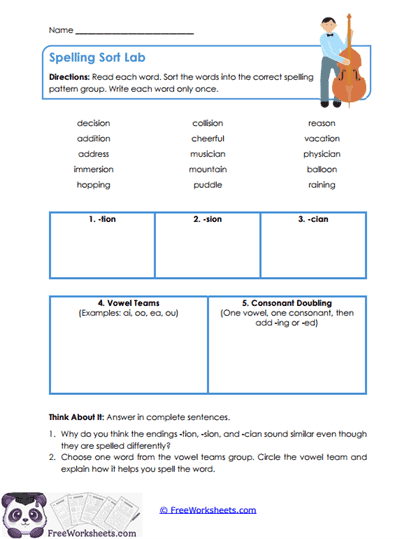
Spelling Sort Lab introduces students to the patterns that influence how words are spelled and organized in written English. This 6th grade vocabulary worksheet presents fifteen words that learners must classify according to suffix endings, vowel teams, and consonant doubling. The activity emphasizes recognizing recurring spelling structures rather than memorizing individual words without considering their patterns. By sorting vocabulary and explaining their observations, students develop a more systematic understanding of English spelling conventions.
Curriculum and Grade Alignment
Recognizing spelling patterns supports vocabulary development, word analysis, and accurate written communication within the 6th grade language arts curriculum. Students examine common endings such as -tion, -sion, and -cian while reviewing vowel combinations and consonant patterns. Words including decision, collision, musician, cheerful, and hopping provide opportunities to identify how spelling features appear across different vocabulary terms. The written reflection questions also encourage learners to connect spelling patterns with pronunciation and explain how recognizing familiar letter combinations can support accurate spelling.
Student Tasks
Learners examine fifteen vocabulary words and sort each one into the appropriate spelling-pattern category, writing every word only once. The five categories include -tion, -sion, -cian, vowel teams, and consonant doubling. Students must recognize patterns in words such as addition, immersion, physician, balloon, and raining before recording them in the corresponding sections of the sorting chart. After completing the classification activity, they answer two written questions about why certain endings sound similar despite their different spellings and how identifying a vowel team can help spell a selected word.
Common Challenges and Misconceptions
Students may confuse the endings -tion, -sion, and -cian because they frequently produce similar sounds despite having different written forms. Vowel teams can also create difficulty when learners assume that a particular combination always produces the same sound, regardless of the word. Another challenge involves distinguishing words containing doubled consonants from words that demonstrate the spelling rule for doubling a final consonant before adding a suffix. Encouraging students to examine the complete structure of each word can help them recognize these distinctions instead of relying exclusively on pronunciation.
Implementation Guidance
Begin by comparing decision, addition, and musician, asking students to identify the different endings and explain why the words have similar final sounds. Encourage learners to sort the remaining vocabulary independently before discussing examples that appear difficult to classify. The printed consonant-doubling rule describes adding -ing or -ed after a one-vowel, one-consonant ending, but address and puddle contain doubled consonants without illustrating that suffix rule; clarify that these are examples of doubled letters rather than the stated suffix transformation. For the reflection questions, have students identify a vowel team in a selected word and explain how recognizing that letter combination supports spelling accuracy.
Details and Features
The worksheet contains a fifteen-word vocabulary bank arranged in three columns above a five-section spelling classification chart. Three smaller sections identify the suffix endings -tion, -sion, and -cian, while two larger sections accommodate vowel teams and consonant doubling. The consonant-doubling category includes a brief rule explanation, and the vowel-team section provides examples of common letter combinations. A Think About It section beneath the chart includes two open-ended questions that extend the activity from word sorting to spelling-pattern analysis.