
About This Worksheet
Vocabulary Fix-It challenges learners to identify and correct academic terminology that has been used incorrectly within an informational passage. This 6th grade vocabulary worksheet presents a short explanation of the water cycle containing deliberately misplaced scientific terms. Students must recognize where words such as evaporation, condensation, precipitation-related terminology, weather, climate, thermometer, and barometer have been confused or used inaccurately. By correcting the passage and explaining the mistakes, learners demonstrate their understanding of scientific vocabulary through critical reading rather than simple definition recall.
Curriculum and Grade Alignment
Evaluating the accuracy of domain-specific language supports vocabulary comprehension, scientific literacy, and analytical reading within the 6th grade curriculum. The activity reinforces terminology associated with the water cycle, atmospheric conditions, and weather measurement instruments. Students practice distinguishing related concepts, including evaporation and condensation, short-term weather and long-term climate, and instruments used to measure different atmospheric properties. Explaining why terminology is incorrect also strengthens evidence-based reasoning and the ability to communicate scientific concepts precisely.
Student Tasks
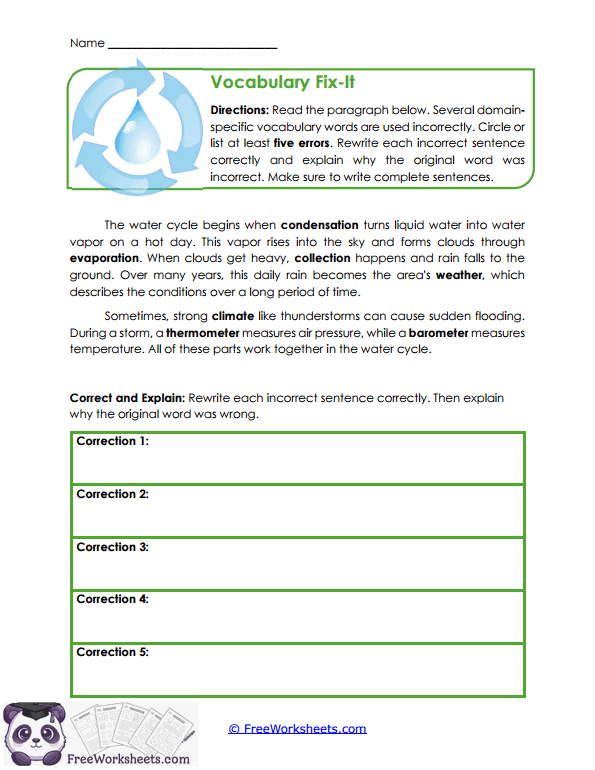
Learners read a two-paragraph passage describing the water cycle and weather conditions, then identify at least five incorrectly used vocabulary terms. They circle or list the mistakes before rewriting the affected sentences with scientifically accurate terminology. For example, the opening sentence incorrectly states that condensation turns liquid water into water vapor, requiring students to recognize that evaporation describes this process. Students record their corrections in the five labeled response boxes and explain why the original vocabulary choices were inaccurate, using complete sentences.
Common Challenges and Misconceptions
Students may recognize that a scientific explanation sounds incorrect without identifying which specific vocabulary term causes the problem. Evaporation and condensation are particularly easy to confuse because both involve changes in the physical state of water. Learners may also struggle to distinguish weather from climate or remember whether a thermometer measures temperature or atmospheric pressure. Comparing each word’s definition with the process or measurement described in the passage can help students identify the precise source of an error.
Implementation Guidance
Begin by reading the opening sentence and asking students to explain what happens when liquid water changes into water vapor. Demonstrate how replacing condensation with evaporation corrects the scientific explanation, then discuss why condensation describes a different process. Encourage learners to examine the remaining sentences independently, paying particular attention to the reversed meanings of weather and climate and the incorrectly assigned measuring instruments. Because the worksheet provides five correction boxes despite containing multiple incorrect uses of vocabulary, teachers can allow students to address related mistakes together or provide additional writing space for more detailed corrections.
Details and Features
The worksheet presents a two-paragraph informational passage containing deliberately incorrect domain-specific vocabulary. Several scientific terms appear in bold, drawing attention to the words students must evaluate for accuracy. Below the passage, five numbered correction boxes provide space for rewriting inaccurate sentences and explaining why the original terminology was incorrect. The directions require students to locate at least five errors and write complete sentences, combining vocabulary analysis, scientific reasoning, and written correction.