
About This Worksheet
Plate Movement Explained challenges learners to apply earth science vocabulary through an original scientific explanation of tectonic activity. This 6th grade vocabulary worksheet provides nine domain-specific terms associated with Earth’s structure, plate boundaries, and geological events. Students must construct a short paragraph explaining how the movement of tectonic plates can contribute to natural events such as earthquakes and volcanic activity. The writing-focused format emphasizes accurate terminology, conceptual connections, and the ability to communicate scientific processes using complete sentences.
Curriculum and Grade Alignment
Using domain-specific vocabulary accurately within an explanation supports academic writing and science literacy in the 6th grade curriculum. The worksheet reinforces terminology related to Earth’s tectonic systems, including mantle, fault, magma, convergent, and divergent. Students practice connecting individual definitions to larger scientific explanations rather than treating each term as an isolated vocabulary item. This activity provides an opportunity to demonstrate how scientific language describes relationships between plate movement, geological structures, and natural events.
Student Tasks
Learners write a four- to six-sentence explanation describing how the movement of Earth’s tectonic plates can cause natural events. A nine-word vocabulary bank provides terms such as tectonic plates, earthquake, boundary, fault, volcano, magma, convergent, and divergent. Students must correctly incorporate at least four of the listed terms into their paragraph while maintaining an accurate explanation of the scientific processes involved. After completing their writing, they circle the vocabulary words they used to demonstrate that they have met the terminology requirement.
Common Challenges and Misconceptions
Some students may understand individual tectonic vocabulary words but struggle to connect them into a scientifically accurate explanation. Confusion can arise between convergent and divergent boundaries, particularly when learners forget that these terms describe different directions of plate movement. Others may assume that every plate boundary produces the same geological events or that all earthquakes involve volcanic activity. Encouraging students to identify the relationship between plate movement and a particular natural event before writing can help them organize their explanations and avoid inaccurate generalizations.
Implementation Guidance
Begin by reviewing the difference between convergent and divergent plate boundaries, using a simple drawing to demonstrate plates moving toward or away from each other. Ask learners to explain how movement along a fault can produce an earthquake, emphasizing the relationship between the scientific vocabulary and the event being described. Before writing, students can select four or more terms from the word bank and organize them into a short sequence of connected ideas. After completing their paragraphs, encourage them to circle the selected vocabulary, reread their explanations for scientific accuracy, and check whether every sentence contributes meaningfully to the description.
Details and Features
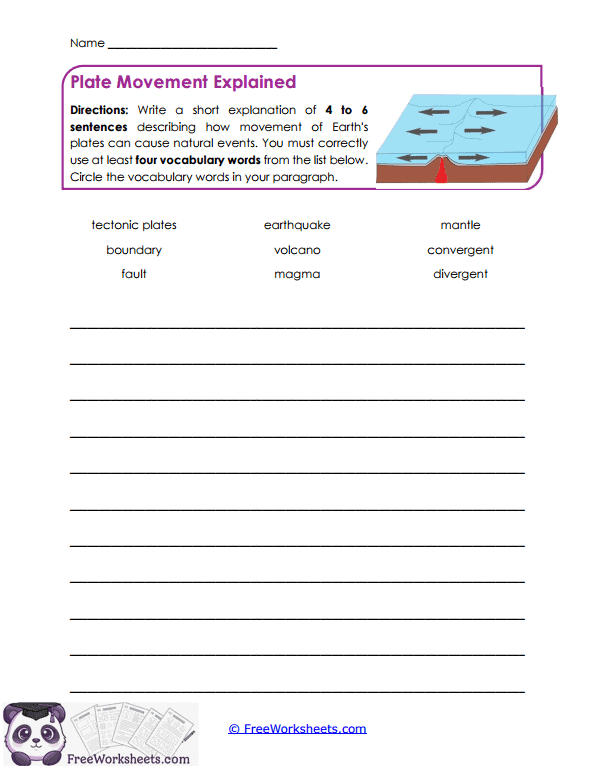
The worksheet presents nine earth science vocabulary terms arranged in three columns beneath the directions. A small illustration of tectonic plates provides a visual reference for understanding plate movement and boundary interactions. The main response area contains multiple writing lines for composing the required four- to six-sentence paragraph. Unlike sorting or matching activities, the worksheet requires learners to independently organize a scientific explanation, incorporate at least four vocabulary terms, and circle the words used in their writing.