
About This Worksheet
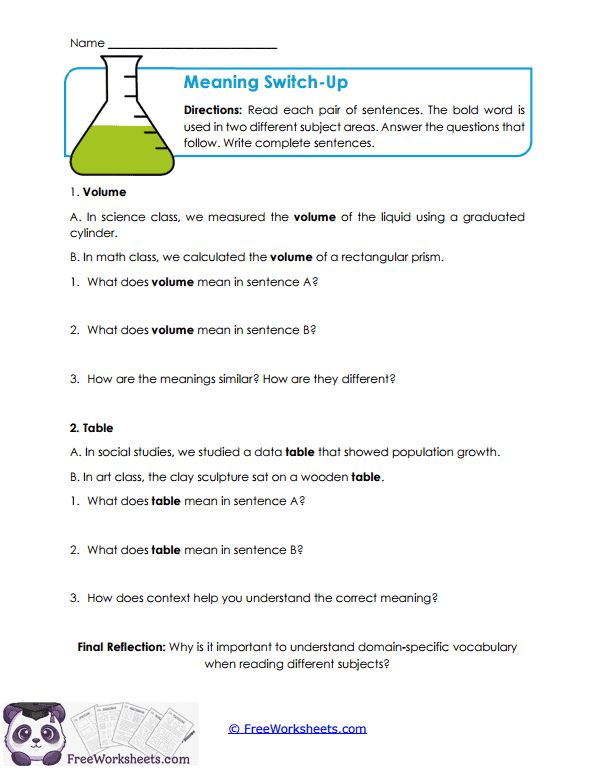
Meaning Switch-Up examines how the same vocabulary word can be used across different academic subjects while retaining or changing aspects of its meaning. This 6th grade vocabulary worksheet focuses on two terms, volume and table, presenting each within contrasting disciplinary contexts. Students analyze how volume describes a measurement in both science and mathematics, while table refers to a data display in social studies and a physical object in art. By comparing these uses, learners develop a more flexible understanding of academic language and how subject-area context influences interpretation.
Curriculum and Grade Alignment
Recognizing how vocabulary functions across academic disciplines supports reading comprehension and language development within the 6th grade curriculum. The worksheet reinforces the importance of interpreting terms according to their surrounding information rather than assuming a familiar word always has one meaning. Students distinguish between related applications of a concept, as with volume in science and mathematics, and substantially different meanings, as with table in social studies and art. This activity encourages precise academic communication and strengthens learners’ ability to interpret specialized terminology in informational texts.
Student Tasks
Learners examine two sets of paired sentences, with each pair presenting a bold vocabulary word in different subject areas. In the first exercise, they compare volume as measured in a graduated cylinder with volume calculated for a rectangular prism, then explain how the meanings are similar and different. In the second exercise, students analyze table as a display of population data and as a piece of furniture supporting a sculpture. Each comparison includes three written questions, followed by a final reflection asking why understanding domain-specific vocabulary matters when reading across subjects.
Common Challenges and Misconceptions
Students may assume that using the same word in different subjects automatically creates two completely different meanings. The volume comparison requires particular attention because both examples concern the amount of three-dimensional space, even though one involves liquid and the other a solid figure. Learners might also focus on the physical appearance of a data table instead of recognizing its purpose as an organized presentation of information. Comparing what remains consistent and what changes between the two contexts can help students distinguish related applications from genuinely different definitions.
Implementation Guidance
Begin with the word volume and ask students to describe what is being measured in both the science and mathematics examples. Guide them toward recognizing that the underlying concept involves three-dimensional space, while the objects and measurement methods differ between the sentences. Next, examine table and discuss how surrounding words such as population growth, sculpture, and wooden establish two distinct meanings. For the final reflection, encourage students to describe a situation in which misinterpreting a familiar word could create confusion when reading a textbook from another subject.
Details and Features
The worksheet contains two numbered vocabulary comparisons, each presenting a pair of sentences labeled A and B. The first comparison focuses on volume in science and mathematics, while the second examines table in social studies and art. Three open-ended questions accompany each pair, asking learners to define the words in context and explain their similarities, differences, or supporting clues. A Final Reflection prompt appears at the bottom, extending the analysis to the broader importance of understanding domain-specific language across school subjects.