
About This Worksheet
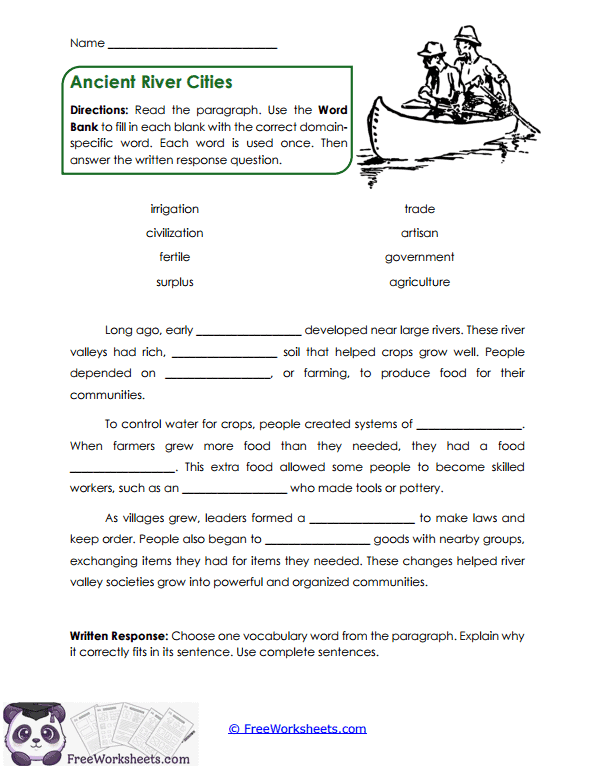
Ancient River Cities explores domain-specific vocabulary through an informational passage about the development of early river valley civilizations. This 6th grade vocabulary worksheet presents a historical narrative containing eight missing terms associated with agriculture, government, trade, and community organization. Students use a word bank to complete the passage, relying on contextual clues and their understanding of social studies terminology to select appropriate words. The activity connects vocabulary comprehension with historical concepts, demonstrating how specialized language helps explain the growth and organization of ancient societies.
Curriculum and Grade Alignment
Understanding domain-specific vocabulary supports informational reading comprehension and academic language development within the 6th grade curriculum. The worksheet reinforces terminology associated with early civilizations, including irrigation, agriculture, fertile, surplus, artisan, and government. Students practice recognizing how these words function within a historical explanation rather than interpreting them as isolated definitions. The activity also supports cross-curricular learning by connecting vocabulary analysis with social studies concepts involving food production, specialized labor, trade, and organized communities.
Student Tasks
Learners read a three-paragraph passage describing how early civilizations developed near rivers and became increasingly organized. They select words from an eight-term vocabulary bank to complete missing portions of the text, using each word exactly once. For example, the phrase “People depended on ___, or farming” provides a direct contextual clue that agriculture belongs in the blank. After completing the passage, students choose one vocabulary word and write a response explaining why it correctly fits its sentence, using complete sentences to support their reasoning.
Common Challenges and Misconceptions
Some students may recognize a historical term without understanding the specific role it plays within the development of a civilization. Words such as agriculture and irrigation can be confused because both involve farming, although one refers to cultivating crops and the other to supplying water. Learners may also struggle to distinguish fertile from surplus, particularly if they do not recognize the difference between productive soil and an excess quantity of food. Encouraging students to examine the surrounding phrases and identify the grammatical role of each missing word can help them make more accurate selections.
Implementation Guidance
Begin by reading the opening paragraph and asking learners what characteristics made river valleys suitable for early settlements. Use the clue “or farming” to demonstrate how an explanatory phrase can reveal the meaning of an unfamiliar academic word. Encourage students to complete the remaining blanks independently, then reread the entire passage to determine whether each selected term fits the historical explanation. For the written response, invite learners to explain a relationship such as how irrigation supported agriculture or how a food surplus allowed people to specialize in occupations beyond farming.
Details and Features
The worksheet contains an eight-word vocabulary bank arranged in two columns above a three-paragraph historical passage. Eight blanks appear throughout the reading, requiring students to place each domain-specific term into its appropriate context. The passage introduces vocabulary through a connected explanation of early river valley societies rather than a collection of unrelated sentences. A Written Response prompt follows the reading and asks students to select one completed term and explain their choice using complete sentences.