
About This Worksheet
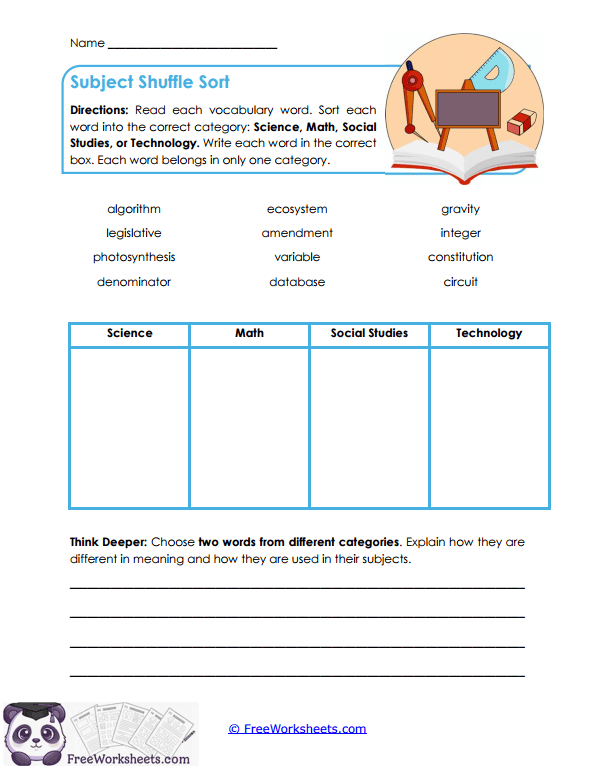
Subject Shuffle Sort challenges learners to recognize how academic vocabulary connects to different school subjects. This 6th grade vocabulary worksheet presents twelve domain-specific terms that students must organize into four categories: Science, Math, Social Studies, and Technology. Words such as ecosystem, denominator, legislative, and database require learners to consider both their meanings and their academic uses. By sorting terminology and comparing words from different subjects, students practice recognizing the specialized language used to communicate ideas across disciplines.
Curriculum and Grade Alignment
Classifying domain-specific vocabulary supports academic language development and informational reading comprehension within the 6th grade curriculum. Students practice recognizing how subjects use specialized terminology to describe concepts, processes, systems, and relationships. The word bank incorporates familiar mathematical language alongside scientific, governmental, and technological terms, reinforcing vocabulary encountered in different learning environments. Explaining the differences between selected words also supports precise language use and an understanding of how academic context influences meaning.
Student Tasks
Learners examine twelve vocabulary words and place each term into one of four labeled subject categories. The sorting activity includes words such as gravity and photosynthesis for science, integer and denominator for math, and amendment and constitution for social studies. Students record each word inside the appropriate column of a four-part classification chart, following the printed instruction that every word belongs to only one category. After sorting, they complete a Think Deeper question by choosing two words from different categories and explaining how their meanings and uses differ.
Common Challenges and Misconceptions
Some learners may recognize a word without knowing which academic subject most commonly uses it. Terms such as algorithm, variable, and circuit can create confusion because they have legitimate applications across multiple disciplines. Students might also classify vocabulary according to where they first encountered a word rather than considering its meaning within the intended subject. Discussing the academic context associated with each term can help students understand why a particular classification is appropriate while recognizing that some vocabulary crosses subject boundaries.
Implementation Guidance
Introduce the activity by selecting a clearly associated term, such as denominator, and asking students to explain why it belongs in the Math category. Encourage learners to consider each word’s meaning before placing it into the chart, particularly when they encounter unfamiliar governmental or technological terminology. Because the directions require a single category for every word, clarify the intended classifications of overlapping terms such as algorithm, variable, and circuit before assessing answers, since these words are also used in other subjects. For the Think Deeper response, encourage students to explain both what their selected words mean and how each is used in its respective discipline.
Details and Features
The worksheet contains a twelve-word vocabulary bank arranged in three columns near the top of the page. A large four-column sorting chart occupies the center, with clearly labeled sections for Science, Math, Social Studies, and Technology. The chart provides open writing space for students to organize all the vocabulary terms without preassigned positions or answer choices. Beneath the chart, a Think Deeper prompt includes multiple writing lines for comparing two words from different academic categories.