
About This Worksheet
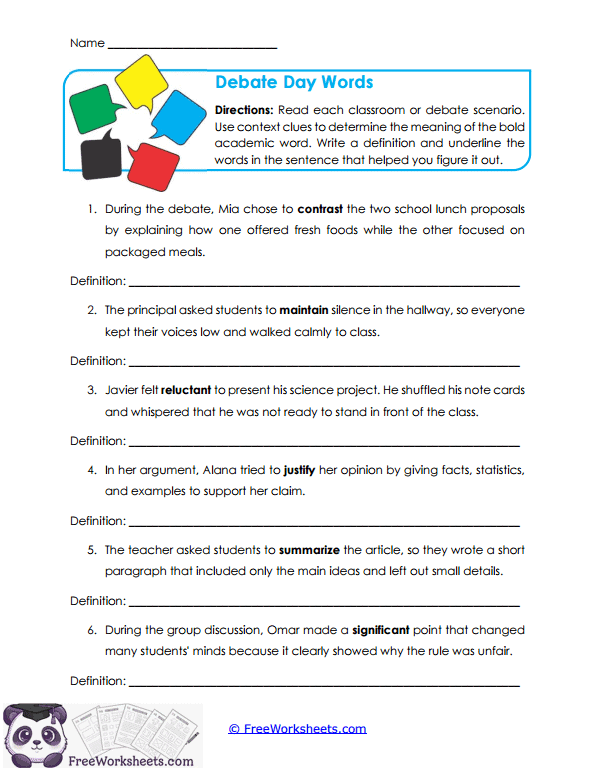
Debate Day Words connects academic vocabulary development with situations involving classroom discussions, presentations, and debates. This 6th grade vocabulary worksheet presents six sentences containing bold terms that students must interpret through contextual details. Words such as contrast, maintain, reluctant, justify, summarize, and significant appear in situations where surrounding actions or explanations reveal their meanings. The activity emphasizes understanding academic language while developing the ability to identify specific textual evidence that supports a vocabulary definition.
Curriculum and Grade Alignment
Interpreting academic vocabulary through context supports reading comprehension, written communication, and classroom discussion skills within the 6th grade language arts curriculum. Students practice identifying how explanatory phrases, examples, and descriptions clarify words commonly encountered in instructional texts and academic conversations. The featured vocabulary includes terms associated with comparing ideas, supporting arguments, presenting information, and communicating important points. These skills are especially relevant to understanding directions, interpreting informational passages, and participating in evidence-based discussions across subject areas.
Student Tasks
Learners read six numbered classroom or debate scenarios and determine the meaning of each bold academic vocabulary word. They write a definition on the line provided beneath each sentence and underline the specific words or phrases that helped them interpret the term. For example, the sentence describing Alana using facts, statistics, and examples to support her opinion provides contextual evidence for the meaning of justify. Other exercises require students to interpret vocabulary through descriptions of comparing proposals, preserving silence, hesitating before a presentation, identifying main ideas, and making an influential point.
Common Challenges and Misconceptions
Students may recognize a vocabulary word from previous lessons but struggle to explain its meaning within the specific sentence. Terms such as justify and significant can be challenging because they communicate abstract academic concepts rather than concrete objects or actions. Some learners may also confuse summarize with simply shortening a passage, overlooking the importance of retaining its main ideas. Encouraging students to connect their definitions with the exact explanatory details in each sentence can help distinguish accurate interpretations from incomplete or overly general meanings.
Implementation Guidance
Introduce the activity by examining the sentence containing contrast and discussing how the two school lunch proposals are presented through their differences. Demonstrate how the description of fresh foods versus packaged meals provides evidence that contrast means to identify differences between things. Encourage students to underline only the most useful contextual phrases before writing their definitions, rather than marking the entire sentence. For an extension, have learners select two of the academic vocabulary words and use them in original statements about a classroom debate, including contextual information that would help another reader understand their meanings.
Details and Features
The worksheet contains six numbered sentences organized vertically, each followed by a clearly labeled Definition line. Every exercise features one bold academic vocabulary word embedded within a classroom, discussion, or debate-related scenario. The directions require two distinct responses: underlining the contextual evidence and writing a definition based on that evidence. The scenarios provide enough surrounding information for students to infer meanings without a word bank, while the response lines offer space for concise written explanations.